



















Executive Summary
- Drone warfare update: Russia continued to equip Shahed drones with new aerial missiles, further increasing the prospects that it could soon stage aerial attacks on commercial or military aircraft.
- Battlefield update: Ukraine recaptured territory on the Kupiansk front while repelling Russian attempts to infiltrate the front lines via gas pipelines.
- Russia employs heavy ballistic missile: Russian forces launched a nuclear-capable Oreshnik intermediate-range ballistic missile (IRBM) at the Ukrainian city of Lviv, approximately 45 miles from Poland.
1. Battlefield Assessment
Last week Russian and Ukrainian forces waged an average of one to two hundred tactical engagements per day, a slower operational tempo than in recent weeks. Still, increased aerial attacks from the Russian Aerospace Forces tested Ukraine’s defenses.
Ukrainian President Volodymyr Zelenskyy warned that the increase in Russian air activity could presage even larger salvos in the coming weeks. Amid harsh winter conditions, Ukraine struggled to repair its energy infrastructure and electrical grid to contend with Russia’s onslaught.
The front lines remained dangerous but largely static. Both Russian and Ukrainian drone warfare formations deployed low-cost robotic weapons 60 to 80 miles behind lines of contact, attacking tactical depth. As this report has previously noted, the Russian military’s specialized Rubicon drone unit is ramping up the operational tempo of its long-range strikes.
Pokrovsk continued to see fierce fighting as well, though Ukraine’s defenses hold small but highly reinforced pockets of the urban area and are halting Russia’s gains. Ukraine’s 25th Separate Airborne Brigade has been one of the principal combat formations repelling Russian advances in the industrial zone around Pokrovsk. The small village of Hryshyne, five miles from the city, has emerged as a critical flashpoint and bellwether of combat trends in the area.
In the Kupiansk-Kharkiv sector, Ukrainian forces scored offensive and defensive tactical successes. The 2nd Khartia Corps of the National Guard of Ukraine recaptured the Kupiansk City Council building. This highly capable unit is a product of the 2025 Ukrainian Defense Ministry’s 2025 corps structure reforms. According to battlefield reports, the 2nd Khartia Corps is now engaged in sweeping operations against the remnants of the Russian presence.
On defense, the Armed Forces of Ukraine successfully detected Russian attempts to send infantry units behind the front lines by traversing gas pipelines. Until recently, subterranean infiltration has proven to be a headache for Ukraine, particularly near Kharkiv.
Ukraine also continued to conduct its deep-strike campaign against high-value Russian targets. On January 13 Ukraine launched a salvo targeting Russia’s drone industrial base. The Security Service of Ukraine reported that its Alpha Special Operations Center, in coordination with the Ukrainian Navy, struck production facilities at the Atlant Aero plant in Taganrog, Rostov Oblast. The operation reportedly produced a series of explosions and triggered a fire at the site. Atlant Aero occupies a discrete niche in Russia’s unmanned warfare ecosystem: the facility covers the full production cycle of Molniya strike-reconnaissance unmanned aerial vehicles (UAVs) and produces key components for Orion drones.
2. Russia Continues to Equip Drones with Aerial Weapons
Russia continues to augment its Iran-designed Shahed drone baseline. Recently uncovered drone wreckage revealed that Russia had equipped a drone with a Verba man-portable air defense system (MANPADS). Unlike similar weapons previously identified on Russian drones, such as the aging R-60 air-to-air missile, the Verba is a modern, potent, high-end weapon.
A Shahed Drone Equipped with a Verba Missile
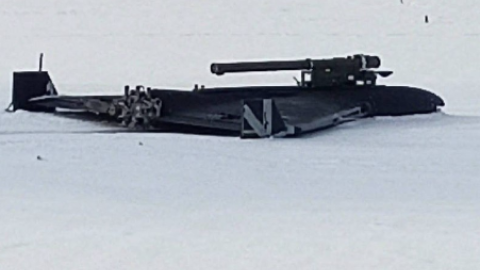
Source: Сергій FLASH (@serhii_flash) on Telegram.
Moreover, Ukraine’s Main Directorate of Intelligence (GUR) has reported that a new, jet-powered variant of the Shahed baseline, the Geran-5, is capable of carrying R-73 air-to-air missiles. Such a configuration would pose a significant threat to the Ukrainian air fleet.
Russia’s ability to innovate its Shahed baseline gives the Kremlin a host of tactical and grey zone options—from staging false-flag operations against commercial airliners to downing expensive manned combat aircraft.
3. Russia Launches an Oreshnik Intermediate-Range Ballistic Missile (IRBM)
On January 9 Russia launched an Oreshnik intermediate-range ballistic missile (IRBM) at the Ukrainian city of Lviv, roughly 45 miles from Ukraine’s border with Poland, a member of the North Atlantic Treaty Organization.
The strike marked the second time that Russian missile forces have used the Oreshnik in Ukraine. The heavy IRBM did not fly alone. The Russian Aerospace Forces preceded its launch with a salvo involving more than 200 loitering munitions, scores of smaller ballistic missiles, and Kalibr naval cruise missiles.
The Oreshnik is a variant of Russia’s road-mobile, nuclear-tipped RS-26 Rubezh intercontinental ballistic missile (ICBM). Analysts believe the projectile uses a shotgun warhead with multiple submunitions rather than a unitary payload. Until recently, analysts believed Russia had produced only a limited number, likely in preparation for the missile baseline’s initial tests.
The Oreshnik poses a potent threat against NATO. Its existence alone justifies Germany’s procurement of the Arrow 3 exoatmospheric ballistic missile–defense system from Israel. Berlin made a $3.1 billion purchase of the system in late 2025, bringing its overall expenditure on the Arrow 3 to $6.5 billion. Equipped with a robust detection capability, the Arrow 3’s EL-M-2080 Green Pine radar is particularly adept at tracking hostile objects in space.
Official Russian sources report that an Oreshnik equipped with a 900 kiloton nuclear warhead could hit NATO Headquarters in Brussels in 17 minutes, Ramstein Air Base in Germany in 15 minutes, and American-deployed missile defenses in Poland in 11 minutes.
4. What to Monitor in the Coming Weeks
- A leadership reshuffle in Chechnya: Multiple press sources report that Ramzan Kadyrov, the pro-Kremlin strongman who has long ruled Chechnya, has been hospitalized with kidney failure. Hudson experts have detailed possible succession scenarios following Kadyrov’s removal or death. The long-volatile Chechnya, a semi-independent autonomous republic of Russia, has been relatively calm for years under Kadyrov’s rule. Amid this recent uncertainty, Ukraine may launch another round of drone strikes on Chechnya, as it did in December 2025.
- Larger Russian salvos: Russia may launch larger-scale missile salvos against Ukraine’s electricity grid. Any drastic increase in the intensity of Russia’s salvos could widen potentially deadly blackouts in Ukraine as winter deepens.
- Emerging Shahed variants and new targets: With air-to-air and MANPADS missiles now augmenting its Shahed drone baseline, Russia may soon launch aerial attacks against military—or even commercial—aircraft.