



















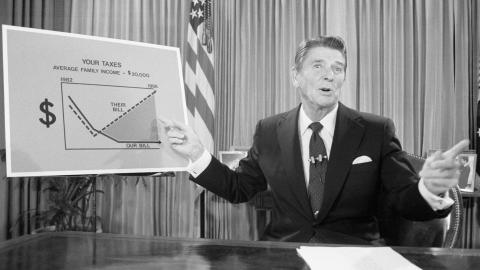
No major economic policy in modern American history is as misunderstood or inaccurately portrayed as President Reagan’s 1981 tax cuts. According to the Encyclopaedia Britannica, “the tax cuts, in fact, produced the largest budget deficit in the country’s history,” all to finance “tax cuts for the wealthy.” That summarizes the consensus contained in virtually every historical account of the era.
The characterization of the tax cuts as “for the wealthy” is easily refuted by comparing relative income tax burdens before and after. Since the top 40% of income earners in America pay some 90% of income taxes, reductions in tax rates would be expected to give a larger dollar-value tax cut to people who pay the most taxes. But data from both the Internal Revenue Service and the Joint Committee on Taxation show that when Reagan took office in 1981, the top fifth of income earners paid 64% of all federal income tax, the next-highest fifth paid 21%, and the bottom three-fifths paid 15%.