











President Trump has backed down from his efforts to stop the United Kingdom from surrendering the key Chagos Islands in the Indian Ocean to Mauritius. Only weeks ago, Trump rightly opposed the United Kingdom’s planned surrender of the island of Diego Garcia, a move that would benefit the top threat to the American way of life: the Chinese Communist Party. Since then, Trump has announced that he had productive negotiations with the British government and the transfer to Mauritius will go forward, the British will lease Diego Garcia for the next century at least, and the United States reserves the right to use force to defend it.
There's no doubt that smoothing relations with the United Kingdom is good as the United States and European Allies go through a turbulent time, but we should hope that President Trump privately continues to encourage the U.K. government to keep these islands.
The second Trump administration’s 2025 National Security Strategy and 2026 National Defense Strategy documents do not describe the threats China poses to the United States and the American way of life the way they did in the first Trump administration. Still, the cold war between the United States and China has intensified. The Trump administration, albeit muting its criticism of China, is not backing away from its claims to vital interests that span the globe, including a free and open Indo-Pacific and unobstructed sea lanes in the Middle East. Keeping the CCP from absorbing Diego Garcia is important for both of those vital interests; getting the United Kingdom to walk this back may have come just in time.
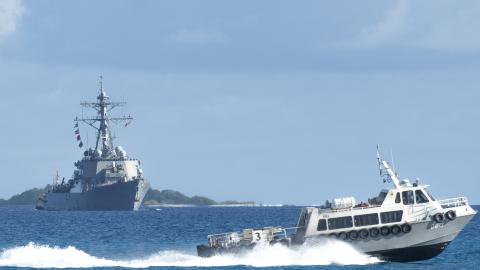
Diego Garcia is the largest island within the Chagos Archipelago, a chain of over 60 small coral islands that are British Indian Ocean Territory. And while there has been a highly contentious political fight and pressure campaign for the United Kingdom to relinquish control over these islands to Mauritius, the reality is that geography matters today just like it did in 1965 when the United Kingdom retained its claim to the islands before recognizing the independence of Mauritius. The islands were used as a U.S.-U.K. joint military base, and its military utility is as relevant now as it was then in countering the Soviet Union. The base became known as “Camp Justice” and supported U.S. bomber aircraft among other naval assets and intelligence operations.
The Trump administration may be underemphasizing the nature of the threats posed by China, though it does emphasize its vital interests in keeping sea lanes open, and especially vital shipping chokepoints. The 2025 National Security Strategy makes this explicit: “We want to halt and reverse the ongoing damage that foreign actors inflict on the American economy while keeping the Indo-Pacific free and open, preserving freedom of navigation in all crucial sea lanes, and maintaining secure and reliable supply chains and access to critical minerals.”
Diego Garcia enables the United States to project power to the Strait of Hormuz, Bab el-Mandeb, and the Malacca Strait, vital chokepoints threatened by pro-China and anti-American proxies in the form of Islamist terrorists funded by and supplied by the Islamic Republic of Iran.
Diego Garcia is also prime real estate for keeping a close eye on what the People’s Liberation Army Navy (PLAN) is up to in the South China Sea. China is systematically ratcheting up its aggressive behavior against the Philippines, a U.S. treaty ally. Just two weeks ago, China deployed naval forces in the region after the United States and the Philippines conducted a joint naval exercise at Scarborough Shoal. The Trump administration has repeatedly reinforced the view that maintaining a “free and open Indo-Pacific” is a vital interest of the United States and it intends on defending it.
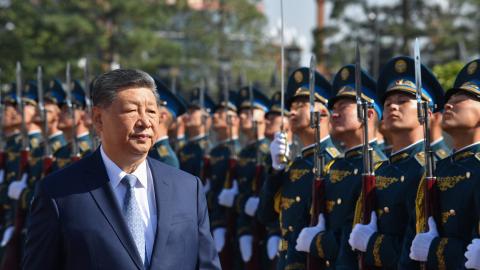
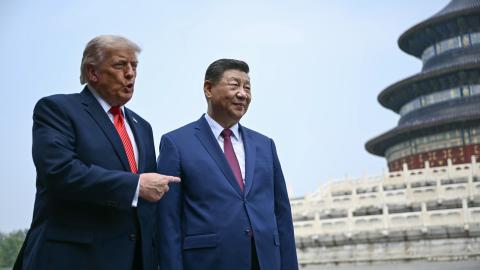
Conversely, the 2026 National Defense Strategy softens its language on China, characterizing it as a “potential opponent” with whom the Trump administration seeks a “decent peace” as long as “potential opponents” “cabin” their “demands.” (A different galaxy from former President Ronald Reagan's strategy to beat the Soviets: "We win, they lose.") Of course, President Xi Jinping is not cabining his demands as he seeks to push the United States out of the region and break the credibility of our alliances with Asian democracies. China has actively expanded its presence across geographies with emboldened strategies to degrade American influence and replace the United States as the preeminent global super-power.
China has, for example, patiently and persistently worked to establish itself and box out the United States and its Western allies from these islands. Over the last 25 years, China has given Mauritius 32 loans with a total value of $637.6 million. This includes a $10.5 million “CCTV Surveillance System” project and another $2.4 million project for “X-Ray Scanning Equipment and CCTV Surveillance System.” We should expect that Mauritius will accept more of these loans, which may include the condition of China setting up CCTV on the Chagos Islands, too, if they are transferred to Mauritius. For China, data is everything. This equipment will be used to spy on the military base. Chinese investment in Mauritius also includes $24.8 million allocated for broadcasting projects, which could allow China to dominate communication networks and thus information flow, a powerful tool to shape public perception and coerce these islands to support China.
Trump was right when he called the United Kingdom’s plan to surrender the islands and security of the key military node an “act of great stupidity.” Conservative British politicians agree, including Leader of the Opposition Kemi Badenoch and Shadow Foreign Secretary Dame Priti Patel, as well as even a few Labour Party politicians like Member of Parliament Dan Carden. British Prime Minister Keir Starmer confirmed that the United Kingdom and the United States would discuss the deal.
The United States can only be harmed by another public fight with one of our closest allies at a time when it needs all the friends it can muster to counter its adversaries. But leasing the base while handing over sovereignty to a Chinese partner is courting trouble—and if private negotiations continue, alongside fierce opposition from wise leaders in the British government, we should hope the transfer never happens.