


















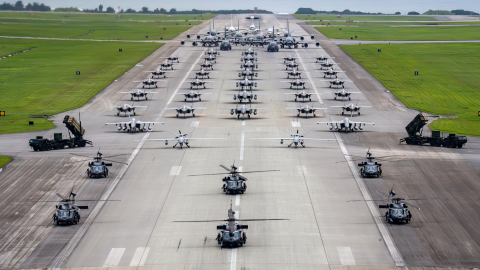
The US Air Force has performed incredibly well in recent operations, but it could be defeated by China in a future conflict. And even if the service received additional funding for more of the same aircraft, weapons, and flight hours, that force would also likely fail.
Instead of accepting its problems, the Air Force can adopt a revised force design that wins by:
- Fielding forward-deployed, runway-independent Edge Force units with air surveillance and targeting, counter-air, and maritime strike capabilities.
- Enhancing long-range strike capability and capacity in the Pulsed Force of bombers, nuclear-armed intercontinental ballistic missiles, and other assets.
- Transforming the Core Force (of intelligence, surveillance, reconnaissance, and targeting, counter-air, strike, mobility, and command and control capabilities) with advanced mission systems and longer-range and more survivable tankers.
- Fielding key enablers—principally counter-command, control, communications, computers, cyber, intelligence, surveillance, reconnaissance, and targeting (counter-C5ISRT) and Resilient Airfields—at scale.
This approach could deter and defeat Chinese aggression, while retaining the global flexibility and capacity the service needs. A balanced, effective force design is viable, and the Air Force can achieve it and win.
Executive Summary
Despite the United States Air Force’s (USAF) stellar performance in recent operations, a geriatric fleet of aircraft, low readiness rates, and dismal prospects in a potential future conflict with the People’s Republic of China (PRC) mean the service could decline within a decade from invaluable to incapable. More importantly, a weak Air Force would face major challenges defending the homeland, maintaining strategic deterrence, and projecting power in support of the nation, which could increase the likelihood the PRC starts a war and defeats the United States and its allies.
The Air Force needs to adopt a new approach to shaping its force that addresses the changed character of warfare, most consequentially against the peer threat of the PRC, and creates the capacity and flexibility to address global demands. The US Air Force’s traditional approach, involving expeditionary and serial power projection, is increasingly insolvent against the PRC for a variety of reasons: China can target in mass the gradual deployment of forces to the Indo-Pacific; forces are vulnerable at airfields once they arrive; the PRC could achieve its aims of aggression, such as invading Taiwan or seizing other allied territory, before US forces could roll back enemy defenses to attack the PRC’s center of gravity; and if the conflict continued, the Air Force would struggle to replace its losses, much less grow in size.1 Absent viable shifts, our analysis indicates that within a decade China could defeat the United States and its allies in a major campaign—even if the Air Force received additional funding for aircraft, weapons, or readiness.2 This suggests that more of the same approach to designing and fielding an Air Force will not work well in the future.
The Air Force has tried to evolve. It has divested thousands of aircraft and cut other units—more force structure than any other US military service—in its attempts to modernize.3 It is on track to cut even more, especially fighter and attack aircraft, in exchange for a smaller fleet of similar, largely short-range assets to offset rising operations and support (O&S) costs.
Instead of accepting its problems, the Air Force can flip the script and impose new challenges on the PRC while retaining the capacity it needs. Rejecting a one-size-fits-all approach, it can divide the force design attributes it needs among portions of its force and change its laydown to overcome operational problems and create dilemmas for the PRC. It can also introduce specialized systems that address specific operational problems and efficiently allow the service to retain appropriate levels of capacity.
Building on the Air Force’s nascent “One Force” force design, we propose an approach with three mutually reinforcing elements and key enablers:
- Edge Force of forward-deployed, mobile runway independent capabilities. Attacking enemy forces, these units operate at a high level of risk-to-force and include truck-launched anti-ship munitions squadrons, air surveillance and targeting capabilities provided by stratospheric balloons and ground-based teams, and counter-air capabilities provided by very long-range surface-to-air missiles (VLR SAMs) and lethal or electronic attack uncrewed aerial vehicles (UAVs). The Air Force has referred to these capabilities as Mission Area 1.
- Pulsed Force that generates episodic effects from range, leveraging less vulnerable and well-defended airfields. It consists of bombers, nuclear-armed intercontinental ballistic missiles (ICBMs), and other units, and the Air Force refers to it as Mission Area 2.
- Core Force that operates from distributed airfields to generate effects, rapidly deploy forces, and ensure day-to-day US global presence. It includes theater-assigned and surging intelligence, surveillance, reconnaissance, and targeting (ISRT), counter-air, strike, mobility, and command and control (C2) capabilities. The Air Force refers to it as Mission Area 3.
- Key enablers, principally counter-command, control, communications, computers, cyber, intelligence, surveillance, reconnaissance, and targeting (counter-C5ISRT) and Resilient Airfields that allow the mission areas to fight effectively. Counter-C5ISRT forces and capabilities degrade and deceive adversary sensing and sensemaking, generating broad area and local access for US forces and limiting the effectiveness of adversary forces. Resilient Airfields with infrastructure, logistics, passive defenses, and active defenses enable appropriate levels of access and sorties across environments. Rather than attempting to uniformly harden all operating locations, this force element would focus resources on a targeted set of key operating locations and forces (ranging from lightly defended temporary operating strips to heavily defended strongpoints) that enable mission area forces.
Leveraging access to forward allied and partner territory, the Edge Force would circumvent deployment delays, airfield vulnerability, and other difficulties by fielding ground-based mobile and low-signature capabilities that would be predominantly forward-deployed or stationed and would operate largely independent of fixed airfields. Customized to solve specific operational problems such as maritime strike, air surveillance and targeting in highly contested environments, and destruction of heavily defended high value enemy aircraft, its goal would be to provide new friendly kill chains and break enemy ones.
Simultaneously, Pulsed Force strikes would dismantle key nodes and targets, and Core Force capabilities would generate air superiority, conduct strikes, and sustain the continuous deployment and employment of forces from varied forward, intermediate, and distant Resilient Airfields. In this manner, the Air Force could retain the offensive initiative and not default to an approach of operating solely from “longer and longer ranges,” which would sap its strength.4 It would also provide new ways to generate air superiority. Rather than only attacking PLA aircraft at airfields or through aircraft engagements in the air, the specialized, ground-based units could conduct targeting and employ weapons that asymmetrically fight them from the ground.
Collectively, this approach would improve the United States’ ability to deny the initial aims of adversary aggression, and it would better posture US forces for protracted conflicts by preserving a large fraction of mainline forces and fielding new systems that could be mass-produced. It would also provide US commanders with a broader range of force employment options, which can not only enhance tactical and operational success, but also impose dilemmas on the PRC.
In addition to helping deter PRC aggression, this new approach to force design would generate capabilities applicable in different capacities and combinations to solve challenging problems in other theaters, such as in Europe or the Middle East. It would also help generate capacity and flexibility in the Air Force to continue addressing other national security priorities.
Figure E.1 describes key attributes of the force, and figure E.2 depicts a simplified laydown of these forces. Commanders could deploy the forces shown in figure E.2 to ensure each is able to generate effects against the enemy and operates at an acceptable level of risk. The Edge Force predominantly operates in the most contested areas at the left of figure E.2 to attack enemy forces with expendable and attritable systems, using camouflage, concealment, deception, and active defenses to survive. The Core Force deploys and employs forces from a mix of dispersed forward airfields, forward and intermediate well-defended airfields (referred to as “strongpoints”), and distant airfields. And the Pulsed Force generally operates far from the enemy, as well as from a select number of intermediate strongpoints, to conduct long-range strikes at scale.
Figure E.1. Proposed Force Design Attributes
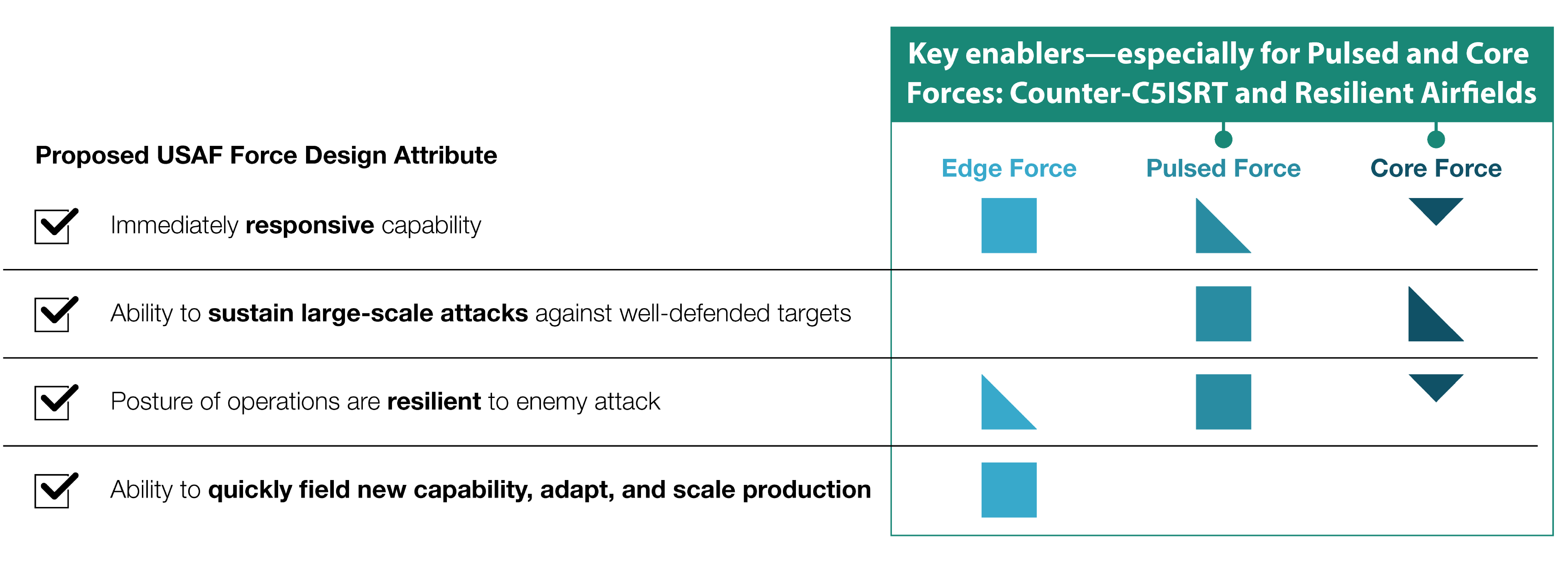
Note: Area of geometric shapes represents the approximate relative level of capacity to fulfill the desired force design attributes in a challenging, large-scale scenario against the PRC. Other figures could depict the force design’s capacity to address other scenarios, as well as capture how the contributions of assets could vary depending on the phasing of conflict.
Source: Authors.
Figure E.2. Representative Laydown of Force Design Elements
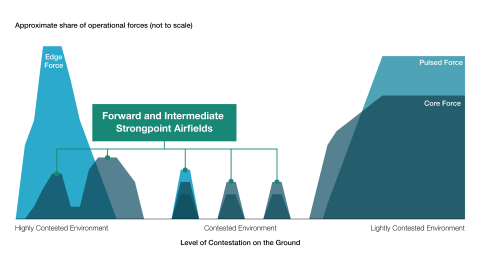
Source: Authors.
The new force design’s attributes make it more credible than today’s Air Force. Adversaries and allies would recognize that the USAF could generate effects early and fight in new and unexpected ways. By embracing easily manufacturable assets and weapons, the force could also rapidly scale in production, allowing the USAF to field the Edge Force and other elements in large numbers within a few years and position itself to surge mass-production in a protracted conflict. It could also extend elements of the proposed force design to many of the United States’ allies and partners, bolstering their own defenses. And lastly, the proposed design would be more affordable to design, procure, and sustain than today’s Air Force.
Assessing Architectures in a Taiwan Scenario
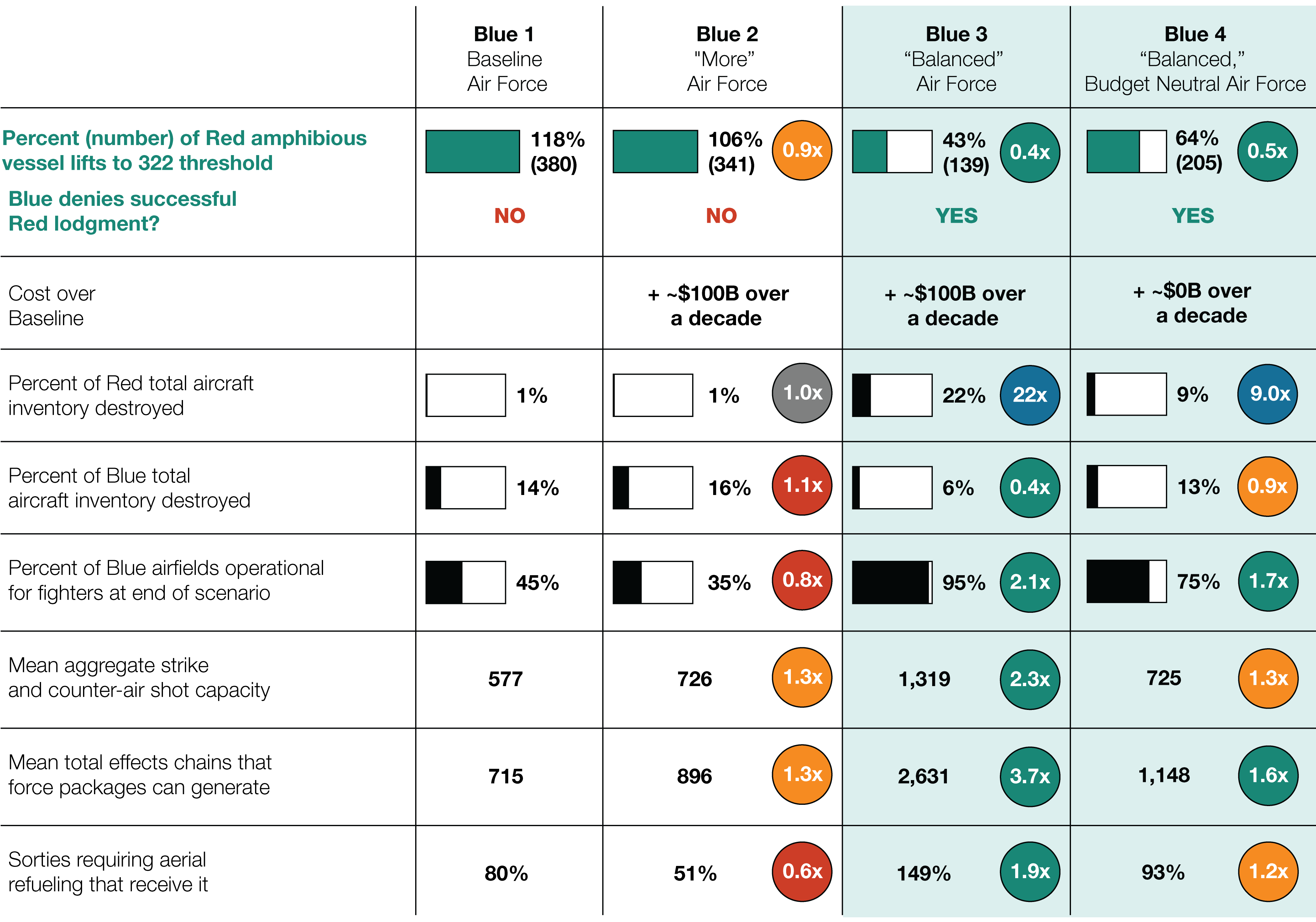
To explore the relative performance of different force designs and employment concepts, we assessed them using theater-level simulations of a circa 2035 Taiwan invasion scenario. We tested four 2035 force architectures. Blue 1 is a baseline force that kept the US Air Force on its current plan. Blue 2 and Blue 3 force architectures invested an additional approximately $100 billion in research, development, test, and evaluation (RDT&E), procurement, military construction, and O&S costs over a decade in different ways. The Blue 2 (“More” Air Force) architecture added nearly 500 additional aircraft, more weapons, and boosted readiness, and the Blue 3 “Balanced” force adopted a balanced approach to force design with Edge Force, Pulsed Force, Core Force, and Resilient Airfields shifts, and additional RDT&E, munitions, readiness, and budgetary reserve investments. Blue 4 is a budget-neutral plan that, through a set of difficult trades, has around 200 fewer aircraft than Blue 1 in its inventory and prioritizes funding a limited set of the most impactful elements of the “balanced” force design. All force architectures operated from 40 airfields across the Pacific and contiguous United States.
Figure E.3 summarizes key results from the simulations, comparing Blue 1’s baseline with the alternatives. Both the baseline Blue 1 force architecture and Blue 2, which acquired nearly 500 more aircraft, failed to deny the PRC (Red) a successful amphibious lodgment and lost over 14 percent of their simulated aircraft inventories in the process, mostly due to airfield attacks.5 The PRC defeated these force architectures.
Despite an additional approximately $100 billion for aircraft, weapons, and readiness, Blue 2’s architecture performed similar to the baseline Blue 1 force, since its aircraft were also heavily attrited on the ground and outnumbered in the air. This suggests that simply buying more of the same aircraft, munitions, and readiness would bear little fruit.
In contrast, the balanced force architecture we proposed, Blue 3, denied a successful Red lodgment, suffered far fewer aircraft losses, and destroyed a large fraction of the PRC’s aircraft fleet. The Blue 3 force architecture greatly outperformed the alternatives in terms of campaign success, level of losses, and other metrics, such as the percentage of operative airfields, offensive strike and counter-air capacity, the optionality resulting from the number of effects chains that force packages could generate, and the tempo that robust aerial refueling support enabled.6 This outcome not only stopped the initial invasion but put Blue 3 in a favorable position to continue a protracted conflict or seek a favorable cessation of hostilities. Blue 4 also defeated the invasion and significantly improved performance over Blue 1 and Blue 2 across the board, but its smaller force suffered major aircraft losses.
Figure E.3. Simulation Results: Four Force Architectures
Source: Authors.
Recommendations: Begin Implementation Today
The Air Force can pursue a new, viable force design and implement it. Neither practical levels of funding, nor personnel, nor technology, nor alliances and partnerships stand in its way. We recommend the Air Force, US Department of Defense (DoD), which President Donald J. Trump gave the secondary title of Department of War (DoW), and Congress start with the following steps.7
- Pursue a force design that prioritizes Edge Force and Pulsed Force initiatives, and key enablers—especially counter-C5ISRT and Resilient Airfields.
- Revise the initial force design, “One Force,” to articulate the essential roles of the Core Force and key enablers, in particular counter-C5ISRT and Resilient Airfields.
- Prioritize funding for the establishment of the Edge Force, a targeted set of counter-C5ISRT and Resilient Airfields investments, and the expansion and improvement of the Pulsed Force, all of which provided the greatest leverage in our scenario simulations. Then, direct additional funding to other areas, such as producing more and new types of munitions; hardening mobility aircraft with improved command, control, and communications (C3) and self-defense capabilities; developing and procuring a new medium-sized blended wing body (BWB) aerial refueling tanker; boosting readiness; and finally, procuring more uncrewed and crewed fighter aircraft.
- Address acute gaps in joint support to Air Force operations, particularly Army air and missile defense and bulk fuels. Unless the DoW shores up these gaps, regardless of the changes the Air Force makes, it is reasonable to expect defeat in a major war.
- Ensure Air Force Futures’ new Chief Modernization Officer assesses Air Force logistics, engineering, and force protection activities and the nuclear enterprise.
- Define opportunities for deeper operational, programmatic, and industrial collaboration with allies and partners.
- Increase Air Force funding through the DoW and Congress to accelerate the transition to the new force design.
The Air Force is likely the service that currently has the most mature and promising concepts for defending the homeland, maintaining strategic deterrence, and projecting power, including to deny adversary aggression by the PRC. The National Defense Strategy should highlight this, and DoW leadership and Congress should steer additional funding to raise Air Force capability, capacity, and readiness.
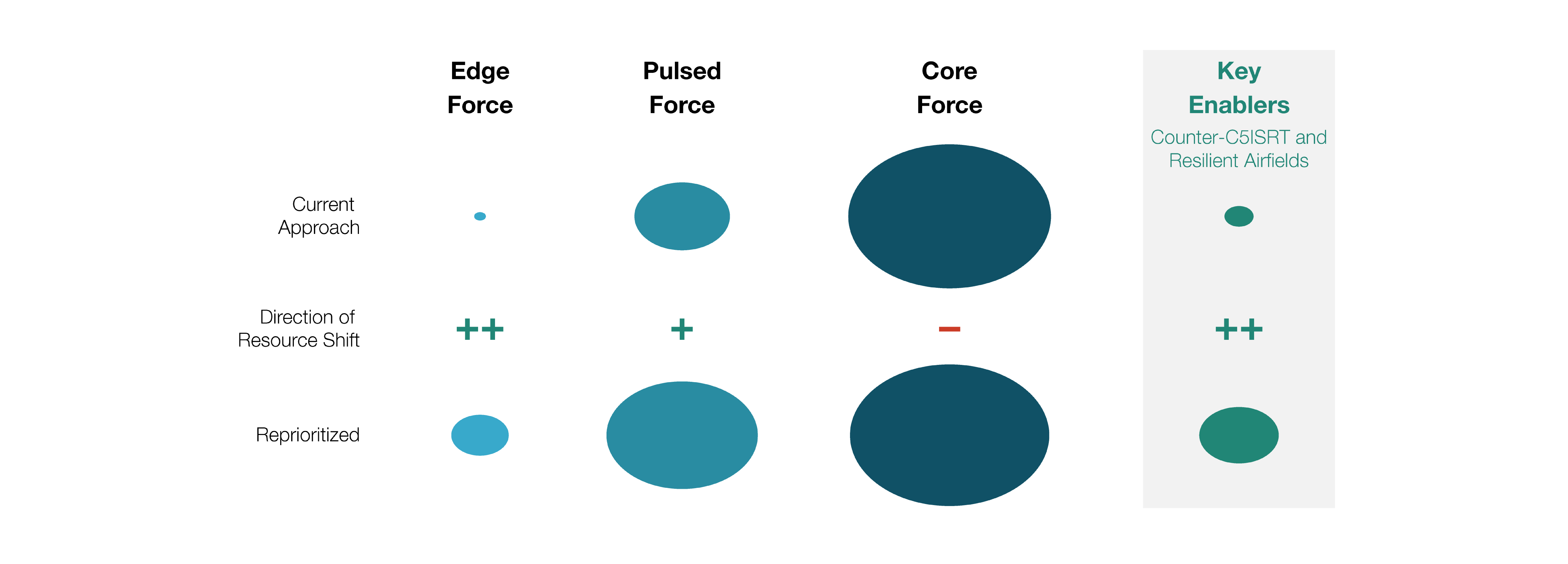
Nonetheless, in a tight fiscal environment, the Air Force will likely need to make difficult choices to fund the new design, which it should pursue regardless of topline funding levels, in order to deter conflict and fight effectively. As depicted in figure E.4, the Air Force should prioritize its resources to achieve these goals:
- Create the Edge Force, which does not exist today.
- Substantially grow and enhance the effectiveness of the Pulsed Force.
- Transform the Core Force by retiring outdated fighter, attack, and support aircraft in the near term to free up resources for the Core Force’s modernization, for mission integration and C3 across the force, and to fund the other elements of the necessary transition.
- Fund a targeted set of counter-C5ISRT and Resilient Airfields force elements to enable the other mission areas.
Figure E.4. Relative Resource Shifts Necessary to Implement the Proposed Force Design (Not to Scale)
Source: Authors.
As the recently passed One Big Beautiful Bill Act demonstrates, Congress and others will continue to add funding to the same familiar Air Force programs if the service’s leaders do not explain their resource priorities based on a new force design. However, no realistic funding increase will allow the current force design to address the emergence of a peer adversary in the PRC, the proliferation of militarily relevant technology across all theaters, and growing challenges in maintaining and crewing the fleet.
As DoW and congressional leaders consider options for the Air Force, they should resist the siren song that tempts “a score more of the same aircraft, weapons, or flying hours each year will tip the scales.” No, only through a major transformation of the Air Force’s force design and commensurate architecture can the Air Force position itself to deter and defeat PRC aggression while retaining the flexibility and scale it needs to address other global demands. A balanced force design is viable and can achieve this.