












There is a bipartisan consensus amongst Australians that we are the most successful multicultural country in the world. This refers to a national and societal approach that celebrates a diversity of cultures, faiths, and even values coexisting peacefully, if not harmoniously.
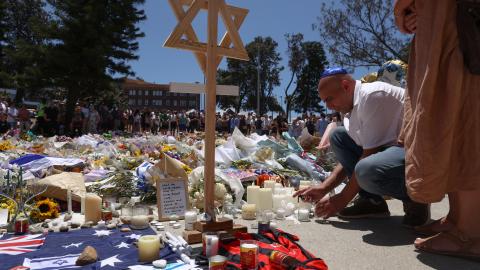
Yet this week, at least 15 Jews celebrating Hanukkah were just shot and killed, with many more injured. How then, do we make sense of the worst terrorist attack against Jews since the Oct. 7, 2023 atrocity, right here at the iconic Bondi Beach in Sydney?
Australian elites have clearly failed in their role as self-appointed custodians of multiculturalism. But there is likely to be little accountability for any of them. To paraphrase political scientist Hannah Arendt in her study into the evils of Nazism, when too many people are guilty, no one will be blamed. Regarding the creeping anti-Semitism which has occurred in Australia since the attacks on October 7, there are too many elites at fault. The national grieving might be sincere. But it will be accompanied by a national washing of collective hands from blame.
Israeli Prime Minister Benjamin Netanyahu directs his ire toward Prime Minister Anthony Albanese because the latter “let the disease of antisemitism spread.” The Australian leader is not alone. Days after the October 7, 2023 attacks, the Israeli flag was beamed onto the architectural sails of the Sydney Opera House to offer support for Israelis. On that very evening, pro-Palestinian protesters marched to the Opera House chanting slogans such as “F— the Jews” and “F— Israel,” denying Jewish Australian Jewish mourners their opportunity to grieve together in a public place. The state government in New South Wales tolerated the protest on the basis that it was more dangerous to public peace to prevent the pro-Palestinian march.
Indeed, the most notable arrest that evening was of an Australian Jewish businessman holding an Israeli flag — supposedly detained for his own protection.
Those early responses set the standard for what has been permitted since. Since 2023, and under the banner of supporting Palestinian justice and statehood, Jewish Australians have suffered significant increases in harassment, intimidation and threats. Synagogues and Jewish shops have been targeted by arsonists and graffitied with insults and hate slogans. University leaders have allowed students and academics to camp out on campuses to rally against Jews and Zionism on behalf of the Palestinian cause.
There have been almost weekly protests permitted by state governments and police forces in major cities that involve not just pro-Palestinian chants of ‘From the river to the sea, Palestine will be free,” but at times the burning of Australian and Israeli flags, placards with images of Iranian Supreme Leader Ali Khamenei, and symbols of Hamas, even though it has been listed as a terrorist group by the Australian government since 2003.
Political violence becomes ever more likely when hostility toward Jews becomes commonplace, normalized, and eventually legitimized. However, there was a further insidious role played by Australia’s elites in the legitimization of hostility towards Jews and Israel. From Albanese to provincial and community leaders, Islamophobia was elevated alongside antisemitism as an evil of equal standing and prevalence, despite the threats and intimidation being against Jewish rather than Muslim Australians.
False equivalence in the moral identification of threats is dishonest. It plays down and even delegitimizes instances of blatant antisemitism by downgrading it as a national priority. In response to the widespread targeting of Jews, and at the same time a Special Envoy to Combat antisemitism was announced by Albanese in September 2024, a Special Envoy to Combat Islamophobia was also appointed. This muddied the waters as to who the victims really were in a divided Australia. It deepened the false narrative that bias in favor of Jews is as much a problem as bias against them.
There is a further piece of the antisemitic puzzle. The twisting of political and social truths and loss of perspective by Australian elites must be understood in the context of the typical, lackadaisical Australian attitude toward religious and historical rivalries. To many Australians, these are problems of little concern and relevance to their country. Some Australians with no true interest in geopolitics joined the marches and protests because they became fashionable. But, assured by many elites that the anti-Semitic problem in Australia was exaggerated, many more simply tuned it all out.
This meant that there was little ground-up interest to speak out against and oppose what is now clear to all regarding the gathering tide of elite-sponsored anti-Semitism taking root in Australia since 2023. Even after the Bondi Beach shootings, social sites and media are awash with comments warning against the importation of foreign and ancient rivalries to our shores, ignoring the ample evidence that they have already taken root.
The two shooters were father and son. The former came to Australia in 1998, and the latter was born and raised locally. Australians are in shock, even though it was an entirely foreseeable attack.
Australians are going to have to rethink what successful multiculturalism looks like. When the term gained in popularity in the 1990s, it was a rejection of homogeneity or integration as the organizing principle for society. But multiculturalism at that time still meant equal responsibilities and rights for all identities that made up Australian society.
That recipe for tolerance is giving way to a ranking of social identities and causes based on notions of separating groups into victims and oppressors. The causes linked to perceived victims, such as the Palestinians, means their advocates enjoy maximum rights and minimal responsibilities. If it continues, multiculturalism in Australia will become a failed experiment.