












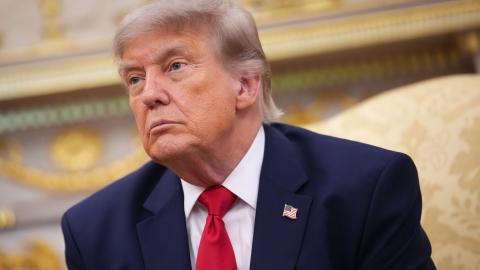
President Trump often touts the number of wars he’s ended, and notes that ending Russia’s war against Ukraine has been harder than he thought. The root of the problem is that Vladimir Putin is ideologically committed to his hostility against the United States and the West. This is why Trump’s strategy hasn’t worked. He has sought to appear impartial and demand that both sides compromise, focusing on territory in the Donbas, as if the war is a violent real estate dispute between feuding personalities.
But Ukraine (and Volodymyr Zelensky) is neither at fault for the cause nor for the continuation of the war, and if he surrendered the territory Russia demands, the war would continue and end in Ukraine’s total defeat. Only Putin can end the war by, at the very least, accepting a cease-fire. Ukraine and NATO could then focus on rebuilding their stocks and defense industrial capacity to deter further Russian aggression, especially as the U.S. urges Europe to help carry more of the burden of defense.
Trump has shown a willingness to adapt when his plans don’t work, and now is the time to shift the strategy. The only way for Trump to help end the war is by applying pain and pressure to Russia and encouraging Ukraine and the rest of NATO to do the same. For a while, Trump seemed convinced that Ukraine couldn’t hold back Russia. But flouting the Russian argument that Moscow will inevitably succeed, Trump noted in September of last year that he thought Ukraine may be able to retake territory Russia occupies, that the Russian economy was faltering, and that Putin should make a deal. Since the president observed this, developments have presented an opportunity for a new diplomatic push.
First, Ukraine is winning. In recent weeks, the nation struck more than 1,500 miles deep into Russian territory with attacks on oil refineries in Siberia and Moscow. Ukraine has also successfully targeted Crimean bridges and energy infrastructure, which fund the war. Last month, the Ukrainian military liberated more Ukrainian territory than Russia seized. U.S. officials affirm this new battlefield reality; Ambassador Dan Negrea, representing the United States to the U.N., stated recently, “Russia is taking 40,000 casualties per month” and “time is not on Moscow’s side.” Ukraine’s bold and daring attacks against Moscow’s legitimate military targets, while avoiding Russian civilians, bring the war much closer to the homes of Russians who may blame Putin for the fear and chaos. Ukraine’s recent attack in Moscow came with a foreboding promise from President Zelensky. “If Ukraine is going to burn, your Moscow will burn too,” he said, adding that the attack was meant to push Russia to stop. “It is time to end the aggression, time to end this war.” The United States should encourage, not restrict, Ukraine’s bolder operations and should exhort NATO nations to continue supplying Ukraine with weapons, including by purchasing key systems from American companies.
Second, Ukraine has proven itself a net contributor to the strength and security of the U.S.-led West. Ukraine has received air defenses, guided bombs, medium- and long-range strike missiles, and other weapons. Ukrainians have adapted the way they use them, have improved the missiles’ technology, and have made Ukraine a coveted location for Western arms producers to test their weapons and tactics against a sophisticated adversary. Ukraine’s success in the current phase of the war, which primarily uses drones, has made it a world leader in unmanned warfare. Ukrainians created the Sting drone, which can intercept Russian suicide drones at a fraction of the cost of traditional interceptors. The country’s advanced indigenous drone capabilities led the U.S. State and War Departments to form a framework for a joint drone production deal. The United States should look for more ways to take advantage of this alliance, Ukraine’s drone warfare ecosystem, and its battlefield experience.
Third, the Russian economy is veering toward crisis. Russia’s budget deficit skyrocketed in the first four months of 2026, going well beyond the desired annual target of 3.79 trillion rubles to 5.87 trillion rubles (approximately $81 billion). Russia is facing a wave of corporate defaults and increased risk for consumer lending and bonds, along with a 5.52 percent inflation rate. The Russian public is feeling the biting pain of a war that until recently has been kept mostly out of sight. Russian households are suffering from 18 percent higher food prices, sky-high utility bills, and gasoline shortages. The United States has allowed its sanctions waiver on Russian oil to expire, and it should go further and embrace Congress’s effort to pass secondary crushing sanctions against Russia, while cracking down harder against Russia’s shadow fleet.
Ukraine has agreed to every cease-fire Trump has announced. Ukraine will compromise enough if it agrees to a cease-fire along the current lines of contact, as long as the temporarily occupied Russian territories are never recognized as de jure Russian. Russia has thus far refused to alter its original objectives and still seeks the total subjugation of Kyiv, though its aggression has inspired Sweden and Finland to join NATO and has made Ukraine an even stronger, more robust military power with increased national cohesion and proud identity.
As Secretary of State Marco Rubio asserted earlier this month, “All of our sanctions are on Russia and all the aid that we’ve provided has been on the Ukrainian side. . . . We are not an impartial mediator here. We clearly are supporting one side over another.” The U.S. strategy should more overtly reflect that reality if it is to be effective. The United States should lead our allies to increase the pain against Russia now and sharply to make it clear: things will only get worse for Russia, and Putin should take the deal.