








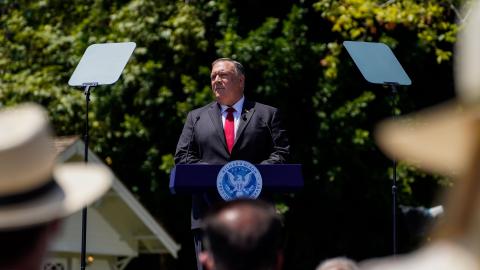
In the midst of the COVID-19 pandemic, then-Secretary of State Mike Pompeo gave a speech making the case to the American people that the United States needed to reassess its approach to the People’s Republic of China (PRC) and the Chinese Communist Party (CCP). It was the culmination of several speeches from high-ranking cabinet officials in President Trump’s first term. While other remarks focused on ideology, espionage, and economics, Pompeo sought to “put it all together for the American people and detail what the China threat means for our economy, for our liberty, and indeed for the future of free democracies around the world.”
Pompeo spoke at Richard Nixon’s presidential library, a highly symbolic move. It was Nixon who laid the groundwork for Washington’s diplomatic relationship with the PRC and also sought to downgrade America’s relationship with Taiwan. It was Nixon who argued that the world could not be safe until China had changed, and he sought to change China by engaging it. Five decades on, Pompeo questioned what Americans had to show for that engagement? Was the PRC a fair commercial partner? Did the CCP respect America’s democratic system of government and its neighbors in the Indo-Pacific? Did China grow freer as it grew wealthier? Pompeo made the case that rather than changing China, the CCP was changing the free world, and would continue to degrade and exploit open societies if the status quo prevailed. “Today,” the secretary of state warned, “China is increasingly authoritarian at home, and more aggressive in its hostility to freedom everywhere else.”
It was the speech’s call to action that set it apart. Pompeo focused on the CCP for the purpose of isolating it, not normalizing it as Nixon did. Whether in commerce, intelligence, cultural exchanges, or military affairs, the CCP was not “a normal country, just like any other.” Thus, Pompeo called on America’s allies to join the United States in demanding reciprocal, fair treatment from Beijing. Most notably, the 70th Secretary of State called on the United States and its partners to “engage and empower the Chinese people” to change their political future. Supporting this effort would be a new “alliance of democracies” bound by optimism in the future and resolve to oppose tyranny.
The speech was meant to be the final nail in the coffin of America’s engagement policy with the CCP and project confidence in the United States’ ability to prevail in great power competition. While the U.S.-China relationship has not categorically shifted in the ways Pompeo called for in 2020, his remarks serve as a worthy guidepost for what America’s approach to the CCP could, and should, be.