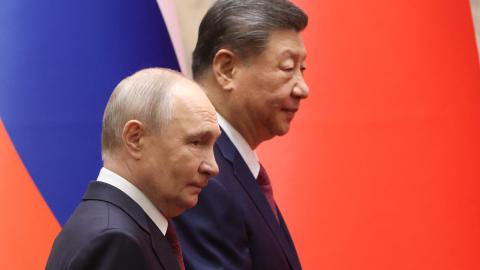







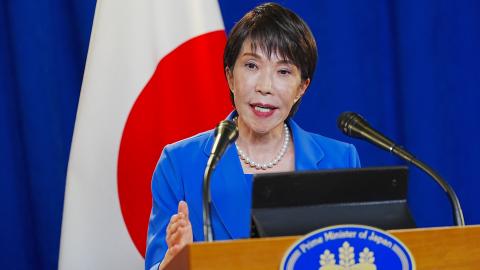





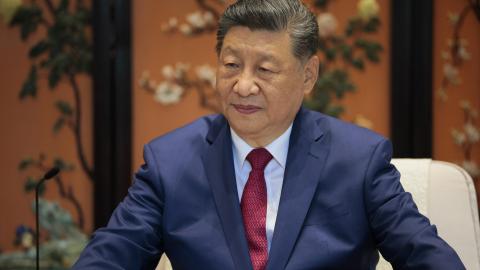
After meeting Chinese leader Xi Jinping in Beijing, U.S. President Donald Trump made no public mention of Japan. Yet according to a Financial Times report, it was one of the most contentious issues in their talks, with Xi accusing Japanese Prime Minister Sanae Takaichi of leading Tokyo's "remilitarization."
That claim sits uneasily with Japan's security reality. Japan's rising defense spending is a direct response to China's military expansion and repeated incursions by Chinese vessels into waters around the Japanese-administered Senkaku Islands in the East China Sea.
At the recent Shangri-La dialogue in Singapore, Japanese Defense Minister Shinjiro Koizumi rejected accusations from China of "new militarism."
"Think about it. There's a country that has a huge arsenal of nuclear weapons and strategic bombers. Japan has neither of such weapons and yet Japan is labelled 'new militarism. 'Isn't it strange?" he said at the security conference.
The reported exchange between Xi and Trump is nonetheless revealing. It reinforces a view increasingly shared in Tokyo: that Xi's conception of Japan differs markedly from that of his predecessors. In his worldview, China is a principal victor of World War II and a co-architect of the postwar order. Japan, as a defeated nation, has limited standing to shape regional security norms.
Unlike earlier Chinese leaders, who prioritized development and engagement with the existing international system, Xi expects that system to accommodate a more powerful China. In his framing it is the world, not China, that must adapt.
According to the Yomiuri Shimbun newspaper, Trump expressed the view that Takaichi is not the kind of leader who deserves criticism. But the issue is unlikely to fade. With more Trump-Xi summits expected this year, how the U.S. president responds will matter. Beijing's narrative is designed to weaken the U.S.-Japan alliance while justifying China's own military buildup.
Even seemingly harmless language risks reinforcing this framing. References to a U.S.-China "co-management" of global stability, or to China as a coequal architect of the postwar order, can be read in Beijing as tacit recognition of special Chinese authority in Asia -- and as a signal that Japan's security normalization lacks legitimacy.
Earlier generations of Chinese leaders struck a notably different tone. Mao Zedong took a pragmatic approach to Japan, renouncing war reparations in the 1972 normalization with Tokyo.
Deng Xiaoping went further, arguing that historical grievances should not dominate contemporary policy. In 1978, he proposed shelving the contentious issue of the Senkaku Islands -- which China claims and calls the Diaoyu -- for future generations to resolve. Development, not historical reckoning, was his priority.
Today's rhetoric from Beijing signals a shift away from such pragmatism. Last month, Chinese Foreign Ministry spokesperson Guo Jiakun criticized Japan's defense budget increases, invoking the Potsdam Proclamation to argue that Japan remains bound to disarmament and that its portrayal of itself as a "victim" challenges the postwar order.
In the Xi era, Chinese official discourse increasingly emphasizes "the outcomes of the Second World War," presenting China as a central architect of the postwar order. Within this narrative, Japan is cast as lacking the moral authority to revise its security policy or contest China's strategic claims.
This interpretation is historically selective. The Potsdam Proclamation was designed to secure Japan's disarmament at the end of the war, not to freeze Japan's defense posture indefinitely.
Nor was China a principal architect of the postwar system it now invokes. The U.S. and its allies shaped the alliance network, Bretton Woods institutions and much of Asia's security architecture, while Beijing remained outside many of these frameworks for decades.
There is no doubt that, through its colonial rule and aggression, Japan "caused tremendous damage and suffering to the people of many countries," as acknowledged in the 1995 statement by Prime Minister Tomiichi Murayama.
But Beijing's accusation that Japan is undermining the postwar order is overblown. Japan's security policy remains firmly anchored in the postwar order, one based on sovereignty and the rule of law. China, meanwhile, invokes its status as a victor in World War II, while backing Russia as it violates those same principles in Ukraine.
Trump should resist any framing that elevates historical status over present conduct. The question is not who stood on the right side of history in 1945 but who is upholding international norms now.