











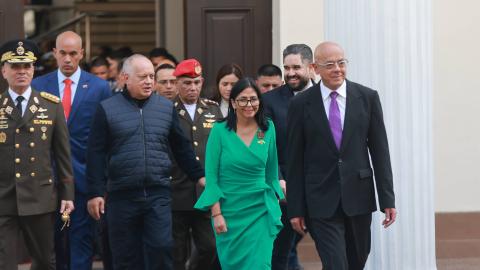
If the regime of Nicolás Maduro is illegitimate, as President Trump repeatedly declared before ousting Maduro, why is the administration now in bed with Maduro’s vice president, Delcy Rodríguez?
Four days after the extraordinary capture of Maduro by US special forces, reports of life under Rodríguez are grim for Venezuelans who hoped for change.
On Tuesday, pro-regime armed colectivos were roaming Carácas searching for anyone who might have been celebrating Maduro’s downfall. Journalists were getting hauled in and later let go. Political prisoners remain locked up — despite some holiday releases before Maduro got nabbed.
The unfortunate decision to work through the existing power structure reflects the unique situation Trump now faces in Venezuela.
Most leaders would have concluded the post-Maduro challenges were insurmountable — and never attempted the operation. Trump’s bold move succeeded tactically, but now comes the far more difficult strategic test.
The administration’s rationale for working with the regime is likely based on short-term needs and an awareness that instability could undermine US objectives in Venezuela.
Maintaining the status quo allows the country to keep pumping oil, a key objective for Trump.
Going forward, though, the administration likely understands that it would be a strategic error to rely on this arrangement for any longer than absolutely necessary.
Rodríguez represents a continuation of the Maduro regime and of the criminal networks that have brought so much devastation to Venezuela. Vice president since 2018, she has been sanctioned by the United States, Canada and the European Union for her role in cracking down on dissent.
Even if Rodríguez makes concessions to the United States on drug trafficking and the presence of US adversaries in Venezuela, unless the networks connecting the regime and its criminal allies are fully dismantled, any gains will be short-lived.
This is unlikely to happen until Venezuela has a democratically elected government with institutions that are up to the task.
A realistic path forward
A realistic strategy for the administration is to use Rodríguez as a bridge to a caretaker government, not a long-term partner.
The administration could make the partnership with her contingent on meeting specific US demands, while actively working toward transitioning to a caretaker government led by a non-regime figure that can organize elections.
That should mean immediately expanding civil rights and political spaces. The first focus should be releasing all political prisoners and allowing safe return for political exiles, giving Venezuelans evidence that change is coming.
The United States needs to communicate its vision and expectations. Ambiguity breeds uncertainty and allows bad actors to exploit gaps.
The administration needs to tell the regime, the military and the Venezuelan people what the US wants as an end state: A democratic, sovereign Venezuela that is free of the influence of US adversaries and organized crime.
It also should address the opposition’s role. The apparent sidelining of María Corina Machado, winner of the 2025 Nobel Peace Prize, sends the wrong signal. Democratic forces deserve a central role in Venezuela’s transition.
At the same time, the United States shouldn’t pick the toughest fights now. While the US can remove members of the regime from power, the criminal networks that operate in Venezuela will not be dismantled overnight. Trying to do so now will ensure that they work to undermine US objectives.
Finally, the administration needs to make clear that it’s not about oil. Emphasizing it detracts from larger US objectives in Venezuela.
Decisions about oil and other resources are up to the Venezuelan people, and Trump should say so.
Making history or repeating it
The capture of Maduro was an astounding military and intelligence triumph, but history will judge Trump by what comes after.
The real question is whether the US can facilitate durable change in Venezuela, or whether we’ll simply swap one authoritarian arrangement for another.
The US partnership with Rodríguez may be necessary as a short-term measure, but it cannot be normalized — and it cannot come at the cost of change.
Trump currently has leverage and momentum. He should use both of them wisely while he has them.