





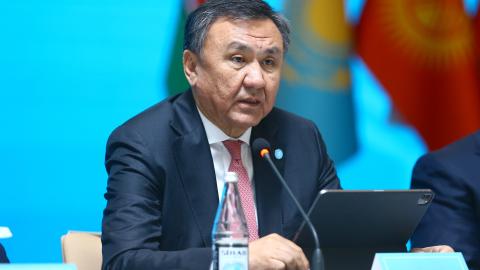
Washington on Monday played host to an unusually quiet but geopolitically significant visit. Kubanychbek Omuraliev, the secretary-general of the Organization of Turkic States, arrived in the US capital for meetings with State Department officials, members of Congress and policy leaders. This was an important visit that could lead to closer relations between the Turkic world and the US.
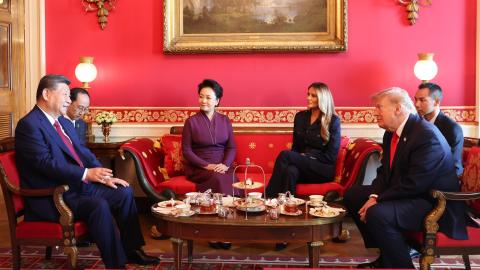
It came on the heels of last month’s historic meeting between President Donald Trump and his Central Asian counterparts at the White House to mark the 10th anniversary of the C5+1 format, as well as the US-brokered diplomatic breakthrough between Armenia and Azerbaijan earlier this year. Taken together, these developments underscore the growing strategic relevance of the organization and help explain why this was the right moment for the secretary-general’s visit.
The Organization of Turkic States — made up of Turkiye, Azerbaijan, Kazakhstan, Uzbekistan and Kyrgyzstan — is an increasingly important intergovernmental organization on the global stage. The original idea for more formalized Turkic cooperation was proposed as early as 2006 by then-Kazakh President Nursultan Nazarbayev. It was subsequently founded in 2009 as the Turkic Council by Turkiye, Kazakhstan, Kyrgyzstan and Azerbaijan, with the aim of strengthening shared cultural, historical, linguistic and economic ties among ethnically Turkic countries.
Uzbekistan later joined as a full member in 2019, while Turkmenistan, Hungary and the de facto administration in northern Cyprus participate as observers. The organization’s headquarters and secretariat are in Istanbul and it meets regularly throughout the year to advance cooperation and integration among its members.
The countries of the bloc are in one of the most geopolitically significant regions of the world, set at the heart of the Eurasian landmass, and they possess considerable economic and energy potential. Collectively, the organization’s members and observers represent more than 158 million people across about 1.64 million square miles, with a combined gross domestic product approaching $2 trillion.
Except for Turkiye, all current members were formerly part of the Russian Empire and later the Soviet Union. Since regaining independence in the 1990s, these ethnically Turkic states have rediscovered and embraced their Turkic roots and identity after, in some cases, centuries of having it marginalized.
This rediscovery has not been merely symbolic. It has included deliberate efforts to abandon the Cyrillic alphabet in favor of Latin-based scripts and to move toward a common Turkic alphabet framework, alongside broader initiatives to revive shared language, culture and historical identity among Turkic peoples.
Beyond the millions of ethnic Turks who live within the borders of the organization’s member states, there are millions more ethnic Turkic populations residing in nonmember countries across Eurasia. These communities are strongly influenced by Turkic soft power, particularly through television, cinema and music. Turkic languages are spoken across a vast geographic belt, stretching from Southeastern Europe through Central Asia into Western China and northward toward Russia’s Arctic regions.
Although the Organization of Turkic States represents a relatively modest share of the global economy, its strategic importance far outweighs its members’ combined economic size. The region is rich in oil, natural gas and rare earth minerals, resources that are increasingly central to global supply chains and economic security. It is also home to some of the world’s most important transit routes and trade chokepoints, including the Turkish Straits and the Middle Corridor, which connects Europe and Asia while bypassing Russia. For these reasons, the bloc has attracted increasing attention from Western policymakers.
At a time when the geopolitics of the Eurasian landmass are largely shaped by Russian and Chinese influence, the reassertion of Turkic identity and the expanding role of the Organization of Turkic States provide an additional strategic pull across Eurasia. What began as an organization rooted primarily in shared cultural identity has steadily evolved. Over the years, it has made tangible progress on economic integration, trade cooperation and connectivity initiatives.
More recently, it has begun exploring avenues for cooperation on security-related matters. Discussions among member states now include joint training, defense coordination and the prospect of future multilateral military exercises.
Looking ahead, member states are likely to experience strong economic growth and favorable demographic trends, with population growth rates that many European countries would envy. This combination of youthful populations, expanding markets and strategic geography makes the organization an increasingly important actor in Eurasian affairs.
If the Trump administration is serious about implementing a policy of global leadership and engagement, particularly one that emphasizes business, trade and economic diplomacy, working more closely with groupings like the Organization of Turkic States makes strategic sense. It is composed of countries that want to do business, deepen trade ties and engage globally as actors in their own right.
Trump has already demonstrated a keen interest in engaging with Central Asia and the South Caucasus and he enjoys a strong relationship with Turkiye, which serves as the economic, political and security motor of the organization.
While Omuraliev’s visit to Washington was an important step, the US should build on the momentum created by Trump’s recent engagement with the region. It should seek to elevate US-Turkic relations, with the long-term goal of hosting a summit at the foreign ministerial level. Doing so would help unlock new economic and trade opportunities in a region that has too often been overlooked by Western policymakers, while reinforcing America’s strategic presence at the heart of Eurasia. Such an outcome would be beneficial to all involved.