










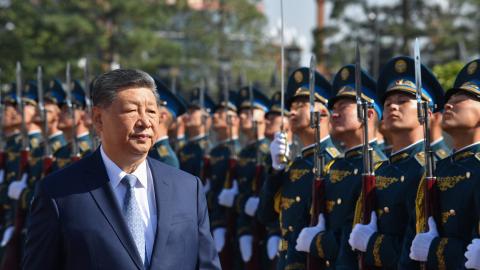


Xi Jinping doesn’t do overseas trips for diplomatic show. So why did he meet Kim Jong-un in North Korea earlier this week in his first trip abroad this year?
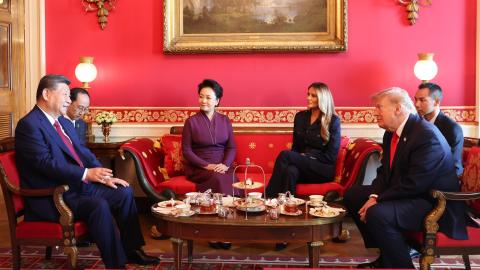
Despite a common perception that Xi is a master strategist, several steps ahead of hapless democratic leaders, it has not been a good year for him. In different ways, both Donald Trump and the North Korean leader are messing things up for China. Xi met Trump last month and didn’t really achieve what he wanted in the form of permanent US concessions on Taiwan. He was in Pyongyang to get other matters back on track.
North Korea has long been part of Xi’s asymmetrical approach against the US and its allies. This means China remains a relatively lonely great power in terms of having few formal alliances. For a long time it appeared that the decisive advantage over the so-called CRINKs (China, Russia, Iran and North Korea) was the US-led alliance system, which has endured for decades.
The latter grouping includes virtually all the rich, technologically advanced and fully industrialised economies. In contrast, China’s closest strategic friends include Russian, where living standards have barely improved for decades. The Ukraine war is only making things worse. Iran is a corrupt security state overly dependent on oil for economic survival. And North Korea is one of the poorest nations in the world.
Even so, the major asymmetrical advantage for Xi can be best summarised by the maxim attributed to Vladimir Lenin: “You probe with bayonets. If you find mush, you push. If you find steel, you withdraw.” For all the advantages in wealth, US allies in Europe and Asia remain woefully unprepared for war. As Xi would see it, what ultimately decides the rise and fall of great powers – and the shape of the international order – is material power and the will to use it when required.
Xi was fond of telling Vladimir Putin “great changes unseen in a century are occurring”. This refers to US decline – an end to the dominance by democracies – and China’s readiness to fill that gap.
The CRINKs might not have the trappings of fully industrialised economies. But unlike US allies, they were readying for war. In other words, it is not GDP per capita and living the good life that shape history but what capability and resolve we bring to the fight. In Xi’s mind, this is the CRINKs’ asymmetrical secret sauce.
Which brings us to the Trump factor. The US President’s unsentimental approach to allies and longstanding security arrangements is unsettling. Allies have been scored and disrespected. But they have been persuaded, or else coerced, into rearming. Damage to some alliance relationships might well be lasting. Regardless, for a materialist such as Xi, the remilitarisation of the US and its allies is a profoundly significant, negative and startling development.
Of highest concern for Xi is what’s happening around China’s periphery, most of all in Japan, which is not only rearming but developing long-range strike missiles that can hit the Chinese mainland. This is the context within which Kim Jong-un is becoming problematic for Xi. North Korea is China’s only formal ally. The former is useful to China because Pyongyang creates problems and distraction for the US and Asian allies.
This works to China’s advantage only if North Korea doesn’t overplay its hand. The problem is that Kim has been talking up the “exponential” expansion of his nuclear arsenal. North Korea has been ramping up development and testing of advanced strategic and tactical missiles capable of carrying conventional and nuclear warheads. Together with pressure from Trump, recent North Korean actions have driven Japanese rearmament. In recent times, South Korea is looking to do the same.
The nightmare scenario for Xi is that the US, Japan and South Korea form an integrated military network of sensors, weapons and command systems against North Korea, which can also be used against China in the event of a Taiwan contingency.
The more aggressive and militarily capable North Korea becomes, the more likely this integrated allied military network will emerge.
An even worse scenario for China – which maintains a mutual defence treaty with North Korea – is that Kim’s aggression inadvertently drags Xi into an Asian war that would be as disastrous for China as for every other participant.
There is also the matter of loss of Chinese leverage and therefore control over North Korean activities. In return for sending troops and weapons to help Russia’s war efforts against Ukraine, it is likely that Moscow has shared military technology with Pyongyang. This might well include Russian missile and nuclear secrets. This will not only intensify military co-operation between Asian allies but also reduces North Korea’s dependency on China as the latter appeared to be caught unawares by the Pyongyang-Moscow arrangement.
What does this mean for Australia as we slowly progress AUKUS? Geography provides only temporary relief. As the saying goes: We might not be interested in the geopolitics of Asia, but the latter is, and will be, increasingly interested in us.