







By any conventional calculation, the Cuban regime should be negotiating with the United States. The Trump administration’s campaign to compel change on the island arrived at what looked like an ideal moment. With Nicolás Maduro in a prison cell, Venezuelan oil cut off, Cuba’s economy in shambles, and a federal indictment hanging over former President Raúl Castro, Havana might have been expected to grasp the gravity of its position. Moreover, the administration has demanded reforms, not the end of the Cuban revolution. A government weighing its own survival would engage with Washington.
It has not. Even as Havana has hosted senior U.S. officials and participated in back-channel talks, the regime under Miguel Díaz-Canel has refused to give ground while continuing to detain dissidents. It has announced a raft of economic reforms, but pointedly characterized these as “perfecting the construction of socialism,” and in any event has a long history of reversing such reforms once pressure eases.
Washington has called the reforms superficial and its demands run well beyond economics: it wants political prisoners freed, Russian and Chinese intelligence operations out, and movement on outstanding property claims.
Several factors may contribute to this resistance: The regime surely fears that reform of any kind will erode Communist Party rule. It may believe President Donald Trump has already decided to move against it, and competition between factions within the regime likely breeds inertia.
But one factor, too often overlooked, is central to the regime’s refusal to negotiate: the deep anti-U.S. doctrine that is at the heart of the regime. The Cuban revolution’s anti-Americanism operates powerfully, individually and institutionally, to place cooperation with Washington beyond the range of acceptable thought.
This is what separates Cuba from Venezuela. Chavismo was a movement barely a generation old, built on oil money and loyalty to a charismatic leader. The Cuban revolution has had 67 years to become institutionalized and to fuse itself to national identity. Resistance to the “Colossus of the North” is foundational to how Cuban communists narrate their history and place in the world, and is among the last remaining sources of the regime’s legitimacy.
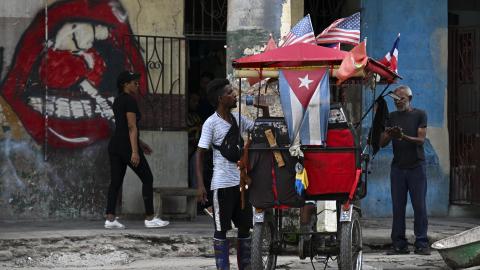
The U.S. “blockade” sits at the center of this narrative. As propaganda aimed at ordinary Cubans it is only partly successful, most know perfectly well that the embargo is not the source of their misery, and that the regime’s own incompetence is. Calling the embargo “the main cause” of Cuba’s problems provides the regime a ready excuse for failure and creates a reality in which any accommodation with Washington is not pragmatism but capitulation to the enemy. The doctrine need not be sincerely believed by a single member of the elite to bind them all — its function is less to persuade than to discipline.
It is true that the regime has negotiated in the past, when it agreed to the 2014 thaw under President Barack Obama, but the Obama thaw proves very little: Washington asked for no meaningful change, the regime conceded none, and it pocketed the opening. And it is tempting to think that recent talks hint at a willingness to deal, perhaps even at a reform-minded figure somewhere inside the system. But even if the United States has identified a Cuban Delcy Rodríguez, that person must survive long enough to achieve something. In Cuba, the official publicly cast as Washington’s man does not become an agent of transition. He becomes a traitor, and is dealt with as one.
What might Washington do differently? The deepest flaw in the present approach is that intensifying pressure and choking off fuel strengthen the siege mentality within the regime and likely narrow whatever space exists for substantive discussions.
A wiser course would ease the humanitarian pressure and find a pathway, possibly through mediation by a third party such as the Vatican, that allows the regime to cast change as its own sovereign choice rather than capitulation to the United States.
Even if Washington did everything right, it would face long odds. The men who control Cuba’s security services and its military-run economy have the most to lose from any genuine opening, and the anti-American doctrine is precisely what lets them defend that self-interest as something nobler.
Cuba urgently needs change, and President Trump’s determination to bring relief after 67 years of misrule is laudable. But Washington’s present course plays into the regime’s oldest story and makes refusal too easy. A narrow window may remain, but the moment when a more subtle strategy might have worked may already have passed.