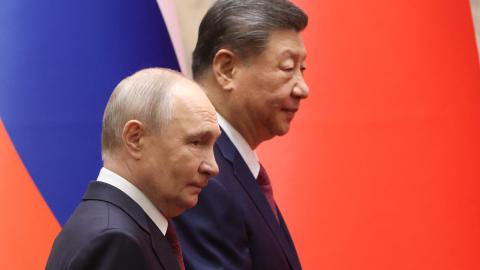


















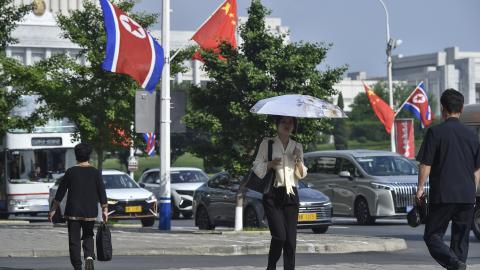
Xi Jinping’s visit to Pyongyang this week signals that Northeast Asia’s power balance is recalibrating. Returning to North Korea for the first time since 2019, Xi is deploying his personal political capital at a moment when North Korea has gained leverage from its advancing nuclear program and a nascent Moscow partnership. For Kim Jong Un, sustained high-level attention from major powers, including Beijing, is key as Pyongyang seeks to project itself as a member of the club of nuclear great powers.
For Xi, the Pyongyang trip advances several foreign policy imperatives. It strengthens his credentials ahead of a likely fourth term in 2027, reinforces Beijing’s bid to be seen as a global stabilizer and the champion of a multipolar order, and projects unity while reasserting China’s sway in Pyongyang. Beijing remains North Korea’s principal economic lifeline, supplying goods, services, and connectivity that Moscow cannot fully substitute. Xi has every reason to warn Kim that North Korea’s expanding alignment with Moscow must not come at China’s expense, a message that simultaneously signals Beijing’s willingness to defend its core interests while resisting coercive pressure from other major powers.
Xi arrives as a mediator, not a meddler. He can convey Washington’s views to Kim while committing to nothing on negotiations. Beijing’s interest is to deter North Korea from being drawn into renewed nuclear dialogue, since overt pressure would likely backfire. Kim’s September 2025 Beijing meeting placed no public emphasis on nuclear issues, highlighting a shared preference for managing risk over provoking new rounds of bargaining.
Kim enters the encounter from a position of greater confidence than at any point since the pandemic. Hosting Beijing’s leader underscores his country’s diplomatic rehabilitation and signals the regime’s success in restoring its strategic relevance. North Korea now enjoys “dual patronage” from both Russia and China. The Kremlin’s dependence on Pyongyang’s manpower, munitions, and military support for its war in Ukraine reduces North Korea’s traditional reliance on China, while Beijing and Moscow can be played off against one another to extract concessions. Kim Il Sung would be proud of his grandson, whose leverage is growing and whose autonomy within the Beijing–Moscow–Pyongyang triangle is expanding.
North Korea’s expanding nuclear and missile capabilities reduce its reliance on both China and Russia while strengthening its ability to deter or complicate US intervention. Kim’s recent visit to a new uranium enrichment facility last week underscores how he sees nuclear weapons as shoring up his ability to deal with major powers, including China. Meanwhile, these capabilities provide Pyongyang with greater coercive leverage over both Washington and Seoul.
What should allies do? The implications for the United States and South Korea are fourfold:
First, recognize the limits of diplomacy. Washington and Seoul should acknowledge the boundaries of diplomacy with Pyongyang. Strategic communications remain essential to reduce risk and avoid miscalculation, but expecting North Korea to surrender its nuclear arsenal is unrealistic. The objective is risk management, stability, and a controlled diplomatic horizon, not magical thinking about negotiated denuclearization.
Second, accelerate alliance modernization. Focus on deterrence and military effectiveness, not symbolic gestures. Concrete steps include supporting South Korea’s development of a nuclear-powered, conventionally armed submarine to bolster undersea deterrence; expanding production in shipbuilding, semiconductors, and emerging technologies; and deepening Korea–Japan–US trilateral cooperation to build a more integrated regional deterrence-by-denial architecture.
Third, secure critical supply chains. Deepen cooperation with like-minded partners to safeguard access to processed rare earths, critical minerals, and other essential technologies, while diversifying suppliers and investing in resilient domestic capabilities, including offshore and domestic production capacity. The allies may not be able to halt North Korea’s nuclear industry, but it can bolster US and South Korean industrial strength.
Finally, strengthen extended deterrence. The United States should demonstrate credible deterrence in a more contested nuclear environment. This should include ongoing modernization of US forces and capabilities, with visible demonstrations as appropriate, and coordinated signals ahead of future summits involving major leaders.
If Beijing, Moscow, and Pyongyang are using military modernization to shape perceptions of power, the United States and its allies should respond with credible deterrence and a resolute commitment to maintaining the balance of power in the Indo-Pacific.