


















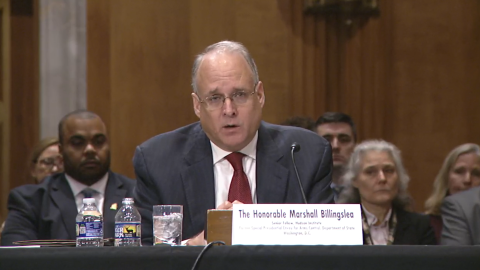
Marshall Billingslea testified before the Senate Foreign Relations Committee on the growing threat posed by China’s nuclear weapons development and the need for the United States to modernize its own arsenal and update its arms control strategy to counter both Russia and China. He also outlined how the New Strategic Arms Reduction Treaty (START) framework may hinder US efforts to do so.
Written Testimony
Chairman Risch, Ranking Member Shaheen, and Members of the Senate Foreign Relations Committee, I am pleased to appear before you again on a matter of utmost importance to our national security – the nuclear arms buildup by both Russia and Communist China.
In 2020, when I last briefed this Committee in classified session on this topic, as the Presidential Envoy for Arms Control, I provided details on what these two adversaries were doing, and warned that China was in the early stages of a massive increase in its nuclear arsenal. I also discussed many of the problematic things Russia was pursuing, both with novel weapons and with its huge arsenal of theater-range nuclear weapons.
Five years later, the grim assessment I delivered to you back then now seems to have been overly optimistic. China has proceeded at breathtaking pace. They field over 600 operational warheads, and are ahead of schedule to field 1000 weapons by 2030. As the Strategic Posture Commission, of which Rose and I were both members, warned a few years ago, China will field at least 1500 warheads by 2035. That is roughly equivalent to what both the U.S. and Russia field today, and I believe China may ultimately exceed that number by a wide margin.
In the past few years, we have discovered three new Chinese ICBM fields, bringing the total number of silo launchers to around 400. That is more silos than we have. China has also been recently discovered building 30 new silos for its DF-5 ICBMs in the mountainous regions of central-eastern China. The new DF-5C will be able to carry a multi-megaton warhead – a so-called “city 2 buster” – or may be deployed with 10 warheads. For comparison, our Minutemen III missiles generally only carry one warhead, up to a maximum of three. We do not have megaton warheads on our ICBMs or SLBMs.
In addition to fielding a nuclear triad, involving both silo- and road-mobile ICBMs, bombers, and submarines, China is also pursuing a range of other capabilities, including low yield warheads. It also flight tested in 2021 a fractional orbital bombardment system, which could be used in a decapitation first strike scenario. Finally, CIA Director Ratcliffe and Senate Intelligence Committee Chairman Senator Cotton have both confirmed that China is engaged in nuclear weapons testing, despite its public commitment not to. For its part, Russia has for several years engaged in super-critical nuclear weapons tests despite its pledge to the contrary. This is something that the State Department under multiple administrations has warned about. Russia continues to possess a nuclear arsenal that is much bigger than ours (5,500 or more warheads) and highly diverse, with a myriad of theater range and tactical nuclear weapons, such as torpedoes, landmines, artillery shells, and medium and short range missiles.
Russia keeps its warhead stockpile in a constant state of refurbishment and readiness, whereas many of the warheads in our “hedge” are not operationally-available, in various stages of disassembly, and/or lacking associated delivery systems. In short, Russia’s warhead stockpile is growing, while ours is shrinking.
Finally, I am sure Senators have heard about Vladimir Putin’s various Dr. Strangelove experiments, such as Skyfall – the nuclear tipped nuclear powered cruise missile, and Poseidon – an undersea version of the same. Russia also is developing an indiscriminate space-based nuclear weapon, which may put it into anticipatory breach of the Outer Space Treaty.
For the first time since the dawn of the atomic era, we soon will face two nuclear peer adversaries, and we must consider the possibility that they could engage in simultaneous coordinated, or opportunistic, aggression.
So what should be done?
First, we need to look to our own affairs. As Secretary Gottemoeller notes in her testimony, the current program of record for nuclear modernization is necessary but not sufficient. It also carries huge risk, with cost overruns and schedule delays now threatening just-in-time delivery of new capabilities to replace aging systems in two of three legs of the triad.
The Strategic Posture Commission saw this coming. In October of 2023 we issued our report, which contained a number of recommendations, all of which had unanimous, bipartisan support. I continue to stand by the report in its entirety. I highlight for the Committee a few of the most salient points:
With urgency we need to:
- Prepare to upload some or all of the nation’s hedge warheads;
- Plan to deploy the Sentinel ICBM in a MIRVed configuration;
- Increase the planned number of deployed Long-Range Standoff Weapons (for the bombers);
- Increase the planned number of B-21 bombers
- Increase the planned production of Columbia SSBNs and their Trident ballistic missile systems;
- Look at fielding a road-mobile ICBM;
- Prepare to put a portion of the future bomber fleet on continuous alert status;
- Develop plans and procedures to “re-convert” SLBM launchers and B52 bombers that were rendered incapable of launching a nuclear weapon under New START; and
- Prepare to keep operating Ohio-class SSBNs past their currently planned retirement dates.
We also need to modify our theater nuclear forces to give the President better militarily effective nuclear response options to deter or counter Chinese or Russian limited nuclear use in theater, something we came dangerously close to seeing happen by Putin in Ukraine. That includes development and deployment of theater nuclear weapons that are survivable against preemption, with a wide range of yield options, and which can be delivered in a timely fashion. This should be done with respect to both Europe and the IndoPacific.
The extended nuclear deterrence that we have offered our allies, in both Europe and Asia, is vital to our alliance framework and our national security. This longstanding commitment has reassured allies and has dissuaded them from feeling the need to pursue their own nuclear weapons programs. Like my colleague, I do not consider “friendly proliferation” a wise concept, for it surely would cost us the Nuclear Nonproliferation Treaty, the IAEA and its nuclear safeguards program, and would make constraining countries like Iran all the more difficult. For this reason, I believe the establishment of warhead storage area (WSA) and integration of Poland into the NATO nuclear burden-sharing process would be a wise and stabilizing set of actions to take.
We also recommended, and I strongly believe this, that the United States should develop and field homeland integrated air and missile defense capabilities that can deter and defeat coercive attacks by Russia and China. President Trump’s “Golden Dome” initiative has the potential for providing this protection as it is rolled out incrementally. Given the geostrategic uncertainties we face today, we urgently need to defend the American people from missile attack.
So what should not be done?
For starters, an arbitrary political extension of the New START Treaty.
Many of the measures that I set forth cannot be taken if we continue to bind ourselves to a treaty that Russia has been flagrantly violating. There is an urgency to several steps that we need to take, such as pulling the cement 5 plugs out of the Ohio class submarines so that we can put missiles back in. That will be a lengthy process that will take two to three years to complete, in a best case scenario. Reconversion of the one third of the B-52 fleet that we denuclearized by stripping out wiring and removing antennas and firing systems will also be a lengthy process. For as long as we abide by New START, this cannot happen.
Moreover, the New START Treaty does not constrain the bulk of Russia’s nuclear capabilities. The Senate recognized this fact with Declaration 11 in the Resolution of Ratification for the treaty. That declaration called upon President Obama to pursue an agreement with Russia that would address the disparity intactical nuclear weapons stockpiles and reduce the weapons in a verifiable manner. This was never accomplished, though we did make progress towards the end of the first Trump administration on a framework to address the massive imbalance. Extending the New START Treaty for another year or more without placing verifiable limitations on the thousands of weapons that Russia uses to threaten our NATO allies would seem at odds with the Senate’s intent.
Quite obviously, the New START Treaty also does not place any limits on Communist China. They are not party to the treaty. To be fair, New START was negotiated long before we became concerned that Xi Jinping would derail longstanding bipolar strategic stability by engaging in his own, secretive nuclear crash program. But any future nuclear agreement needs to both cover all of Russia’s weapons, as well as China’s. The days of U.S.-Soviet / U.S.- Russia bipolar arms control are over. We are living in an unstable, tripolar world now.
And there is one further obvious point here. The New START Treaty will expire on February 5, 2026. The Biden Administration used the complete five year extension, and by the treaty’s own terms it cannot be further extended. Of course, any administration could try for a non-legally binding agreement, though that is something that the Senate, on a bipartisan basis, has historically rejected. In fact, Declaration 12 of the treaty’s ratification 6 resolution makes clear the Senate will only consider such obligations pursuant to the treaty making power under Article II, section 2, clause 2 of the Constitution. Declaration 9 is even more explicit. It states that “any agreement or understanding which in any material way modifies, amends, or reinterprets United States or Russian obligations under the New START Treaty, including the time frame for implementation of the New START Treaty, should be submitted to the Senate for its advice and consent to ratification.”
This does not mean that there are no prospects for meaningful arms control in the future. I strongly support President Trump’s desire to prevent a three way arms race, if at all possible. Here I commend for the Committee’s consideration the Chapter on Risk Reduction in the Strategic Posture Commission’s report, which Rose and I basically co-wrote.
Robust diplomatic engagement which reduces uncertainty, the potential for deterrence failure, or unnecessary arms competition is in our national interest. We should lead, and be seen as leading, such efforts. There are many options for confidence building measures and risk reduction that fall well short of blocking our ability to respond both Russian and Chinese arms racing; ranging from things such as continued operation of the Nuclear Risk Reduction Centers, launch notifications, a pledge not interfere with National Technical Means (NTM) of monitoring, and even forswearing missile-launched FOBs.
But as we said in our report to Congress: “The United States cannot set its arms control limits without first determining the requirements for its overall strategic posture, and the strategy that those requirements will support.” For this reason, I do not favor continuing to abide by New START limitations, or negotiation of any other form of militarily significant nuclear limitations, until we have first done our homework. That starts with a Nuclear Posture Review that involves the full interagency, and revised Presidential Employment Guidance to U.S. Strategic Command. Once that process is complete we should be able to decide what we will pursue in terms of trilateral nuclear arms control with Russia and China.