



















The US Army introduced the multi-domain operations (MDO) concept, originally called Multi-Domain Battle, in 2017. After almost two decades of counterinsurgency (COIN) operations, Army leaders were concerned that improving and proliferating precision strike weapons would make traditional ground manoeuvre warfare obsolete. Although the US military pioneered networked precision strike warfare during the Cold War, the world had entered what Dr. Andrew Krepinevich calls a “Mature Precision Strike Regime” by the 2010s in which most armed forces used guided munitions that exploited US innovations in satellite navigation and mobile communications.
The Army had reason to be concerned about rising and capable threats. Russia was nearly a decade into its grey-zone cyber and proxy campaign against Ukraine and had already annexed Crimea. Several wargames suggested Russian troops could overrun the Baltic NATO allies within a few days. In these scenarios, using its large inventory of conventional surface-to-surface and air-to-surface precision missiles, Russia could eliminate NATO air defences and command and control (C2) while its long-range air defences could deny US and NATO air superiority.
Under the Multi-Domain Battle concept and its successor, MDO, the Army and its Training and Doctrine Command (TRADOC), who elaborated the documents planned to counter the reach of enemy air defences using longer-range surface-to-surface missiles targeted using air-launched effects (ALE) drones delivered by a new family of faster, longer-range and stealthier rotary-wing aircraft. In addition to finding enemy air defences, ALE drones would conduct electronic warfare (EW) jamming or decoy operations against adversary radars to protect crewed aircraft or improve the survivability of US strike weapons.
As ALEs and missiles suppressed or destroyed enemy air defences, new rotary-wing aircraft would scout and land assault teams close to the enemy’s neutralised rocket and air defence artillery. Army forces would then destroy enemy fires capabilities and allow friendly troops to move forward at scale. In addition to stopping an enemy advance, the MDO approach would allow US forces to retake ground in a contested, precision-strike environment. The other US military services also saw the need for new operational approaches to address the improving anti-access/area-denial (A2/AD) capabilities being fielded by Russia and China.
This effort started with the Air-Sea Battle concept developed by the US Navy and Air Force in 2011, and culminating in the Joint Staff and Air Force incorporating Joint All-Domain Operations (JADO) into their doctrine in 2021. Like the Army, other services viewed MDO as orchestrating actions across domains to overcome adversary long-range precision weapons. For the Navy and Air Force, this consisted of using actions in the electromagnetic spectrum and space to degrade enemy targeting so air and maritime weapons platforms could approach closely enough to attack.
However, unlike the Army, the other services did not translate the broad outlines of JADO or MDO into more detailed service-centric concepts or force structure. The Navy pursued Distributed Maritime Operations to increase the targeting problem for opponents like China while retaining the ability to mass fires against enemy forces, such as in an invasion of Taiwan. The Air Force published doctrine for how it would support JADO but did not advance an independent cross domain concept.
1.1 Implementing MDO
Out of the US military services, the Army did the most work to both mature the MDO concept and implement it through programmes and organisation. The then-Army chief of staff, General James McConville, described in a series of concept papers starting in 2021 how the service would transform to implement MDO. The centrepiece of this transformation would be the Multi-Domain Task Force (MDTF), which would integrate C2, intelligence, surveillance, reconnaissance (C2ISR) capabilities, air defences and long-range fires to give ground forces unprecedented reach in relatively contested areas.
Army leaders recognised that the entire service could not be reorganised and equipped to conduct MDO against a high-end adversary like Russia. Instead, MDTFs would act as the vanguard force in two ways: in operations by gaining access for the rest of the ground force; and in development by pioneering new tactics and experimenting with new systems.
Although MDO was initially oriented toward the European theatre against Russia, Army leaders hoped that MDTFs would make MDO and ground forces relevant in the Indo-Pacific, which was the stated priority of several presidential administrations. By emphasising long-range fires, Army leaders envisioned that MDTFs deployed in Japan’s southwest islands and in the Philippines could impact a largely maritime fight against China in the South and East China Seas. During the past five years, the Army established two fully-functional MDTFs. The 1st MDTF is stationed in Joint Base Lewis-McChord, Washington and focused on the Indo-Pacific.
The 2nd MDTF is stationed in Germany and concentrates on the European theatre. The Army plans to field three more MDTFs during the next three years, with two focused on the IndoPacific and one oriented toward Europe. The Army rotationally deploys MDTF elements to their theatres to conduct training and exercises.
1.2 Equipping for MDO
To equip MDTFs and relevant portions of the remaining force for MDO, the Army initiated six main modernisation priorities during the late 2010s and early 2020s. These included long-range precision fires (LRPF), future vertical lift (FVL), next-generation combat vehicles (NGCV), assured precision navigation and timing (PNT), soldier lethality and air defence. The Army retains these priorities today, but substantially modified most of them since 2022 in response to lessons from the war in Ukraine.
Under LRPF, the Army planned to replace its 1990s-era Army Tactical Missile System (ATACMS) with the longer-range Precision Strike Missile (PrSM). By exploiting lighter materials, new propulsion designs and miniaturised electronics, the PrSM can reach 50 nm farther than ATACMS in half the space, allowing a launcher to carry two PrSMs instead of one ATACMS. By most measures, PrSM has been a success, and is already being fielded through low-rate initial production.
To provide MDTFs longer reach, the Army established two other programmes as part of LPRF modernisation. The Mid-Range Capability (MRC) programme developed launchers and fire control systems to operate Navy SM-6 and Tomahawk missiles. The MRC programme’s Mk70 Typhon launcher is a ground version of the US Navy’s Mk-41 vertical launch system, and may be replaced by a smaller launcher emerging from the Army’s Common Autonomous Missile Launcher (CAML) programme. At the longest ranges, the Army is developing a long-range hypersonic weapon (LRHW), called Dark Eagle, which uses a boost-glide hypersonic missile able to hit targets more than 2,000 nm away.
The FVL modernisation effort included two programmes. To enable scouting in contested air environments, the Army pursued the Future Armed Reconnaissance Aircraft (FARA), which would replace Kiowa and other small helicopters. To complement FARA and enable delivery of troops and material the Army started the Future Long-Range Assault Aircraft (FLRAA) programme.
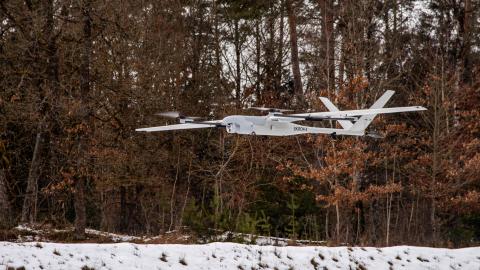
The Army substantially revised both FVL programmes based on the low survivability of rotary wing aircraft during the war in Ukraine. Army leaders cancelled the FARA programme in 2024 after spending nearly two billion dollars on research and development (R&D), deciding to instead use small uncrewed air systems (UAS) for the armed reconnaissance mission. Emulating the model demonstrated in Ukraine and Russia, Army troops would use a variety of small UAS to find, fix and even engage enemy forces.
The Army continued the FLRAA programme and awarded Bell a contract in 2022 for a longrange tilt-rotor assault aircraft called the V-280, which is now entering production. To address the vulnerability of helicopters demonstrated in Ukraine, the Army developed a new tactic for MDO in 2024 called large-scale, long-range air assault (L2A2). Under L2A2, after long-range fires and EW suppress enemy air defences, V-280s would deliver a brigade-sized group of several thousand soldiers up to 500 miles away during one period of darkness. This approach would, in theory, circumvent enemy efforts to stop the manoeuvre using small drones.
The MDO concept depends on soldiers ‘survivably’ moving at speed to take ground after long-range missiles and UAS have degraded enemy fires capabilities. To transform its approach to manoeuvre the Army planned to develop, as part of Next Generation Combat Vehicle (NGCV) modernisation, a mobile protected firepower (MPF) light tank, a robotic combat vehicle (RCV) and an optionally-unmanned troop transport to replace the Cold War-era Bradley Fighting Vehicle.
In less than a decade since it established the NGCV programmes, the Army has substantially revised or cancelled all of them. The Army cancelled the M10 Booker MPF light tank after concluding it was not survivable in a fight like that happening in Ukraine, where a 500 US dollars drone can disable a tank and kill most of the occupants. The RCV programme was renamed Unmanned Ground Commercial Robotic Vehicles (UGCRV), and is pursuing low-cost commercial autonomous vehicles that will provide mobility and fires to support MDO tactics being developed through the service’s Transformation in Contact (TIC) initiative.
The Army has made steady progress on its efforts to field assured command, control and communications (C3) through the NextGeneration C3 programme, which is using TIC to co-evolve tactics and new equipment like the TITAN command, control, communications, computers, intelligence (C4I) system. To control the electromagnetic spectrum these systems depend on, the Army radically shifted its approach to EW from vehicle-borne to man-portable systems in 2025 drawing upon lessons from Ukraine.
Air defence is the modernisation priority with the most unknowns at this point. The Army is fielding a comprehensive integrated air and missile defence (IAMD) C2 system called the Integrated Battle Management C2 System (IBCS), along with a new Lower Tier Air and Missile Defence Sensor (LTAMDS) for the Patriot system. Both of these programmes are in production. Poland was the first international customer for IBCS and conducted a live fire exercise in 2025 combining IBCS with a domestic surface-to-air missile system.
Patriot and IBCS are designed for strategic or national air defence rather than protecting troops on the move. The Army is addressing those needs with the Indirect Fire Protection Capability (IFPC), a vehicle-mounted system which carries 18 AIM9X Sidewinder or AGM-114 Hellfire missiles to engage threats up to 10 km away. Closer in, the Army’s vehicle-mounted short-range air defence (SHORAD) systems like the SGT STOUT and Avenger use Stinger missiles and guns to shoot down aircraft within a few kilometres.
1.3 Joint All-Domain C2
The most significant investment in MDO at the joint level is the US Department of Defence’s (DoD) Joint All-Domain Command and Control (JADC2) initiative. While the other services diverged from MDO in their own doctrine and programmes, joint and DoD-wide leaders focused on developing new capabilities to connect sensors, shooters and commanders across domains and
services under JADC2. DoD leaders originally envisioned JADC2’s goal as creating a dramatically more interoperable military. But the difficulty of upgrading multiple generations of C2 systems and networks to be compatible became too difficult and the DoD has since downscaled its ambitions to focus JADC2 on specific kill chains needed to address combatant commanders’ key operational problems.
The DoD mounted a series of Global Information Dominance Experiments (GIDE) that connected forces and commanders across theatres and domains. To complement this overall joint effort, the Navy began Project Overmatch and the Army started Project Convergence to assemble priority kill chains across domains and services. These service experimentation campaigns have yielded substantial interoperability improvements in a bottom-up manner.
1.4 Transforming for the future
Army leaders recognised in 2024 that the MDO concept and its enabling capabilities were not adapting quickly enough to the operational environment reflected by the war in Ukraine. They initiated TIC to experiment with uncrewed vehicles, counter-UAS capabilities and new systems and tactics for sensing and C3 in contested environments.
Instead of a traditional approach, which would push new systems out to units and train them on their use, TIC provides Army units new systems just before or during their time at the Army’s major training centres and asks units to both assess the systems’ utility and develop tactics that best exploit them. With TIC, the Army has again reformed its priorities for MDO to be C3, long-range fires from rocket artillery or drones, and air defences in the form of counter-UAS systems.
MDO has undergone many changes in the decade since its emergence. Instead of quickly gaining ground after adversary air defences and long-range fires are suppressed, infantry and armour units now must contend with a highly contested electromagnetic environment dominated by small drones. Through TIC, Army leaders hope to ensure the Army remains relevant to a rapidly changing operational environment.
Read the full document in Istituto Affari Internazionali (IAI).