





















Executive Summary
- Battlefield assessment. The battlespace remained largely stable despite intense fighting, with Russian pressure again concentrated around Huliaipole, Kostiantynivka, and Pokrovsk.
- Ukrainian strikes. Ukraine’s long-range strike campaign continued to disrupt Russian logistics and impose further strain on the country’s beleaguered fuel-supply system.
- Ukraine’s Flamingo missiles. Ukraine used its indigenous Flamingo FP-5 missile to strike military-industrial, oil, and logistics nodes in the Russian city of Volgograd, forcing Moscow to defend an expanding battlespace.
1. Battlefield Assessment
Open-source intelligence revealed no major changes in the battlespace last week. The Ukrainian General Staff again reported a heightened operational tempo, with more than 200 tactical engagements occurring nearly every day.
Huliaipole, Kostiantynivka, and Pokrovsk continued to absorb the bulk of Russia’s offensive push. According to Ukrainian tactical commanders, mid-range strikes are critical in disrupting the Russian war machine’s logistics routes and holding the line in important sectors, particularly Huliaipole.
Lyman, Sloviansk, and Kramatorsk also remained important flashpoints. Despite heavy casualties, the Armed Forces of the Russian Federation have been boosting their combat deployments. Roughly 720,000 Russian personnel are serving in occupied Ukraine as of June 2026. Nonetheless, the Ukrainian General Staff reported that Kyiv holds a favorable 1.5:1.0 ratio of first-person-view drones over Russia’s forces.
Ukraine’s systematic deep strikes produced growing signs of a developing fuel crisis in Russia. Russian President Vladimir Putin convened an emergency meeting to address the issue, while Russia’s federal statistics agency, Rosstat, reportedly halted publication of its consumer price bulletin.
2. Ukraine’s Flamingo Missiles Join the Fray over Volgograd
On the night of June 26–27, Ukraine’s deep-strike deterrent once again demonstrated that its reach is no longer limited to occupied Ukrainian territory. According to remarks by Ukrainian President Volodymyr Zelenskyy, a Ukrainian salvo targeted the Titan-Barrikady plant in the Russian city of Volgograd.
The plant is a major Russian military-industrial facility involved in producing artillery and missile launch systems, including at least two intercontinental ballistic missiles and the Iskander-M tactical ballistic missile. A fire reportedly broke out on the plant’s premises after the strikes, while Russian authorities later acknowledged that Volgograd had come under attack.
Ukraine’s targets—artillery plants, missile-launcher component facilities, oil-pumping stations, and logistics nodes—form the connective tissue of the Kremlin’s war machine. By striking these targets repeatedly, Kyiv is attempting to compress Russia’s strategic rear, complicate its repair and production cycles, and force Moscow to defend a much larger battlespace.
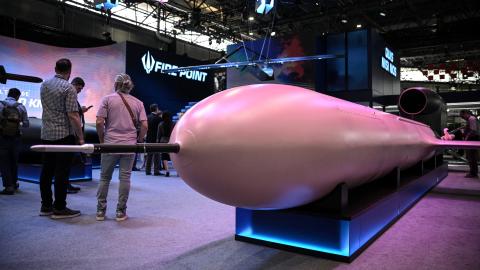
Ukraine’s weapon of choice in its strike on Volgograd is equally noteworthy: its own indigenously produced FP-5 Flamingo missiles, manufactured by the Ukrainian company Fire Point. The co-owner and chief weapons systems designer of the manufacturing company posted a video of the attack on X, in which he noted the missile’s “beautiful” flight.
With a reported range of roughly 1,860 miles and a 2.5-ton warhead, the Flamingo is among the largest and longest-range ground-launched cruise-missile systems currently in operation. Its significance lies in its range, payload, and design philosophy.
The Flamingo made its combat debut last year and saw action in 23 different strikes between August 2025 and March 2026. Its visible antenna configuration, combined with its lack of electro-optical or infrared sensors, suggests that the missile is unlikely to possess a high-bandwidth, beyond-line-of-sight data link. The projectile may possess a more limited data link sufficient for telemetry or for in-flight reprogramming, but the Flamingo’s architecture hints that it is optimized for deep-strike capabilities at scale rather than complex terminal-phase target acquisition.
Moreover, the FP-5 Flamingo appears to reflect Ukraine’s wartime preference for scale, affordability, and rapid production over advanced engineering. Rather than employ specialized, miniaturized turbojets or turbofans, the propulsion systems normally associated with advanced long-range cruise missiles, the Flamingo reportedly uses a locally produced Ivchenko AI-25TL turbofan, originally designed for manned aircraft. This choice allows for a large missile while reducing the Flamingo’s dependence on expensive, tightly controlled propulsion technologies.
The same logic applies to the missile’s guidance and control architecture. There is no clear evidence that the Flamingo uses terrain contour matching or Digital Scene Matching Area Correlator, the guidance methods often associated with more sophisticated cruise missiles. Instead, the system relies on satellite navigation, jam-resistant controlled-reception-pattern antennas, and open-source ArduPilot autopilot software. It is a wartime instrument designed to be produced and launched at scale.
3. What to Monitor in the Coming Weeks
On June 30, President Zelenskyy announced that Ukraine had concluded an agreement with Sweden to acquire 16 Swedish Gripen E fighter aircraft, along with associated equipment, technical assistance, and support. Under earlier arrangements reached with Sweden’s prime minister, Ulf Kristersson, Ukraine is also expected to receive its first 16 Gripen C/D fighters in early 2027. In the coming weeks, Ukrainian pilots and ground crews will likely begin training on the aircraft with Swedish teams, while Russia increases its pressure on Sweden to reduce its support for Ukraine.