



















Executive Summary
- Battlefield assessment. Russian forces retained the offensive initiative in land warfare, waging at least 200 combat engagements a day. Huliaipole, Pokrovsk, and Kostiantynivka remained the conflict’s primary pressure points, while Ukraine expanded its interceptor drone operations.
- Ukraine stress-tests Russia’s occupation of Crimea. Ukraine’s deep-strike campaign began to stress Russia’s rear areas and the systems that sustain the Kremlin’s control over the Crimean Peninsula. Strikes on Kapotnya, near Moscow, and on Crimea’s fuel, rail, power, and air-defense targets presage a likely increase in strategic pressure.
- What to look for. TrophyLab, a new Ukrainian effort to share intelligence gathered from captured Russian weapons, could provide Kyiv’s allies with increased access to information about Russian systems, components, vulnerabilities, and test data.
1. Battlefield Assessment
Military activity remained heightened across the Ukrainian battlespace, with Kyiv and Moscow conducting at least 200 combat engagements a day. Huliaipole, Pokrovsk, and Kostiantynivka again bore the brunt of Russia’s offensive push, while Orikhiv, Oleksandrivka, Lyman, Sloviansk, and Kramatorsk also saw combat.
The Russian military continued to maintain its offensive footing in land warfare, and sustained increased drone warfare activity. In return, Ukrainian forces ramped up their interceptor drone operations.
Ukraine’s deep-strike campaign imposed rising costs on Russia far beyond the battlefield. Recent Ukrainian attacks have reached targets in Moscow, including energy infrastructure, factories linked to Russia’s defense industry, logistics nodes, and other industrial sites.
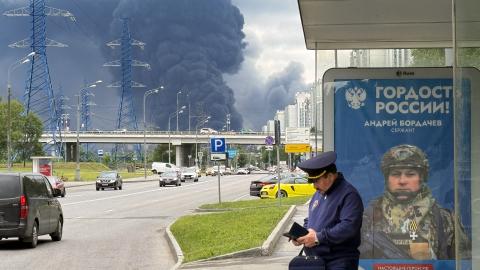
Ukrainian strikes on the Kapotnya Refinery illustrate this development. Drones struck the facility in southeast Moscow on June 18 for the second time in three days, causing large explosions, a major fire, and heavy black smoke over the city. Ukraine’s General Staff later released satellite imagery showing damage at the site. The refinery lies inside the capital’s ring road, roughly 10 miles from the Kremlin, making the Ukrainian strikes both operationally and politically significant.
2. Ukraine’s Military Stress-Tests the Russian Invasion in Occupied Crimea
Ukraine’s medium-range strike program, initiated under the country’s defense minister, Mykhailo Fedorov, is increasingly turning occupied Crimea into a logistics nightmare for Russian President Vladimir Putin. Kyiv’s campaign in the peninsula has moved beyond episodic strikes on high-value assets and now targets Crimea’s fuel supply, rail access, power grid, air-defense network, and rear-area military movements.
Ukrainian officials describe the concept guiding their Crimea campaign as a “logistics lockdown” involving strikes against Russia’s operational depth, including storage sites, command nodes, equipment, and supply routes. Kyiv has also allocated additional funding for middle-strike assets, a class of unmanned, artificial intelligence–assisted aerial drones optimized to strike targets at operational depth. This concept reflects Ukraine’s effort to institutionalize its attacks rather than treat them as one-off raids.
The campaign’s most visible effect is Crimea’s fuel crisis. On May 22, Russia began fuel rationing in Sevastopol, the peninsula’s largest city, limiting fuel sales to roughly five gallons per vehicle. By June 21, the government had reportedly suspended gasoline sales to civilians.
Ukraine’s strikes have destroyed the routes and the storage architecture that supply Crimea. Ukrainian drones have struck vehicles, including fuel tankers, along the land corridor in occupied southern Ukraine, and have also damaged fuel infrastructure inside Crimea, including the Feodosiia Maritime Oil Terminal, the Semykolodezianska oil depot, and the ATAN fuel depot near Simferopol.
Bridges have become another pressure point. Ukrainian forces previously destroyed the Chonhar Bridge, a road bridge to the peninsula, forcing freight traffic onto longer, more vulnerable routes. On June 22–23, Ukraine’s Special Operations Forces also attacked the railway bridge over the North Crimean Canal near Rozdolne in a two-phase operation. The first strike damaged the rail line, collapsing one span of the bridge. The second strike destroyed repair equipment and the bridge’s remaining spans. Ukrainian forces later asserted that the bridge no longer exists, though independent authorities have not confirmed the claim.
Ukraine’s latest wave of strikes also hit Crimea’s energy system. Ukrainian Unmanned Systems Command reportedly used attack drones to strike fuel reservoirs at the Kerch Thermal Power Plant, the Simferopol gas distribution station, and the West Crimea 330/110 kilovolt electrical substation. Russian occupation authorities later stated that approximately half of Crimea was without electricity and introduced preventive load-shedding measures to manage pressure on the area’s electrical grid.
Local operators also reported blackouts in Yevpatoriia, Saky, Dzhankoi, and Krasnoperekopsk, while monitoring channels reported a major fire at the Kerch plant, where a smoke plume stretched about 29 miles. Some areas of the peninsula reportedly now receive electricity only a few hours each day under scheduled supply arrangements.
Ukraine’s strikes have both highlighted and exacerbated Crimea’s structural energy vulnerabilities. Before Russia’s 2014 occupation, the peninsula relied on mainland Ukraine for more than 80 percent of its electricity. Moscow later reduced this dependency by constructing and modernizing the area’s plants—which are now targets for Ukrainian drones.
The peninsula also faces fuel vulnerabilities. Crimea’s civilian population alone consumes roughly 2,500 tons of fuel a day, while total demand on the peninsula typically reaches about 4,000 tons. Meeting that demand requires 120,000 tons of fuel each month, which is roughly the equivalent of 2,200 railway tank cars. Observers find these volumes difficult to conceal, especially as Ukraine expands medium-range drone coverage across the peninsula’s supply routes.
Ukraine is also increasing the pressure on Russia’s military presence in Crimea. In their June 23 strike package, Ukrainian forces stated they had hit more than 60 Russian military targets across the country’s occupied territories. Reported targets on Crimea included three Orion reconnaissance-strike drone launchers, a Nebo-U radar, a Pantsir-S1 air-defense system, an S-300 launcher, and a ZU-23 anti-aircraft gun. This pattern suggests that Ukraine is coupling interdiction with the suppression of Russia’s local air-defense and intelligence, surveillance, and reconnaissance architecture.
3. What to Look for in the Coming Weeks
Ukraine recently launched its TrophyLab initiative, a controlled-access platform that turns captured Russian weapons into a structured intelligence resource for its allies and partners. The platform provides vetted governments, defense firms, research institutions, and Ukrainian defense manufacturers and military units access to technical data on Russian systems. Resources include documentation, laboratory studies, component analyses, schematics, and vulnerability assessments.
Kyiv says the platform already covers more than 115 captured Russian systems across 79 categories, including assets such as the Kinzhal air-launched ballistic missile and the T-90 main battle tank. Verified users of the platform can also request physical access to captured hardware for inspection, disassembly, or destructive testing. This innovation will almost certainly accelerate the development of new countermeasures against Russian weapons.
It will be worth monitoring how the TrophyLab project is received by Ukraine’s partners in the North Atlantic Treaty Organization ahead of the alliance’s July 2026 summit.