



















Executive Summary
- Battlefield assessment. Ukraine and Russia continued to engage at a heightened operational tempo, with Pokrovsk bearing the brunt of the fighting and Russia making localized gains near Kostiantynivka and Chasiv Yar.
- Ukrainian strikes. Ukraine expanded its campaign against Russian logistics, stressing Russia’s rear-area sustainment network by striking rail assets in Bryansk Oblast and vessels in the Sea of Azov.
- Ukraine’s drone-defense innovations. As pressure mounted from Russian drones and ballistic missiles, Ukraine expanded its air-defense efforts with assistance from private-sector teams and semi-autonomous interceptor drones.
1. Battlefield Assessment
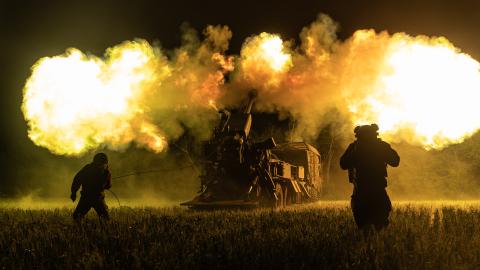
Fighting continued last week at a heightened operational tempo, as it has in recent weeks. Russian and Ukrainian forces engaged in 200 tactical engagements nearly every day.
Pokrovsk was again the most impacted region, accounting for one-fifth to one-fourth of all combat activity. Huliaipole also saw significant clashes. The battlefield geometry remained largely stable, except on the Kostiantynivka and Chasiv Yar fronts, where Russian forces continued to make tactical advances.
Ukraine’s 413th Raid Regiment, a subordinate formation of the country’s Unmanned Systems Forces, struck a Russian locomotive reportedly carrying military cargo roughly 25 miles from the Ukrainian border in Bryansk Oblast. The 413th Raid Regiment claimed that this was the third Russian train it had hit in four days.
The strike is significant because Russia remains heavily dependent on its railway system to move ammunition, fuel, equipment, and manpower over long distances. If attacks on Russian railway assets continue, such strikes could impose delays, rerouting costs, repair burdens, and rolling-stock attrition on the Kremlin’s military logistics efforts. Hitting a moving locomotive is also an advanced skill that hints at the existence of a sophisticated Ukrainian kill chain capable of detecting, tracking, identifying, and striking mobile targets inside Russia.
Additionally, on June 5, Ukraine’s Unmanned Systems Command conducted overnight drone strikes against Russian logistics vessels in the Sea of Azov, reportedly damaging five cargo ships in or near the occupied ports of Mariupol and Berdiansk, as well as in nearby coastal waters. Ukrainian drones also struck a drone facility at Donetsk Airport, though no available open-source footage exists of the facility after the strike. These attacks serve Ukraine’s wider campaign against Russian logistics, fuel infrastructure, and military facilities across the occupied territories. Crimea also continued to face significant fuel rationing, indicating growing pressure on Russia’s rear-area sustainment network.
2. As Shahed Attacks Mount, Ukraine’s Private-Sector Drone Defense Network Grows
Recent Russian drone salvos have been placing overwhelming pressure on Ukraine. In May, Russia launched a record 8,150 unmanned aerial vehicles (UAVs). Ukrainian forces claimed to intercept 7,476 of these drones, including 5,053 officially identified Shahed-type one-way attack UAVs. Ukraine recorded some 508 drones as hits, while 674 were not intercepted, placing Kyiv’s claimed interception rate at roughly 92 percent.
In May the median size of a Russian salvo reached 209 Shahed attack drones. This underscores the scale and regularity of Moscow’s mass UAV campaign. Ukraine is still intercepting most of the inbound drones Russia sends its way, but Moscow is generating record launch volumes to saturate Kyiv’s air-defense network. As a result, some drones inevitably pass through Ukraine’s defenses.
In return, Ukraine is boosting its interceptor-drone capabilities, incorporating drone-on-drone air defense into semi-autonomous combat operations. Brave1, an indigenous Ukrainian platform designed to connect companies with innovative ideas for the country’s defense, is particularly important in this effort. The platform backs a firm that has developed an interceptor system that automates roughly 95 percent of the drone-engagement cycle, from launch to terminal attack. This innovative system has already been combat-tested in the Kharkiv region.
The system works by connecting an interceptor to a radar network that tracks aerial targets in real time. A system operator then uses command software to select a target and authorizes an engagement. Once an engagement is approved, the drone autonomously conducts an intercept. In the impact phase, onboard artificial intelligence identifies and locks onto an incoming Shahed-type one-way attack UAV, while the operator remains in the loop and can opt to abort the attack at any point. Though the system is not fully autonomous, it enables an operator-authorized kill chain with autonomous guidance and AI-enabled terminal-target recognition.
Ukraine is also integrating the country’s private sector into its national air-defense architecture. On June 8, the Ukrainian Ministry of Defense recently announced that 30 companies (out of 43 applicants) had joined a pilot program authorizing them to conduct air-defense activities under state supervision. This effort aims to protect personnel, production facilities, and critical sites that are repeatedly targeted by Russian UAVs.
About half the companies authorized to participate in this program are already operators of critical infrastructure and enterprises. The remainder are private companies. Several corporate air-defense teams have started conducting assigned combat missions and have reportedly downed more than 20 Shahed-type attack drones and Zala reconnaissance UAVs, including one jet-powered Shahed-type drone.
This private-sector initiative supports Ukraine’s stated 2026 air-defense goal of detecting and destroying 95 percent of all aerial threats. By forming their own air-defense groups, Ukrainian companies are contributing directly to this national goal.
3. What to Look for in the Coming Weeks
Ukraine is under mounting pressure from Russian ballistic missile attacks and is pressing its Western allies for additional supplies of Patriot surface-to-air missile systems. How the United States and Kyiv’s European partners respond to this request will be worth monitoring in the coming weeks.