




















President Trump’s recent executive order, “Restoring Truth and Sanity to American History,” states that there has been a “widespread effort to rewrite our Nation’s history” and promote a “distorted narrative driven by ideology rather than truth.” To address that, Trump calls for “revitalizing key cultural institutions and reversing the spread of divisive ideology.”
Critics charge that Trump’s order, issued in late March 2025, is an attempt to whitewash and sanitize American history in federal institutions, ignoring slavery and other “uncomfortable” issues.
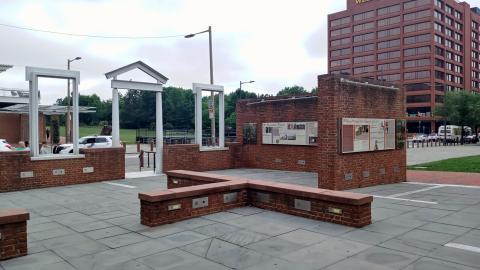
These arguments are set to come to a head before a three-judge panel in Philadelphia’s Third Circuit Court on June 2. As we approach America’s 250th anniversary, the controversy before the court pits two very different interpretations of how to portray the President’s House in National Independence Historical Park in Philadelphia, which is managed by the Interior Department’s National Park Service (NPS). The President’s House is the site where George Washington and John Adams lived during their presidencies in the 1790s, before Washington, D.C. and the White House were built.
In 2010, after an eight-year campaign by a local activist organization, Avenging The Ancestors Coalition (ATAC), working in conjunction with the Democratic political leadership of the city of Philadelphia, the President’s House exhibit opened. After more than half a decade, ATAC and the city of Philadelphia succeeded in pressuring the National Park Service to accept an exhibition at the President’s House site centering almost exclusively on the evils of slavery in George Washington’s household during his presidency.
It is perhaps not completely inappropriate to note that the founder and most prominent member of Avenging The Ancestors Coalition, Michael Coard, declared in a column in The Philadelphia Tribune that “July 4th is a celebration of kidnapping, transporting/buying/selling human beings, separating families, torture, whippings, rapes, castrations, lynchings and enslavement.” Coard further remarked that African Americans who celebrate July 4th are either “ignorant or traitors or they’re both.”
Jeffrey Anderson, writing in RealClearPolitics, states that George Washington, the “biggest hero of the American Revolution, was portrayed as the chief villain” at the President’s House site. The Philadelphia city-activist interpretation focuses primarily on denouncing Washington’s character. Describing the exhibit as a one-sided disparagement of Washington would be an understatement. Washington’s actions are described as “deplorable,” “profoundly disturbing,” and having “mocked the nation’s pretense to be a beacon of liberty.” Washington is accused of “injustice” and “immorality.” Signage at the exhibit decry “Washington’s Deceit” and suggest his death offered the possibility of leading to better days, “Washington’s Death and a New Hope of Freedom.”
There are 30 signs at the exhibit, 25 of which deal with slavery or race relations. The New York Times cultural critic noted that the President’s House is historically significant for the most part because its residents, “Washington and Adams were shaping the new country,” but that the exhibit was presented “almost as if it were the Slave Market of Charleston.”
In January 2026, the National Park Service, at the direction of the Department of the Interior, began to implement President Trump’s executive order “Restoring Truth and Sanity to American History” by removing the signs from the President’s House with the aim of replacing them with a more accurate, truthful, and comprehensive interpretation of the significance of the site. In response, the city of Philadelphia sued to block the removal of its signage, citing an earlier agreement with the Park Service as giving it a voice in the matter. Federal District Court Judge Cynthia Rufe ordered the signs to be reinstated. Then an appeals court judge ordered a stay of the restoration of the original signage. All activity at the President’s House site is now halted until a three-judge panel of the Third Circuit Court hears oral arguments on June 2.
The critics of the Trump administration’s actions repeatedly make one core argument: The President’s House controversy is about historical truth. The National Park Service should present the public with the truth, particularly during America’s 250th anniversary year.
The Pennsylvania Senate Democratic Caucus filed an amicus brief supporting Philadelphia’s city-activist interpretation of the exhibit. The brief declared that the
Senate Democratic Caucus is proud to affirm that the full, truthful history of our nation, even those parts that are uncomfortable, does not change depending on who occupies the oval office… our members stand on the side of truth and the visibility of Black history in the public square particularly as we approach the Semiquincentennial….We look forward to continuing our work as defending our history as truth.
At the heart of the controversy over the President’s House is the question of the juxtaposition between freedom and slavery in American history generally, but more specifically, it is about the relationship between George Washington and the institution of slavery. What is true? What is accurate? What is the “full” history? Is Philadelphia’s city-activist interpretation of George Washington and slavery, which is supported by the Pennsylvania Senate Democratic Caucus, a true, accurate, and full history, as the caucus contends? Of course not.
The activist’s interpretation is a crude polemic that omits what is most important. Washington’s actions and beliefs on slavery have been the subject of long study and exhaustive documentation for historians. The current exhibit ignores all serious historical scholarship on Washington and slavery. The Trump administration’s Interior Department offers a credible alternative to the deeply flawed Philadelphia city-activist exhibit. The proposed changes are on the Interior Department’s website.
Moreover, the Interior Department’s alternative does not “erase” or “whitewash” references to slavery at the President’s House during Washington’s administration. The old section on “Enslaved Members of Washington’s Household” that lists all nine slaves and their biographical details is retained in the proposed new version.
The Interior Department’s signage adds important information to an understanding of how Washington confronted the slavery issue. For example, the Interior Department noted:
As president, he [Washington] signed legislation that both upheld and limited slavery. In 1793 he approved the Fugitive Slave Act…. He also signed measures restricting slavery’s expansion, including the 1789 Northwest Ordinance, which banned slavery in the Northwest Territory and the 1794 Slave Trade Act, which barred the participation of American ships in the Transatlantic slave trade.
Even before the Declaration of Independence, the Interior framework states, “In 1774, Washington helped draft the Fairfax Resolves at Mount Vernon that condemned the slave trade as ‘wicked,’ ‘cruel,’ and ‘unnatural,’ and called for putting ‘an entire Stop’ to it.”
The Interior Department alternative also noted,
Washington did take steps to reduce slavery in his own household. He opposed buying and selling enslaved people and sought ways to decrease the number at Mount Vernon…. In his last will, Washington freed his personal enslaved workers and made provisions that the elderly and sick be supported by his estate for the rest of their lives. He also insisted that the formerly enslaved children be taught to read, write, and work a useful trade.
The Interior Department concluded that “although Washington placed national unity above immediate abolition, he hoped for gradual legislation that would eventually bring slavery to an end.”
The Pennsylvania Senate Democratic Caucus emphasized the “visibility of Black history in the public square, particularly as we approach the Semiquincentennial.” Yet the Philadelphia-activist interpretation (which the caucus supports) focuses almost entirely upon the nine slaves in Washington’s household, whereas the Interior Department alternative (which the caucus denigrates) provides a capacious and comprehensive overview of black history from the 18th century to the present. This includes the significant role played by African Americans in the abolitionist movement; the importance of the underground railroad; four paragraphs on the milestones in the career of Frederick Douglass; discussions of the Civil War; the Supreme Court’s Brown v. Board of Education decision, and Martin Luther King’s “I Have a Dream” speech. Most of these events were not even mentioned in the Philadelphia-activist exhibit.
Ben Jealous, former head of both the NAACP and the Sierra Club and a supporter of the original signage, wrote that the argument over the President’s House “is a fight over whether America is strong enough to tell the truth about itself.” Yes, by all means, let us tell the truth and the “full truth” of America’s past. There is no doubt that in the search for truth at the President’s House, the Interior Department’s interpretation is much closer to the mark than the original Philadelphia-activist exhibition.