














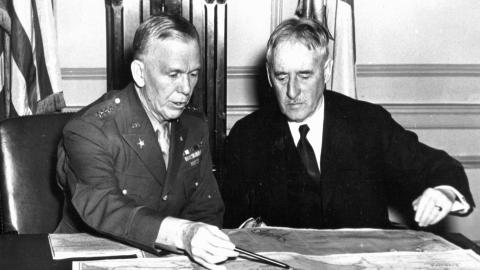
Of those never to have occupied the presidency of the United States, George Marshall may be the greatest American of the twentieth century. Marshall was the “organizer of victory” in the Second World War, as Churchill put it. His administrative acumen was surpassed only by his dignified bearing, born of a deep humility, which infused everything he did with competence and leadership. Marshall radiated greatness because he was totally selfless.
It is therefore all too fitting that Marshall, as secretary of state, did nothing to telegraph to the public that he would deliver one of the most important addresses in American history at Harvard University in June 1947. Harvard had offered the decorated statesman an honorary degree, but instead of accepting it with the sort of perfunctory remarks that characterize such occasions, Marshall took the opportunity to announce a European recovery program. He outlined with perspicacity how Europe might escape the cycle of war that had led to its ruin and “the vicious circle” of privation that was destroying it in the late 1940s.
In his speech, Marshall recognized that American leadership in Europe was indispensable to peace. He called on the American people to jettison the isolationism of the interwar years and “face up to the vast responsibility which history has clearly placed upon our country.” But he also placed the onus for what became known as the Marshall Plan on Europe. “The initiative,” Marshall argued, “must come from Europe [and] be a joint one, agreed to by a number, if not all European nations.” In other words, Marshall envisioned European collaboration supported by the United States.
Crucially, Marshall rejected those powerful voices at home and abroad who called for exceptionally punitive terms for Germany. Instead of permanently repressing or dismembering Germany, Marshall aimed to unlock its economic and military potential for the West. By putting European skin in the game and resuscitating Germany, Marshall turned an economic support program into a boon for the U.S. economy.
It also positioned the United States for success in the Cold War. Just a few months earlier, Marshall had departed meetings in Moscow at loggerheads with the Soviets. In his speech at Harvard, he went on offense. Marshall announced that his plan “is directed not against any country or doctrine but against hunger, poverty, desperation and chaos.” He added that “its purpose should be the revival of a working economy in the world so as to permit the emergence of political and social conditions in which free institutions can exist.” Marshall understood that Moscow had no intention of letting its satellites participate in a recovery program meant to foster freedom, autonomy, and cooperation. By rejecting Marshall’s plan, the Soviets revealed the totalitarian nature of their system.
It is no exaggeration to say that the Marshall Plan set the post-war foundation for what became the transatlantic world. The fact that politicians and analysts still regularly invoke it to sell their own proposals today testifies to its near universal acclaim. George Marshall ranks amongst the very best of his generation.