












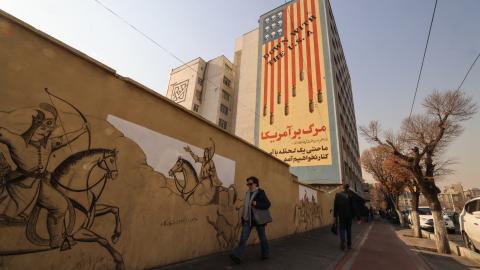
Two parties to the “memorandum of understanding,” the road map for ending the Iran war, view the deal differently. Supporters in Washington believe it’s a diplomatic triumph, a way to reduce tensions and the price of energy. Supporters in Tehran consider it an ideological victory, a deal that confirms the regime’s claims to dominate the Strait of Hormuz and project power in the Middle East.
If the agreement holds, the Iranians could receive more than $300 billion through an economic reconstruction fund, sanctions relief, expanded oil exports and unfrozen assets. That is reminiscent of the 2015 nuclear deal but at three times the price. The hefty bill will only get more expensive if the West has to bolster its own defenses in return. Skeptical observers want to know: How much extra security spending will be necessary if Iranian terror groups receive the biggest injection of funds in a generation?
Recall what happened a decade ago. Once the Obama administration eased sanctions as part of the Joint Comprehensive Plan of Action, the Iranian regime got to work. It spent billions on the Islamic Revolutionary Guard Corps’ support for the Assad regime in Syria and on Hezbollah in Lebanon, Hamas in Gaza and the Houthis in Yemen. The delay to Tehran’s nuclear program was matched by an acceleration in terrorism. Agents laundered money, exploited corrupt governments and targeted enemies abroad.
Some in Europe have viewed Iran as a regional problem, but geography is shrinking. In October 2025, the director general of MI5, Britain’s domestic security agency, said the country had tracked more than 20 potentially lethal Iran-backed plots in the past year alone. A parliamentary committee added that “the Iranian Intelligence Services have shown that they are willing and able,” often through third parties, to attempt kidnappings or assassinations of regime critics and political opponents — wherever they reside.
Tehran’s influence campaigns have evidently moved online too. Pro-Scottish independence accounts — some of which regularly criticized the king and advocated “death to the Union” — recently went silent when the internet was shut off in Iran. Other operations to spread division, including through charities in Britain, reflect the same pattern of interference.
Despite Tehran’s track record, the world is now being told not to worry. As Vice President JD Vance said, there is a transformation underway in the Iranian political system. The agreement, he added, establishes “a structure whereby if the Iranians behave like a normal country, then we want to treat them like a normal country and welcome them into the world economy.” But the deal rewards Iran without it behaving normally, and there’s no indication it wants to do so anyway.
Look at the past four months of conflict. Since the death of the last supreme leader and the disappearance of his replacement, the IRGC has largely taken over the state. The rotten fruits include dispersed missile forces, active proxy networks and corrupted sectors of the economy. Each confirms that the radical guards aren’t a normal military institution subordinate to a civilian government. They aren’t interested in serving their fellow citizens but in killing ours. Whatever any treaty says, once new money is in the country, it will allow funds once spent on essentials to be used to spread hate. No deal will tie the hands of the IRGC.
There is a lot of mess to be made with $300 billion. Intelligence officers, criminal intermediaries, surveillance teams and proxy actors cost a fraction of what many states spend on tanks, aircraft or warships. A small diversion of funds toward intelligence, influence operations and regional terrorism could have substantial consequences.
Never mind that Iran also operates some of the world’s most advanced drones. Tehran has already invested in South African technology, which Moscow has reportedly used to deadly effect in Ukraine. A windfall for the mullahs will aid that development.
History suggests, then, that this deal is more expensive than the fine print lets on. The price won’t be paid only by Gulf states or measured in diplomatic communiqués. It will accrue in intelligence budgets, police operations and counterespionage investigations. A richer Iranian regime will be a more violent regime, costing lives in the region and threatening others around the world. That means national security services will face more hostile state activity and a new urgency in detecting and disrupting threats. London’s MI5, Washington’s FBI and Paris’s equivalent, the DGSI, will be among the agencies needing more resources for that fight.
The White House may believe the benefits outweigh the risks. For Britain and others, that equation isn’t as clear. What is certain is this: Current spending on defense and intelligence won’t keep pace with a threat that could be trebled — or more — by a richer terrorist regime.