

Hong Kong’s Jimmy Lai is a hero for all people who cherish the fundamental freedoms of speech, press and religion. Yesterday, he was falsely convicted of foreign collusion and other vague national security crimes because he stood up for these principles.
Hong Kong’s kangaroo court will next hand down the unjust sentence, which could mean actual or effective life imprisonment for the 78-year-old and ailing Lai, a Catholic.
When Lai was imprisoned and thrown into solitary confinement five years ago, he was well known as an ardent champion of Hong Kong’s democratic system, free society and rule of law — Hong Kong’s separate system that the Chinese Communist Party promised to respect when the U.K .transferred the territory to it in 1997. The party predictably broke its promise and in 2020 began its crackdown on Hong Kong in earnest with the imposition of the National Security Law.
Lai was among those in the first wave of arrests. The party couldn’t tolerate his lighting a candle at a vigil of remembrance for the victims of Tiananmen Square, his peaceful dissent against creeping communist tyranny over Hong Kong or his role as founder and writer for his newspaper, the Apple Daily.
Lai always followed his star. A lifelong search for freedom and truth may have been shaped by the fact that the Communist Party labeled his mother as a “class enemy” and imprisoned her in a labor camp during his childhood. At 12 years old, he became a stowaway on a boat from Guangzhou seeking economic freedom in Hong Kong.
Starting as a worker on the factory floor of a textile factory, he founded his own garment company in his 20s. He became a billionaire at the end of the Mao era when many Chinese shed the drab suits signifying ideological conformity for Lai’s colorful and affordable apparel.
Mark Clifford, a friend of Lai’s who wrote a wonderful biography of him last year, entitled The Troublemaker, notes that Lai was self-educated and, as an adult, was deeply impressed after reading Friederich Hayek’s The Road to Serfdom on free market capitalism.
In the decade after the 1989 Tiananmen Square massacre, Lai sold his company and put his money into founding Next Digital media and Apple Daily, which he ensured was a free press. He wrote frequently and feistily in it in defense of democratic freedoms.
His position as a billionaire businessman and media mogul, and a citizen of both China and the United Kingdom, led him to travel widely, maintain homes in several countries and naturally to meet with many foreign officials along the way. All of this was held against him at the sham trial.
In 1997, he converted to Catholicism and was baptized by Hong Kong’s Cardinal Joseph Zen Ze-kiun. The Wall Street Journal’s William McGurn served as his godfather. Alone in his cell, he spends lonely hours drawing sketches of the Crucifixion, one of which hangs on the wall of the business school of The Catholic University of America.
Mark Simon, Lai’s financial adviser, told me Lai gave generously to the Catholic bishops in Hong Kong and helped rebuild churches on the mainland that were destroyed during the Cultural Revolution. Neither those bishops nor anyone among China’s 1.4 billion people, are free to speak out for him now in his time of need. This speaks volumes about China’s forced absolute conformity of expression.
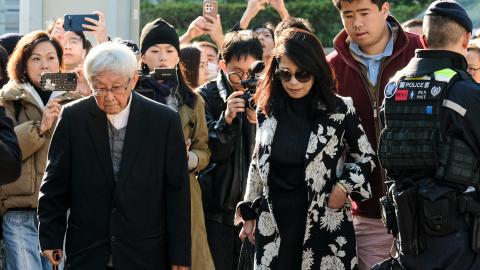
Hong Kong officials took a page from the CCP playbook in creating the deception that Lai is the dangerous subversive that they charged him of being. Each day in court of the two-year trial, they transported him in a police van with a motorcade. Snipers were stationed on top of bridges and rooftops all along the route. Security lined the streets and police barracked sidewalks.
Lai was kept shackled. When he wasn’t in court, he was locked up in a maximum security prison, alone in an entire cell block. “It’s as if they were expecting Seal Team Six to parachute in and evacuate him,” Simon told me. “It made no sense.”
Hong Kong’s chief executive, John Lee Ka-chiu, added to the Orwellian scene when he told reporters upon the announcement of the verdict, “The judiciary is confident and unafraid of any intimidation and firmly discharges its responsibilities to safeguard national security.”
Lai’s daughter, Claire, recently met me at my Hudson Institute office in Washington to discuss her father’s case. She said he suffers from diabetes, high blood pressure and other diseases developed over his long years of solitary confinement. Last summer, he developed heart palpitations that delayed court proceedings for several days.
Claire had been allowed to visit him in prison for less than an hour, periodically. She showed me images of a cell that is similar to his. It is a small cement rectangle with no view of the outdoors. Lacking air conditioning, it is sweltering for much of the year. He has no neighbors in the surrounding cells. She and her family worry that Lai’s health will continue to deteriorate and that he may never taste freedom again.
Lai had the means to leave Hong Kong before his arrest, but he didn’t on principle.
“When you lift yourself above your own self-interest, you find the meaning of life. ... The way I look at it, if I suffer for the right cause, it only defines the person I am becoming,” he once said. When the court condemned Jimmy Lai, it showed the world the hero he has become — and the People’s Republic of China’s tool that Hong Kong now is.