













This memo reviews how the Czech defense industry is strengthening the transatlantic alliance, topics which will be covered in depth during the Czech-US Defense and Security Forum at Hudson Institute on October 13, 2026.
Europe is facing its gravest defense crisis since the early days of the Cold War. Russia’s invasion of Ukraine illuminates what peacetime assessments rarely reveal: Europe remains structurally dependent on the United States for the full spectrum of high-end warfighting capabilities, from precision strike and strategic lift to command architecture.
Until now, nearly all of Europe’s militaries have operated under the North Atlantic Treaty Organization (NATO) framework and have essentially served as modular components of an American-led force. Though Europe may eventually emerge as an autonomous actor, that process would take years. Transatlanticists, therefore, should update and adapt NATO to ensure the alliance can continue to deter adversaries via partnerships that increase allied capabilities through the reinvigoration of a scalable and responsive defense industrial capacity.
The Czech Republic offers some guidance. Over 27 years of NATO membership, the Czech Republic has grown into a reliable contributor to collective defense and a promoter of strategic stability. This safe and predictable environment in central Europe provides the firm foundation for today’s strong business and investment ties between the US and Czechia. While headlines have focused on Prague’s recent commitment to allocate only 1.7 percent of its gross domestic product to defense spending,[1] policymakers should not ignore lessons from the country’s innovative approach to defense partnerships, a number of which were discussed during NATO Secretary General Mark Rutte’s visit to Prague in April.[2]
The Czech Republic became a key defense partner after its accession to NATO over two decades ago. At that time, Prague swiftly reorganized its command structures, modernized its equipment, and shifted its training priorities to emphasize interoperability and meet NATO standards. It also developed specialized electronic warfare; surveillance; and chemical, biological, radiological, and nuclear (CBRN) defense capabilities that remain the envy of the alliance. These reforms made Czech contributions respected and reliable within NATO and bolstered collective alliance capacity.
Fast forward 20 years, and the Czech Republic is adapting again.
Czech Ammunition Initiative
When the history of the war in Ukraine is written, the Czech Republic’s efforts will deserve a chapter. After Russia launched its full-scale invasion of Ukraine in February 2022, Western production lines could not meet Kyiv’s voracious demand for weapons. To solve this problem, Prague launched an ammunition initiative. Utilizing their connections, especially in non-Western regions, Czech officials identified caches of large-caliber artillery worldwide and worked with willing donor countries in Europe to purchase those assets. Last year, the initiative “accounted for 43 percent of the total ammunition supplied to Ukraine.”[3]
The result was one of the war’s most creative and successful supply efforts. Last year, for example, the Czech ammunition initiative supplied Ukraine with nearly two million rounds. In some categories, the program surpassed the collective output of Europe’s defense industrial base and, by some assessments, accounts for more than half of all large-caliber artillery ammunition reaching Ukraine’s military today.
The initiative is as architecturally elegant as it is innovative. Prague does not manufacture weapons but aggregates them from a larger pool. It identifies and coordinates procurement of NATO-standard and Soviet-legacy ammunition and then routes deliveries into Ukrainian stockpiles through established logistics channels, bypassing Europe’s production bottlenecks. It taps global inventories that no single European government has the will or infrastructure to exploit at scale.
While the Czech ammunition initiative has proven instrumental in supporting Ukraine, it has also helped refute the contention that Europe is a mere supplicant in the transatlantic relationship, forever awaiting action from Washington.
Czech Modernization and Integration
The Czech Republic has sought to redress the perception that Europe is not investing enough in its own defense. In 2024, Prague decided to acquire 24 F-35A fighters,[4] marking a generational break from its aging fleet of Swedish JAS-39C Gripens. What followed made fewer headlines but may prove even more significant: the finalization of 11 industrial cooperation frameworks[5] that bring Czech firms and academic institutions into the F-35 supply-and-sustainment architecture.
Production of the Czech F-35 aircraft is scheduled to commence in 2027, with delivery set to begin in 2029 and continuing into the mid-2030s.[6] This timeline puts the Czech Air Force squarely within the expanding European F-35 operator pools. With Europe projected to soon possess more than 700 F-35s, the fighter jet is rapidly becoming the keystone of NATO’s future airpower architecture. Due to the aircraft’s unrivaled stealth, sensor fusion, and information superiority capabilities, the Czech Republic will soon sit in an elite club.
There are substantial costs associated with the F-35 upgrade, as well as other aspects of military defense. All of these will require the Czech Republic to maintain larger defense budgets in the years to come.
Reindustrializing America
The Czech Republic has also distinguished itself in outbound investment. Prague’s foreign direct investment (FDI) into the United States is pioneering a new form of transatlantic defense cooperation. From the Česká zbrojovka Group SE (CZG)[7] acquiring the iconic Colt brand in 2019[8], the Czechoslovak Group (CSG) purchasing Vista Outdoor’s ammunition business, the Kinetic Group in 2024,[9] to PBS Aerospace opening a manufacturing facility in Georgia.[10] Czech private capital is active in the US and projected to grow further. This model, in which European private defense companies invest in America, is a rarity. Data from Jagello 2000 presented at the 2025 Czech-US Defense and Security Forum underscores substantial Czech defense investment that supports 5,000 employees across 12 states (see figure 1).
Figure 1. Czech Defense Investments in the US
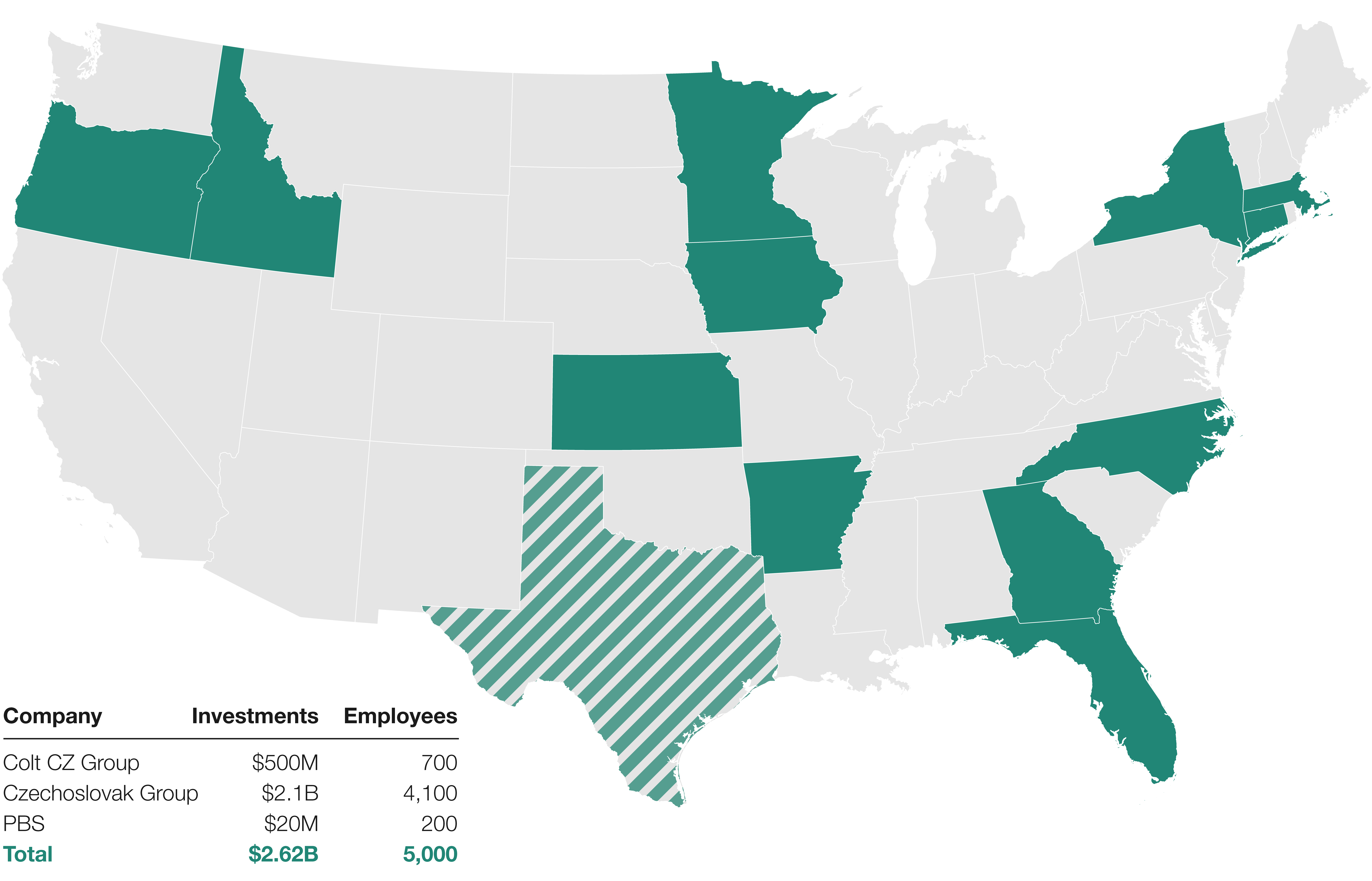
Source: Jagello 2000 Association.
In addition to lessening friction over tariffs, Czech defense investments contribute directly to one of the few areas of bipartisan agreement in Washington: the reindustrialization of the US heartland.
The Path Ahead
Although more than half of European and American FDI is transatlantic,[11] investment in defense has struggled to overcome significant regulatory barriers and cultural sensitivities. It is well past time for this to change.
To that end, US policymakers should offer streamlined processes to investors from NATO countries, rather than subject them to layers of bureaucracy. When it screens incoming investments, the United States should meaningfully distinguish between a treaty ally and a third country or an adversary. Washington should also work with allied governments to build legal barriers against shell companies that adversaries could utilize as Trojan horses, and guard against technological leakage. Once these efforts are accomplished, the transatlantic zone should be considered a distinct defense-investment arena and should be treated differently from non-allied parts of the world.
Europe should also implement reforms. For starters, policymakers there should not use environmental, social, and governance (ESG) and other sustainability frameworks to block investments into weapons. Because Europe needs a stronger, more cohesive defense industrial base, it should incentivize institutional investors to enter the defense sector. The enormous reservoirs of capital in Europe’s national wealth funds, pension systems, and other sources should be put to good use for defense development at home and in the United States. While the NATO Innovation Fund and the Defense Innovation Accelerator for the North Atlantic (DIANA) are important initiatives, they are relatively modest undertakings that cannot bridge the gap between American and European venture capital investments in defense.
The Czech Republic can provide a case study for how to proceed. This may seem counterintuitive when the current US administration has criticized the Czech government for its defense budgets. But the country’s decades-long defense innovation efforts speak volumes. Prague’s status as a frontline ally that has supported Ukraine, procured major US weapons systems, and spawned defense companies with a presence in the United States makes it worthy of study. Like the Czech Republic, other European countries should position themselves not just as defense customers but as transatlantic defense industrial partners.
While the transatlantic alliance’s future is uncertain, following the Czech example offers NATO the best chance of success.
Endnotes
- Karel Janicek, “Czechs Won’t Meet NATO Defense Spending Target under Populist Leader Babiš,” Reuters, March 11, 2026, https://apnews.com/article/czech-defense-spending-nato-trump-f66498682218a609a37fd2ea5647dfbd. ↑
- “NATO Secretary General Visits Czechia to Discuss Euro-Atlantic Security with Prime Minister Babiš,” North Atlantic Treaty Organization, April 16, 2026, https://www.nato.int/en/news-and-events/articles/news/2026/04/16/nato-secretary-general-visits-czechia-to-discuss-euro-atlantic-security-with-prime-minister-babis?selectedLocale=. ↑
- “Czech-Led Ammunition Programme for Ukraine Can Continue, PM Says,” Reuters, January 6, 2026, https://www.reuters.com/world/czech-led-ammunition-programme-ukraine-can-continue-pm-says-2026-01-06/. ↑
- Jangoulun Singsit, “Lockheed Martin Signs All Industrial Projects for Czech F-35 Programme,” Air Force Technology, March 20, 2026, https://www.airforce-technology.com/news/czech-f35-programme-lockheed-martin/. ↑
- Singsit, “Lockheed Martin Signs All Industrial Projects.” ↑
- Jérôme Brahy, “Lockheed Martin Completes 11 Agreements with Czech Industry for F-35 Stealth Fighter Program,” Army Recognition, March 19, 2026, https://www.armyrecognition.com/news/aerospace-news/2026/lockheed-martin-completes-11-agreements-with-czech-industry-for-f-35-stealth-fighter-program. ↑
- Now Colt CZ Group SE. ↑
- “Colt Announces Closing of Acquisition by CZG,” Colt’s Manufacturing Company LLC, news release, May 24, 2021, https://www.colt.com/2021/05/24/colt-announces-closing-of-acquisition-by-czg/. ↑
- “Vista Outdoor Announces Completion of CSG Transaction,” Vista Outdoor Inc., news release, November 27, 2024, https://investors.vistaoutdoor.com/Investors/news/news-details/2024/Vista-Outdoor-Announces-Completion-of-CSG-Transaction/default.aspx. ↑
- “Gov. Kemp: PBS Aerospace Establishes North American HQ in Metro Atlanta,” Office of Georgia Governor Brian P. Kemp, news release, February 3, 2025, https://gov.georgia.gov/press-releases/2025-02-03/gov-kemp-pbs-aerospace-establishes-north-american-hq-metro-atlanta. ↑
- Daniel S. Hamilton and Joseph P. Quinlan, The Transatlantic Economy 2026: Annual Survey of Jobs,
Trade and Investment between the United States and Europe (AmCham EU, 2026), https://transatlanticrelations.org/publications/the-transatlantic-economy-2026/, 27–30. ↑