



















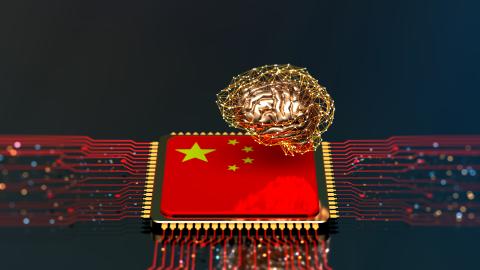
When officials in Washington warn about losing the AI race to China, the conversation turns quickly to military and economic advantage—and rightly so. Advanced AI will reshape everything from weapons systems to medicine, with massive implications for our geopolitical competitiveness. But beneath the great-power competition on AI lies a moral one. The ethical character of the most transformative technology in generations—one that will mediate an ever-larger share of human experience—will be a byproduct of superpower rivalry. At stake is the future of the relationship between individuals and the state, of privacy and control, of human agency and algorithmic authority.
The fear is not merely that China might build better systems, deploy them more widely, or out-sell American competitors. It is that those systems could carry a tide of new norms shaped by a government that surveils its citizens, suppresses dissent, harbors eugenic ambitions, and treats individual autonomy as a problem. As AI comes to dominate our lives as thoroughly as digital media already has—shaping our health and finances, how our children learn, how we are tracked, even our species' genetic makeup—this battle for AI's soul will affect us all intimately.
The contours of that battle are almost always left unexamined, but usually assume one of three forms: some leaders suggest AI's values will be a winner-takes-all byproduct of the race to technical superiority; others imply a conscious struggle to spread tools and platforms with value systems baked in; still others insist that diplomatic cooperation between AI powers is the only way to bend AI's ethical arc toward humanity's benefit. Leaving these three paradigms implicit does everyone a disservice, robbing the United States of both moral clarity and strategic opportunity.
Looking at the history of technological competition, there may be truth to all of these three models. But each implies a different approach to maintaining American leadership while preserving the values we claim to champion. And analyzing them clearly reveals how badly our attention is skewed. Today's debate fixates on breakaway dominance, blinding policymakers to the more consequential contests over encoded values and strategic diplomacy. A rebalanced approach would require something we currently lack: a clear, affirmative vision of what American AI should be for.
Breakaway Tech Dominance
“AI offers the potential promise of extending American hegemony.”
Breakaway tech dominance is the default (if often implicit) ambition for many leaders invested in the Sino-American AI competition. The thinking goes that if the US is able to master AI ahead of others, that advantage will translate into a general offset in American power over China, with powerful ripple effects in economics, culture, and politics globally. Because this winner-takes-all vision provides such a clear motivation for forging ahead, it is the one most often invoked by pro-tech voices and government leaders.
Historically, large technological advantages tend to precede hegemonic power. This dominant narrative about AI competition draws heavily on historical analogy. Britain’s industrial revolution produced not just economic advantages but also cultural ascent. British institutions, law, language, and ideas spread across the globe on the strength of steam engines and mechanized looms. And this was not history’s first instance of technological offset, a dynamic that has persisted since before the Assyrians’ mastery of iron metallurgy expanded their influence over rival groups.
Applied to AI, this logic suggests that the first nation to achieve a decisive breakthrough could gain civilizational escape velocity. According to this view, if China masters AI before America does, Beijing’s authoritarian model—surveillance systems, social credit schemes, algorithmic control of information and behavior—would spread globally with irresistible momentum. Given that many experts expect the AI transformation to be comparable in scope to industrialization or the dawn of the Iron Age, such fears are justified. Whether or not there are dramatic power shifts between the United States and China in the century ahead, AI is certain to play an outsized role.
According to this paradigm, the singular priority must be aggressive progress in AI capabilities. The strategic implication of this perspective is obvious: there is nothing so important as moving faster than China in pushing the bounds of AI technology. Additionally, there is little need for the United States to consider how American values relate to its AI strategy, because they are seen as downstream of the technical rivalry. In other words, if the United States establishes a decisive AI lead, its values will organically spread; if China masters the technology first, Beijing’s moral vision will take root globally.
An AI lead sufficient to achieve hegemony is unlikely to appear on either side. The breakaway-dominance framework functions only if there is a defensible breakthrough to be had, which is not necessarily the case. Some predictions of a superintelligence “takeoff”—in which a sufficiently advanced AI system starts to improve itself better and faster than humans could—fit that mold. But despite regular predictions of imminent AGI breakthroughs, even many bullish researchers are increasingly skeptical of such a scenario, making the prospects of a highly dominant and defensible AI hegemon seem unlikely.
US-China competition is also too tight for breakaway dominance to occur. The observable pattern of AI progress in recent years suggests a different path. China has successfully positioned itself as an aggressive fast follower. In frontier models, the most competitive arena of AI competition, Chinese labs tend to trail American counterparts by just months at a fraction of the cost. That is an achievement in itself—and it diminishes the likelihood that the United States will achieve a sustained, decisive advantage. While not impossible, it’s unlikely that we will see either country develop and maintain an AI lead significant enough to extend Chinese or Western values globally for any sustained length of time unchallenged. This winner-takes-all model, despite its implicit prominence in many policy discussions, almost certainly misses the full picture.
Encoded Values
“China is doing everything it can to dominate AI globally, and they will program the AI with Chinese values…. We’ve got to double down and make sure that American values are the values of the world, and that we control this global AI agenda.”
—Former US Senator Kyrsten Sinema (I-AZ)
A second model for looking at the moral stakes of Sino-American AI competition is the spread of encoded values: the ethics that are baked into new technologies, whether deliberately or subconsciously. This dynamic is ancient: Roman aqueducts built republican virtues into stone by distributing water first to public fountains, then to public baths, and only later to private homes. Fast-forward to the present day, when the internet stands out as a technology consciously designed with libertarian principles: decentralized architecture, open protocols, and resistance to central control. The resulting technology reflected those values in its most basic protocols (if only initially).
The same will be even truer of AI, given its unique ability to absorb and instantiate value systems. The protocols and architecture around AI systems may also reflect value decisions, but particular moral visions and preferences can also be directly distilled in today’s AI systems—or rooted out of them.
China has been explicit about its intentions to imbue AI with its own values. Official Chinese government regulations mandate that frontier AI systems must “uphold core socialist values”—that is, they must adhere to the Chinese Communist Party’s totalitarian view of history and morality. Chairman Xi Jinping has already made considerable strides toward that end. Beijing invests tens of billions of dollars annually in building a techno-authoritarian ecosystem of tools, platforms, standards, and norms aligned with state priorities: social stability, party authority, and collective “harmony,” rather than individual autonomy. Its companies are experimenting with novel, AI-powered methods of conducting surveillance, enhancing censorship, and even predicting political dissent before it occurs.
US efforts to impart values into its AI ecosystem have been less concerted. The United States has been far less deliberate than China in developing AI consonant with American values. True, documents like the Biden administration’s “AI Bill of Rights” and companies’ interminable desire to write AI-principles documents at least pay lip service to the idea of aligning emerging AI systems with democratic principles. The clearest example of this might be Anthropic’s approach to “constitutional AI,” which aims to evoke the US Constitution in its model operations. And on balance, American AI companies’ systems pay much greater attention to ethics and safety concerns than their Chinese counterparts do. But while these examples reflect a different culture around the development of AI in the United States, they are often only window dressing, and pale in comparison to the concerted state focus that Beijing exerts on the normative trajectory of China’s tech sector.
In practice, American AI may actually erode American values more than it supports them. Indeed, American companies have historically been indispensable in building out China’s techno-authoritarian ecosystem. Between public discourse-corrupting deepfakes, microtargeted political manipulation, and algorithmic amplification of extreme content, leading US developers are already arguably producing AI tools that weaken democracy more than they strengthen it. The governments of both superpowers are working to reap the efficiency benefits of AI in their state bureaucracies. But whereas China’s regime is laying out a proactive vision for how AI will advance authoritarian control, the United States has been largely reactive in accommodating AI to democracy—waiting for courts to adjudicate how new technologies can or cannot be used according to existing American law.
The US needs a robust vision for democratic AI and the will to disseminate it. Breakaway-AI proponents see AI’s future as a straightforward innovation race with downstream ethical repercussions. By contrast, proponents of AI as a system of encoded values see the future as a struggle over vision and will. To further American values and strengthen democracy, this view would require developing a much clearer vision: a compelling idea of how to use AI—not just by reactively implementing guardrails but by proactively conceptualizing what democratic AI should look like and enable. Will, equally important, is the drive to commercialize and aggressively spread the resulting systems around the world in collaboration with allies, while also preventing domestic companies from working with China in ways that undermine the United States’ vision.
The Trump administration, by focusing largely on will, has seen some gains in diffusing US technology. But the PRC still maintains considerable diffusion advantages—especially in the Global South, where China’s price-point advantages and shared development conditions give it an edge in building out AI infrastructure for developing nations. A values-driven AI vision, as described above, remains comparatively underdeveloped on the American side: Washington lacks an inspiring, affirmative narrative about what democratic AI enables for its citizens that authoritarian AI cannot.
The US vision deficit has downstream effects on will. Without a clear, compelling sense of what American companies are building toward, it is impossible to muster the political energy needed to make hard choices. For example, US firms are currently bolstering Beijing’s AI ecosystem in sensitive domains like biotechnology, with little oversight. A stronger vision of American AI would galvanize support for restricting US companies from making such contributions to China’s AI ecosystem.
Emergent Control Regimes
“What Soviet-American nuclear arms control was to world stability since the 1970s, U.S.-Chinese A.I. collaboration to make sure we effectively control these rapidly advancing A.I. systems will be for the stability of tomorrow’s world.”
—New York Times columnist Thomas L. Friedman
The third paradigm for how the moral future of AI hinges on Sino-American competition is that of emergent control regimes—the shared rules and institutions that powers build over time to govern consequential technologies. For policy wonks, this is often the most overlooked—or, more accurately, the most dismissed—avenue for shaping outcomes. In part, it is not taken seriously because those who do raise it tend to do so with flagrant naivete about the weakness of the multilateral system and the political infeasibility of any good-faith agreement between the United States and China. But the idea that international control regimes might emerge over time and prove influential is not far-fetched, particularly in areas such as lethal autonomous weapons and AI-powered human gene editing.
The nuclear era shows that self-interest can drive even rivals to manage powerful technologies together, if imperfectly. Early in the Cold War, the idea that the United States and the Soviet Union could reach an agreement about nuclear weapons seemed fanciful. Nonetheless, both nations came to recognize that countering proliferation was in each nation’s interest, even as they remained locked in an existential nuclear arms struggle. No one in 1945 could have predicted the specific contours of what emerged from the complex, path-dependent interactions among nuclear-armed states with evolving interests over decades: the Nuclear Non-Proliferation Treaty, the International Atomic Energy Agency (IAEA), test-ban agreements, verification mechanisms, and norms around nuclear use. While imperfect, these innovations have unquestionably shaped and constrained the most destructive technology that humanity has yet produced.
Advantages will accrue to whichever power crafts and brands politically feasible international controls. To be sure, there are limits on the degree to which such controls can be planned for, given how contingent they tend to be on changing relations and events. But this is not to say that any control regimes emerging from rapidly advancing AI systems are too contingent to plan for in any way. Such controls are not to be confused with the idealistic proposals—such as Pugwash-style scientist convenings or bilateral red-teaming exchanges—that are characteristic of most current track-two dialogues. Nor are they the feel-good unilateral pronouncements of rosy intentions like the resolution on “the promotion, protection and enjoyment of human rights on the Internet,” passed six times by the UN Human Rights Council since 2012. As with nuclear controls, any diplomatic development of consequence will likely be highly controversial, and will necessarily fall far short of what most peace-loving technologists would like to see.
But imperfect measures can still be strategic. President Eisenhower’s famous “Atoms for Peace” speech in 1953 set the foundation for the IAEA. It also served as a tremendous public relations victory for the United States, projecting America as the responsible superpower, willing to help other countries benefit from peaceful applications of atomic technology. It forced the Soviet Union to compete with the United States in building nuclear reactors for other countries, at a high cost to the Soviets. And subsequent US-Soviet nuclear arms control negotiations did more than help to constrain the risks of nuclear war; they also allowed the United States to pursue advantages in qualitative force capabilities at lower cost, under the auspices of quantitative weapons restrictions.
Compared with China, the US is better positioned to lead emergent control regimes. Technologists have given a great deal of thought to unrealistic controls for theoretical future AI capabilities. Yet little serious thought has gone into diplomacy in those areas where international controls could be made politically feasible, soft-power enhancing, and strategically advantageous. The partial exception is the American-led Political Declaration on Responsible Military Use of Artificial Intelligence and Autonomy, which has made strides toward establishing American leadership in rules around the use of lethal autonomous weapons. This guidance is both strategically beneficial to the United States and resonant with American values. Several other areas show promise for similar interventions, not least the ethically fraught genomic applications of emerging AI-powered biotech and the use of AI in high-risk industries. Here the United States has substantial untapped advantages: a global network of allies, a strong history of effective tech diplomacy, and a brand of AI development unencumbered by China’s dystopian techno-authoritarianism. But these advantages so far have not deterred China’s ambitious efforts to eke out a leading position in global AI governance.
A Rebalanced Approach
These three paradigms of AI competition—breakaway dominance, encoded values, and emergent control regimes—are not mutually exclusive. Some areas of AI may see defensible technological breakthroughs that confer long-term advantages; some will become battlegrounds for embedded values; some will develop controls; and some will combine elements from several of these paradigms. They are also interrelated: if one power successfully embeds its values into a widely adopted technology, it will likely occupy a privileged position in control discussions, for example. The question is not which single model is most accurate, but how to allocate attention and resources across all three, and for which issues.
Yet today’s focus remains mistakenly skewed toward a winner-takes-all narrative, blinding policymakers to more consequential contests on encoded values and creative thinking on strategic diplomacy.
To take one example, while initial US nuclear dominance was essential, it was ultimately short-lived. Many developers of the weapon believed America’s 1945 breakthrough would represent an enduring strategic advantage, similar to how many see the race to superintelligence as today’s single defining competition. But America’s nuclear dominance lasted just four short years. The Manhattan Project was indispensable—the United States’ adversaries getting the bomb first would have been catastrophic. But those banking on sustained dominance were in for a rude awakening. Ultimately, clever nuclear diplomacy contributed more to the United States’ victory over the Soviet Union than breakaway nuclear superiority, which never materialized.
Encoding values in technology requires proactive efforts. To the extent that a technology as broad as AI can be compared to a recent innovation, the best analogue is probably the internet—unfortunately, another cautionary tale. Although American engineers deliberately built the internet with libertarian principles, China has been able to co-opt it through force of will. Today, the Great Firewall and the other tools that the CCP has built into the Chinese internet have transformed a freedom-enhancing technology into history’s most sophisticated instrument of surveillance, censorship, and control.
Beijing is exporting these tools abroad, enabling other autocracies to turn the internet away from its original open-society-enhancing design toward repressive ends. The story might have turned out differently if the United States had engaged in more proactive diplomacy—leveraging its unique influence over the development of China’s internet, instead of just issuing feel-good digital-rights statements. At a minimum, curbing American tech companies’ active support of Chinese technological ambitions would have slowed Beijing’s successful authoritarian conquest of the internet. Indeed, the extent of American support for techno-authoritarian progress casts serious doubt on any assertion that the originating society of a technology will organically imbue that technology with its own values. For the war over embedded values, the internet’s lesson is clear: technology neither establishes nor preserves values passively.
The US cannot rely on technological dominance to ensure that AI furthers American values. The United States must learn from these historical cases quickly. AI-powered Chinese “smart cities” are already spreading across the Global South, bringing with them surveillance architectures designed for authoritarian control. Cheap, CCP-compliant Chinese open-source frontier models are already gaining uptake internationally. Party-aligned research centers are developing AI-powered propaganda and censorship tools with unprecedented sophistication; these will soon be diffused abroad, if they haven’t already. Policy and tech leaders may think that their efforts to simply accelerate American technical progress at the frontier of AI innovation will ensure that American values triumph. However, the more probable outcome could be a world awash in cheap, authoritarian AI that outcompetes slightly more sophisticated American offerings that do little to promote American values—and perhaps even erode them.
To course correct, the US must establish a President’s council or congressional commission on democratic AI. A misguided fixation on a winner-takes-all race for technical superiority, as a proxy for a competition of values, risks missing where the real competition lies. It also misses opportunities to rout China diplomatically, similar to America’s successes in nuclear diplomacy. A better approach to AI must start with developing a clearer moral vision for American AI. The President’s Council on Bioethics, established under former President George W. Bush, offers an effective model of what this could look like: a substantive body bringing diverse perspectives to the highest levels of government to grapple with emerging ethical challenges, producing influential reports that shaped discourse and policy. A comparable council on AI and democratic governance could build the intellectual foundations for techno-democracy that do not yet exist, as the American Enterprise Institute’s Council on AI Ethics is beginning to show.
Armed with a clearer, more compelling moral vision for AI, American technologists and policymakers could be galvanized toward supporting the United States’ competition with China with sharper focus. Such a vision would also provide a basis to more aggressively curb American companies’ substantial aiding and abetting of China’s techno-authoritarian ecosystem. And it could provide a stronger foundation for closer collaboration with indispensable like-minded partners such as India: nations better equipped to compete with China on rolling out price-competitive and context-relevant AI offerings in the Global South.
There is little doubt that the Sino-American battle over AI will have tremendous consequences for the future of humanity. Approaching that contest with greater moral clarity is not just the right thing to do; it is also a strategic imperative.