





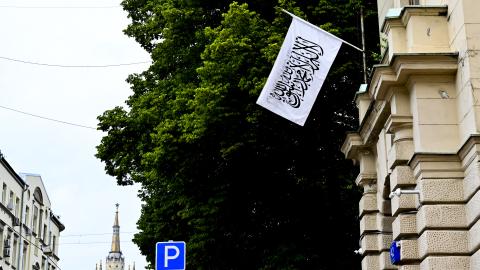
Since the Taliban returned to power in Afghanistan in August 2021, Moscow has pursued increasingly close ties with the extremist Islamist organization. Russia is now the only country that formally recognizes the Taliban as the legitimate government of Afghanistan. Even neighboring countries such as China, Iran, India, and Pakistan have refused to do so. Earlier this year, Moscow signed a military and security cooperation agreement with the Taliban.
Russia is motivated by several factors. First, Moscow naively believes that closer cooperation with the Taliban can serve as a counterweight to other terrorist organizations, such as the Islamic State-Khorasan Province (ISKP). Second, after the Biden administration’s disastrous withdrawal from Afghanistan in 2021, Moscow saw an opportunity to compound Washington’s political and reputational damage: by engaging with Kabul at the expense of Western influence, it could undermine US interests. Finally, just as the Taliban is seeking legitimacy outside Afghanistan, Russia is seeking greater legitimacy outside Europe. The Kremlin’s closer ties with the Taliban government are consistent with its deeper relationships with China, North Korea, and Iran following Russia’s large-scale invasion of Ukraine in 2022.
For a timeline of how the Russia-Taliban relations have grown, see box 1.
Box 1. Timeline of Russia-Taliban Relations
2003: Russia proscribes the Taliban as a terrorist organization.
2015–16: Russia begins quiet contacts with the Taliban in response to ISKP.
Moscow started seeing the Taliban as a possible counterweight to ISKP rather than only as a terrorist enemy.
November 2018: Russia hosts the Moscow Format talks with Taliban participation.
Russian diplomacy shifted from quiet contacts to engaging with the Taliban publicly.
August 2021: The Taliban seizes Kabul.
Russia kept its embassy open and maintained channels with the Taliban, positioning itself for engagement rather than isolation.
September 2022: The Taliban signs a provisional trade deal with Russia for fuel, gas, and wheat.
This deal was one of the Taliban government’s first major international economic agreements and moved the relationship from diplomacy to practical trade.
April 2025: Russia removes the Taliban from its banned terrorist list.
July 2025: Russia formally recognizes the Taliban government.
Russia became the first (and, so far, only) country to recognize Taliban rule after 2021, giving Kabul its biggest diplomatic victory since taking power.
May 2026: Russia and the Taliban sign a military-technical cooperation agreement.
This agreement marked the deepest security cooperation yet, moving the relationship beyond diplomacy, trade, and recognition to formal defense-related engagement.
Military-Technical Agreement Explained
In May 2026, Russia and the Taliban formally signed a military-technical cooperation agreement on the sidelines of the International Security Forum, held near Moscow. Former Russian Defense Minister and current Secretary of the Russian Federation Security Council Sergei Shoigu signed the agreement with Mohammad Yaqoob, who serves as the Taliban’s de facto defense minister and is the son of the late Mullah Omar, the former Taliban leader who refused to hand over Osama bin Laden after the 9/11 attacks.
Neither side has made the details of the agreement public. Reporting and analysis, however, suggest that it could include Russian technical and military assistance to Taliban security forces, joint training, military education opportunities, and the supply of spare parts to help the Taliban maintain Soviet- and Russian-era military equipment still in its possession. This is especially important because many of the higher-end American military systems left behind in Afghanistan have become difficult, if not impossible, for the Taliban to maintain since it lacks proper spare parts and technical expertise.
The agreement formally links a Moscow-Kabul axis against Western interests and takes Russia’s formal diplomatic recognition of the Taliban to a new level of defense cooperation. While no public reporting indicates that the Taliban has agreed to support Russia’s war effort in Ukraine, especially in terms of manpower, the agreement likely marks the starting point for deeper security cooperation. Russia has already relied on foreign manpower during the war, ranging from North Korean troops reportedly deployed under state-to-state arrangements to foreign nationals from countries such as Cuba, India, and Nepal recruited or otherwise drawn into Russian military service. Therefore, Taliban or other Afghanistan-based fighters could eventually serve alongside Russia against Ukraine.
Recent reports also suggest that Russia may directly finance, train, and equip a special 8,000-strong force under the direct command of Hibatullah Akhundzada, the Taliban’s supreme leader. This unit would reportedly sit outside the Taliban government’s usual security structures and chain of command.
Implications for US Policy
The growing ties between Russia and the Taliban should alarm US policymakers for several reasons:
- Russia’s support for the Taliban undermines US interests in Afghanistan and the broader region. Anything that legitimizes or strengthens the Taliban—whether financially, economically, diplomatically, or militarily—undermines America’s broader interests in Central and South Asia.
- Russia-Taliban military cooperation could impact Ukraine. The military-technical cooperation agreement could become the starting point for deeper military ties between Moscow and Kabul. Over time, this could affect Russia’s military operations in Ukraine and further internationalize its aggression against Kyiv.
- Kremlin-Taliban cooperation reinforces the wider anti-Western axis involving Russia, Iran, China, and North Korea. Moscow’s engagement with the Taliban is consistent with its broader effort to build relationships with actors that can help undermine US interests around the world.
- Russian military or security assistance would strengthen the Taliban’s capacity for repression. Any such assistance could help the Taliban continue its oppression of the Afghan people and suppress groups carrying out legitimate armed resistance to Taliban rule, including the National Resistance Front of Afghanistan.