














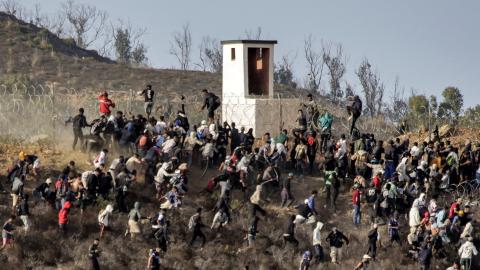




The U.S. Navy faces challenges on multiple fronts. At sea, the fleet is stretched thin responding to China’s continued gray-zone aggression and defending shipping in the Middle East from drone or missile attacks. At home, new ship deliveries fall further behind, fleet readiness is slipping, and recruiters are playing catch up after years of missing goals.
More money and industry innovation could help the Navy mitigate its challenges. But they don’t tackle the root cause of a shrinking, less-ready fleet — the Navy’s force design, which emphasizes large, multi-mission crewed warships and aircraft over robotic and autonomous systems (RAS) or less-complex vessels.
The Navy’s preference for large, crewed platforms is logical. Smaller ships lack the endurance for transoceanic deployments, RAS can’t perform peacetime missions like search and rescue or counter-piracy, and the cost of long-endurance crewed ships or aircraft suggests each one should be multi-mission.
But the Navy cannot afford a fleet of highly survivable warships large enough to address the its global responsibilities. Rising costs and delays in maintaining aging guided missile destroyers (DDGs), amphibious ships, and nuclear-powered attack submarines (SSNs) are already shrinking the operational fleet by forcing the Navy to retire ships early or sideline them for years.
Rather than continuing to field a shrinking force of exquisite ships and aircraft, the Navy should field a larger force of crewed and uncrewed platforms that gain an edge over opponents through their payloads and ability to combine in a diverse array of changing effects chains across domains. By shifting complexity from inside individual ships and aircraft to the kill chains between them, this fleet could gain decision-making advantages over adversaries and generate capacity or capability when and where it is needed.
Deterring without Dominance
After three decades of being the largest, most capable fleet on Earth, the U.S. Navy faces adversaries who are exploiting technology proliferation to field forces that can threaten U.S. military dominance. China is the most prominent example. With the world’s largest rocket force and navy, the People’s Liberation Army could keep Taiwan’s allies at bay long enough to blockade Taiwan or attempt an invasion.
There are a small number of intense scenarios that would require a substantial portion of the fleet, or of key elements of the fleet. The U.S. Navy has traditionally designed the fleet to meet the demands of these scenarios. In its post-Cold War period of dominance, the Navy could build a force able to counter a Taiwan invasion and retain enough residual capability to handle any other situation, albeit much less efficiently than a purpose-built force.
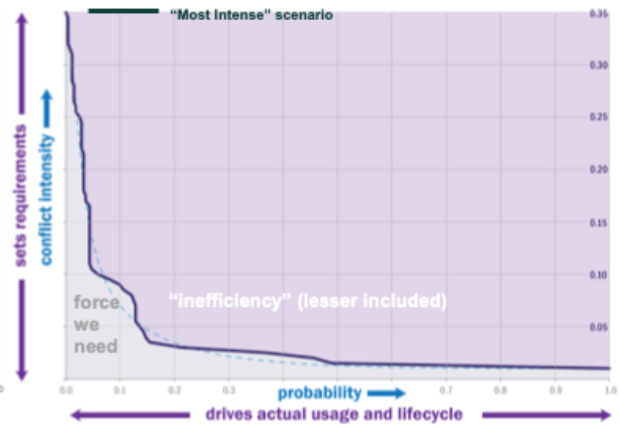
Figure 1
Figure 1 illustrates this approach. It shows U.S. combat deployments from 1943 to 2011 in terms of the probability a given portion of the force is deployed on any given day. (This chart is based primarily on U.S. Air Force data, which is the most comprehensive). The peak on the chart represents World War II, but the speed and scale of a Taiwan invasion would preclude significant mobilization. Navy leaders logically sized the active fleet for that scenario.
But the PRC’s improving and growing military is driving up the capability and capacity needed to defend Taiwan. In the early 2020s, the Navy began to retire or slow production of ships and aircraft that were less relevant to a Taiwan invasion scenario. The one-size-fits all fleet started looking like a one-trick pony fit for one situation and ill-suited for many others.
Other stressing scenarios soon emerged as adversaries began exploiting military-relevant commercial technology and geography. Russia expanded its invasion of Ukraine beyond Crimea and is growing its submarine fleet, Iran’s Houthi proxies attacked shipping across the Red Sea and Bab El Mandeb, and China intensified air and maritime incursions into Philippine and Japanese territory.
This expanding set of challenges leaves the Navy in a strategic cul-de-sac: It doesn’t have enough forces with sufficient capability to be dominant in each region, but it cannot grow in its current form under any realistic budgets. In his opening speech during his assumption of office, new Chief of Naval Operations Admiral Daryl Caudle argued the Navy should use “hedge forces” to solve this force planning challenge.
Hedge forces are specialized groups of units designed to address high-consequence, low-probability situations like those on the left side of figure 1. These forces would provide the additional capability and capacity needed for a specific scenario but may not have broad utility in other regions or situations. Figure 2 depicts this force design paradigm using the data of Figure 1.
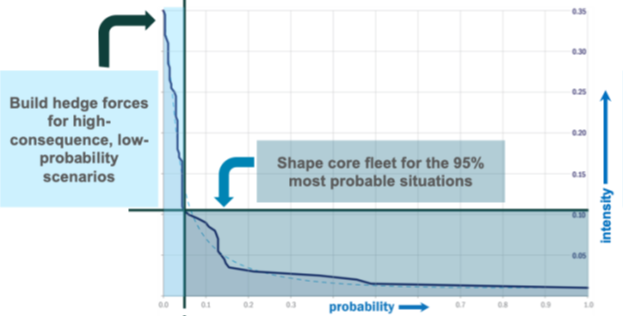
Figure 2
Under this paradigm, the Navy would size its core fleet — or the traditional Navy of today — for the bulk of scenarios that could emerge, including high-probability day-to-day conditions such as homeland defense or responding to gray-zone provocations. The core fleet should also be able to mount relatively large campaigns like Operations Desert Storm or Iraqi Freedom by surging additional deployments for the duration of operation. The Navy would build hedge forces to address the 5% of operational problems that would overstretch the core fleet.
The Navy should forward base hedge forces at allied facilities in their region of interest and organize them separately from the rotationally deployed core fleet. Because they are composed for a specific scenario, hedge forces will generally not be relevant to other theaters and scenarios, although some units may move in response to changing capability and capacity needs among hedge forces. Forward basing helps deter opponents by showing that hedge forces can quickly, potentially automatically, respond to aggression. And from a fiscal perspective, forward basing reduces the number of hedge force units needed compared to rotationally deploying them from U.S. territory.
The Navy’s need for hedge forces to be specialized and forward based suggests they should be predominantly composed of RAS. Conflicts in Ukraine, Nagorno-Karabakh and the Middle East show that RAS can be relevant in high-end conflict. For example, after losing its navy to attack or capture, Ukraine’s military restored access to vital shipping lanes by pushing the Russian Black Sea Fleet to the far side of Crimea using uncrewed attack boats and undersea vehicles.
RAS also offer dramatically lower costs of procurement and, most importantly, sustainment. By shifting some functions of traditional crewed platforms onto uncrewed systems, the Navy could gain scale at lower costs than it would take to achieve the same capacity through crewed ships or aircraft.
The Navy is pursuing RAS and associated operational concepts through an accelerating set of experiments. These initiatives — including Task Force 59 in the Middle East, 4th Fleet in Central and South America and the Integrated Battle Problems in the Indo-Pacific — are great examples of applying new technologies to thorny operational problems. But the Navy needs to go further and stop treating uncrewed systems as merely an additive to the crewed force.
The U.S. Department of Defense is experimenting with concepts like those used by Ukraine and Iran’s proxies to create a “hellscape” for Chinese invaders in the Taiwan Strait. By attacking troop transports with drone boats, undersea vehicles and loitering munitions, a hedge force of RAS could slow or disrupt the invasion, giving U.S. and allied forces targeting information and time to destroy PLA ships with long-range missiles and torpedo fires.
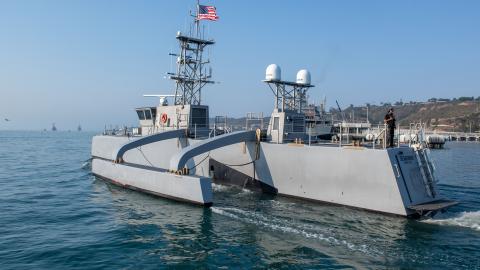
But the hellscape cannot stop an invasion alone. It will need missile attacks from aircraft, submarines and surface combatants to defeat the invasion fleet and its escorts. However, surface forces will be hard-pressed to get close enough to deliver weapons and survive. The Navy could fill the gap by instead relying on a distributed fires hedge force of Modular Attack Surface Craft and submarines in the early phases of the fight.
The MASC program includes three RAS vessels, the largest of which would carry 16 missiles. Hudson Institute’s wargaming and modeling suggests distributed uncrewed missile launchers with between 16 and 32 weapons offer an effective balance between undermining adversary planning and creating risks to adversary objectives. RAS vessels with larger magazines are easier to detect, have difficulty efficiently using their weapons before coming under attack and are large enough to be worth multiple enemy missile salvos. RAS vessels with fewer weapons are often unable to successfully attack a defended target alone, creating a need for coordinated attacks that can be difficult if communications are degraded.
The Navy could benefit from building RAS-based hedge forces to address other stressing situations. For example, deployments by quiet Russian SSNs through the Greenland-Iceland-United Kingdom (G-I-UK) gap could quickly overwhelm U.S. antisubmarine warfare (ASW) forces, especially if other operations in Europe demand attention from U.S. SSNs, P-8A maritime patrol aircraft and DDGs. And a renewed campaign of drone attacks by the Houthis in the Red Sea could once again stretch a Navy surface combatant fleet that is also defending U.S. carriers, territory and other sea lanes.
A Dramatically Different Surface Fleet
This new force design paradigm implies changes in the makeup of the core force. For example, if a largely uncrewed hedge force can slow and disrupt a Chinese invasion, the Navy may need a lower rate of fires from surface combatants, strike-fighters, and SSNs. As a result, the Navy could reduce the number of crewed platforms it buys or delay their next generation.
But the changing threat environment also matters. The fleet’s successful air defense actions in the Middle East during the last two years showed that countering drone and missile attacks is getting harder. These operations already stress the capacity of today’s DDGs. Hudson Institute’s wargaming with U.S., Australian and Japanese officers during the last year suggest China could overwhelm U.S. DDGs and successfully engage U.S. carriers well into a conflict in the Western Pacific.
DDGs will soon have to focus on air and missile defense and forgo other missions like ASW or strike due to combat system and magazine limits. Despite their reach, Tomahawk missiles still require DDGs to approach adversaries like Iran, Russia and China within anti-ship missile range and each adversary would be willing to expend substantial numbers of $20 million ballistic missiles on a $3 billion DDG.
This suggests the surface force will need to both increase its magazine capacity and the range of its weapons to conduct offense and defense during tomorrow’s conflicts. The Navy could realize those characteristics by renewing its pursuit of a CG(X) guided missile cruiser. A CG(X) could, like today’s Ticonderoga CGs, carry 130-plus missiles in a vertical launch system magazine. Like the Navy’s planned DDG(X), a CG(X) could also carry larger missiles like the Navy’s planned hypersonic conventional prompt strike weapon that can reach targets more than 1,500 nautical miles away.
But with a cost of likely more than $5 billion per ship, the Navy will not be able to replace today’s DDG-51s with new CG(X) or DDG(X) hulls on a one-for-one basis. While today’s DDG-51s will be in the fleet for decades to come, the Navy will need to complement its new, larger surface combatants with smaller, less expensive vessels.
Unfortunately, the Constellation guided missile frigate cannot become that more affordable counterpart to the DDG-51. Originally planned to cost less than $800 million per hull, the FFG-62 class has been plagued by production delays and cost overruns driven in large part by Navy design revisions. The Congressional Budget Office now estimates each FFG will cost at least $1.4 billion.
With a cost nearly twice that of its parent FREMM FFG design or the Navy’s original estimates, the FFG-62 no longer has a role in the Navy fleet. Its 32-cell vertical launch system magazine lacks the capacity to defend another ship against even the Houthi threat. The FFG-62’s very low frequency sonar will generate long detection ranges against quiet submarines but still would place the ship well within submarine-launched anti-ship missile range. And the FFG-62’s cost and complexity prevent the Navy from automating the ship or buying it in sufficient numbers to be considered expendable or attritable.
Surface force leaders could use the Navy’s budget constraints to reshape the fleet for deterrence in a post-dominance era. Instead of continuing the flawed and overpriced FFG-62 program, the Navy could pursue a smaller missile corvette like the Israeli Sa’ar-6 or Swedish Visby. A corvette would not be multimission capable like the FFG-62, but it could carry the same 32-cell VLS magazine for offensive weapons. With a reloadable Rolling Airframe Missile air defense system, it would be survivable against realistic missile salvos.
If the Navy used an existing design without significant modifications, it could purchase at least two corvettes for the cost of each planned FFG-62. This is not a novel approach. The Navy is beginning procurement this year of a new medium landing ship based on the Israeli logistics support vessel, which itself was derived from a U.S. Army landing ship.
Corvettes could conduct coastal defense around the United States and across the Western Hemisphere. But they could also lead and manage hedge forces overseas that are defending Taiwan, countering submarines at the G-I-UK gap, clearing mines in the Strait of Hormuz or defeating air attacks in the red Sea. Although hedge forces will be predominantly composed of RAS, human operators will still need to maintain, command and protect them when not in use. Corvettes could help provide those functions while also providing maritime security and addressing other threats.
With their lower complexity and smaller size, the Navy could also automate corvettes enough for them to be remote missile launchers during wartime, as it did with the fast troop transport USNS Apalachicola. They could then join the distributed fires hedge force in defeating amphibious assaults or blockades.
The Navy’s fleet design needs dramatic change to deter in a post-dominance era. Instead of relying on the broad overmatch of its one-size-fits-all fleet, the Navy should pivot to a smaller core fleet complemented by hedge forces to address its most challenging operational problems. Without a change like this, the Navy will lose relevance as opponents exploit proliferation and geography to threaten America’s allies and interests.