





















Executive Summary
Japan’s National Defense Strategy aims to “shape a security environment that does not tolerate unilateral changes to the status quo by force; to deter, through cooperation and collaboration with our ally, like-minded countries and others, unilateral changes to the status quo by force.”[1] In support of these goals, the Japan Self-Defense Force (JSDF) is modernizing its defense capabilities, and the Japan Ministry of Defense (JMOD) has increased defense spending by more than 50 percent during fiscal years 2023–2027 compared to previous plans.[2] But the JMOD will need an effective strategy and corresponding force design to translate these larger budgets into deterrence.
The People’s Republic of China (PRC) is an increasingly dangerous adversary to Japan. Armed with advanced military capabilities and world-leading industrial capacity, it can attack all of Japan at scale, including from the Pacific. It could even attempt to seize Japanese territory, such as the Southwest Island Chain. North Korea and Russia also pose major threats and could collude with the PRC in potential contingencies. As Japan’s closest ally, the United States would join in its defense. A confrontation with China, however, would likely be a regional—if not global—conflict. The PRC will attempt to create multiple demands on US forces to delay or reduce their ability to assist in Japan’s defense. These efforts could include attacks against other US allies, like Taiwan, or on the US homeland.
In line with Japan’s National Defense Strategy, the government has made clear that the JSDF will take “primary responsibility to deal with invasion of Japan.”[3] But even if the JMOD were to spend more on its planned portfolio of systems, the JSDF could suffer major losses and still fail to defend against large-scale PRC attacks. Demographic decline will also constrain the JSDF’s size. Instead of using higher budgets to pursue a larger version of today’s JSDF, the JMOD should pursue a force design that enables the JSDF to disrupt attacks, impose costs, and protract conflicts by leveraging uncrewed systems across domains and adopting adaptable hedge forces focused on key operational problems. A series of Hudson Institute wargames and analyses found that the JSDF could transition to such a force over the next decade within the proposed 2026 funding levels and with likely personnel reductions of 10–15 percent. This force design would prioritize the following goals:
- Enable complex anti-ship attacks by fielding distributed and relocatable ground-based long-range anti-ship and land-attack missile launchers that exploit Japan’s geography.
- Defend islands and choke points with SHIELD hedge forces comprised of slow or short-range uncrewed systems across all domains that can target and attack ships and sub marines.
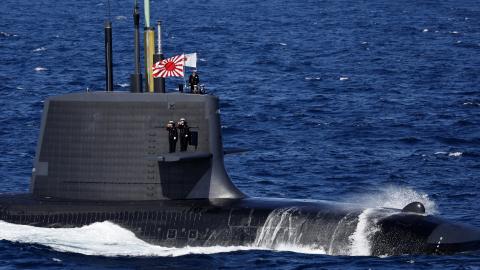
- Protect Japan’s sea lanes and maritime approaches by incorporating vertical launch system (VLS) missiles into each new submarine and fielding a new class of guided-missile submarines.
- Threaten PLA strike capacity by establishing counterair hedge forces that combine uncrewed detection systems, ground-based surface-to-air missiles, and uncrewed targeting aircraft that can engage bombers and airborne early-warning aircraft as they exit Chinese airspace.
- Improve Japan’s capacity for protraction by investing in airborne decoys to counter People’s Liberation Army (PLA) fighter attacks and hardened infrastructure and air defenses to protect relevant JSDF facilities.
- Enhance adaptability by strengthening command, control, and communication (C3) resilience through commercial satellite communications (SATCOM) and decision support systems that can exploit the tactical options and kill chains in a larger, more heterogeneous JSDF.
- Rebalance crewed air and naval forces toward personnel-efficient platforms for peacetime operations and survivable wartime platforms, such as guided-missile destroyers (DDGs), Mogami-class frigates (FFMs), submarines, and low-observable fighters.
The affordable and achievable force described in chapter 4 of this report would exploit Japan’s geography and innovative industrial base to adapt and prevail in a protracted conflict. Over time, it could deter aggression by demonstrating an ability to deny the PRC’s initial objectives and impose disproportionate costs. The Japanese government took a bold step in 2022 by deciding to dramatically raise defense spending to 2 percent of gross domestic product. Japan’s leaders are already discussing further increases to the JMOD budget. With the right investments, these expanding capabilities could help the JSDF advance from simply responding to aggression to deterring attacks—even by the PRC.
Endnotes
- Japan Ministry of Defense, Defense of Japan (JMOD, 2024), 219, https://www.mod.go.jp/en/publ/w_paper/wp2024/DOJ2024_ EN_Full.pdf. ↑
- Daisuke Kawai, “Japan’s Defence Budget Surge: A New Se curity Paradigm,” December 2, 2024, https://www.rusi.org/ explore-our-research/publications/commentary/japans-de fence-budget-surge-new-security-paradigm. ↑
- JMOD, Defense of Japan, 219. ↑