
















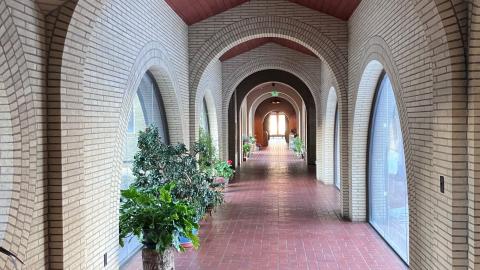
Tomorrow, St. Benedict’s Monastery, just outside Aspen in a beautiful mountain valley called Old Snowmass, will celebrate its last Sunday service as it prepares to move on from its home for the last 70 years. Soon, the new owner of the spiritual landmark, Palantir founder and German-trained intellectual Alex Karp, will make it his new home. The monastery is closing due to costs of maintaining the property and declining number of monks joining the Benedictine order. What Karp will do with what was long a center of spiritual life in the mountain valleys, and whose modern origins owe much to the Western religious and humanist tradition, is yet to be seen.
The post–World War II development of modern Aspen owes much to the vision of Chicago industrialist Walter Paepcke, a generous civic leader with a powerful vision for the decrepit mining town, which he saw as an attractive site for a European-style ski center. Along with and central to his ski resort project, Paepcke saw the possibilities of a humanistic center of revival in the wake of the despair of the Great Depression, war, and the rise of authoritarian, illiberal ideologies.
The key event in the creation of the new center was a 1949 summer conference in Aspen to honor the 200th anniversary of the birth of European humanist icon J. W. Goethe and promote understanding of the humanistic spirit. With the help of University of Chicago philosopher and academic visionary Mortimer Adler, Paepcke assembled a group of distinguished European luminaries such as Albert Schweitzer and José Ortega y Gasset, along with Americans Thornton Wilder and Robert Hutchins, to honor the memory and spirit of Goethe. In grand European tradition for mountain retreats, Paepcke also arranged for the Minnesota Philharmonic to anchor a classical music program.
The 1949 festivals were the origins of the Aspen Institute, grown to be a famous think tank that features an annual “Ideas Festival” and programs to introduce corporate executives to classical texts. It also eventually inspired the world-famous Aspen summer music festival and school. Paepke even attracted Bauhaus refugee Herbert Bayer to enliven the artistic life of the area. The Austrian left an indelible mark on the architecture of the area. An unrelated annual design conference attracted a young Steve Jobs, who credited the summer meeting with inspiring his Apple aesthetic.
Less visible but in many respects more important to creating a spiritual revival was the founding of St. Benedict’s Monastery in 1956 just outside Aspen. The first years of the Catholic mountain center for contemplation and searching for mystical discovery of the creator featured the more rigorous Trappist set of rules, notably the rule of silence. I discovered this personally many decades ago when a stern note of reprimand was left for me on a visit to the Monastery grounds. The Institution is formally part of the “Order of Cistertians of the Strict Observance (OSCE),” which follows the Rule of Benedict but features more rigorous practices.
The Benedictine rules, which date to the 6th century, are the oldest in Latin Christianity, and are more oriented to community life, described as cenobitic, Greek for common life. This rule differs from the more ascetic, or hermetic, life that many understand monastery life to be. Because of this, and also as a bow to modernity, the Snowmass site relaxed the rule of silence and eventually integrated further into community life. A retreat center was built on the grounds of the 3700-acre property, which was leased to local ranchers and farmers, and church services were opened to outsiders.
In a sign of the power of the experience, a resident monk noted that the Aspen Institute corporate program in classical texts sometimes brought its students to the monastery. One admittedly secular participant remarked, “I do not completely understand what I saw there, but I know that I am permanently changed — and for the better.” The brother responsible for the change said, “There is something of the monk that exists in all of us.”
In later years, the monastery welcomed friends in the valley who cherished the vesper services, sung partly in Gregorian chant, and attended the Sunday lauds and Mass. I was able to attend the penultimate Sunday Mass last weekend, and the standing-room-only audience had difficulty finding parking spaces. The presiding priest gave a sermon, being the week of the Epiphany, on the modern science of starlight and celestial movement, coupled with the ancient art that led the Three Magi to the site of the birth of the Savior.
With the local cultural and intellectual life increasingly secular and dominated by privileged, hedonistic, woke, aggressively anti-religious, and new age ideological adherents, the Benedictine monastery was one of the last vestiges of the long spiritual traditions of the Western world in the vision of Paepcke and his collaborators. Apparently, the new owner will use the property as his own mountain retreat. Hopefully, he can find a way to share that magical mountain location and spiritual center with the other souls of the central Colorado valleys.