04
May 2018
Past Event
China's Police State in Xinjiang

China's Police State in Xinjiang

Past Event
Hudson Institute, Washington, D.C. Headquarters
May 04, 2018
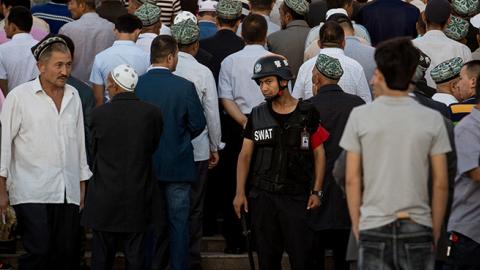
A policeman standing guard as Muslims arrive for the Eid al-Fitr morning prayer at the Id Kah Mosque in Kashgar in China's Xinjiang Uighur Autonomous Region (JOHANNES EISELE/AFP/Getty Images)
Caption
A policeman standing guard as Muslims arrive for the Eid al-Fitr morning prayer at the Id Kah Mosque in Kashgar in China's Xinjiang Uighur Autonomous Region (JOHANNES EISELE/AFP/Getty Images)
04
May 2018
Past Event

1201 Pennsylvania Avenue, N.W., Suite 400
Washington, DC 20004

Speakers:
Sarah Cook

Senior Research Analyst, East Asia, Freedom House

James Millward

Professor of History, Georgetown University

Rian Thum

Associate Professor of History, Loyola University

Louisa Greve

Washington Fellow, Christian Solidarity Worldwide

Eric Brown

Senior Fellow, Hudson Institute

The People’s Republic of China has built the world’s most advanced police state in Xinjiang, the “autonomous region” in northwestern PRC whose indigenous Uighur peoples have long bristled under repressive and discriminatory Communist rule. Cutting-edge surveillance, population control technologies, and large-scale Chinese force deployments have made Xinjiang the most heavily garrisoned part of the country. Five to ten percent of Uighurs have been incarcerated or forced into camps for “re-education.” Meanwhile, the PRC’s efforts to suppress or eliminate Uighur culture and Islamic religious practice have also intensified.

Beijing justifies its police state in Xinjiang by citing security concerns over ethnic “splittism” and foreign Islamist ideology. Despite criticism of Communist Party policy from Chinese themselves, the party has gone to extraordinary lengths to stifle dissent and control what China and the world hears about Xinjiang. What do we know about the situation in Xinjiang, and where is it headed? How are Uighurs responding to this dire situation, and how is it affecting Uighur society? How is the build-up of the police state in Xinjiang impacting Chinese society itself, both as Xi Jinping attempts to consolidate his rule at-home and as the PRC attempts to transform itself into a global power?

On May 4, Hudson Institute hosted a discussion on the Xinjiang police state. Panelists will include James Millward, a professor of history at Georgetown University; Louisa Greve, the Washington fellow at Christian Solidarity Worldwide; Sarah Cook, a senior research analyst at Freedom House; and Rian Thum, an associate professor of history at Loyola University in New Orleans. The conversation was moderated by Hudson Institute Senior Fellow Eric Brown.

Related Events
19
May 2026
In-Person Event | Invite Only
Environmental Agendas, Geopolitical Ends: Climate Policy and Great Power Competition
Featured Speakers:
Michael Doran
Zineb Riboua
Brenda Shaffer
Sam Cooper
Getty Images
19
May 2026
In-Person Event | Invite Only
Environmental Agendas, Geopolitical Ends: Climate Policy and Great Power Competition

To examine this emerging challenge, Senior Fellow Dr. Michael Doran will convene a conversation with Research Fellow Zineb Riboua, Professor Brenda Shaffer—Research Faculty Member at the US Naval Postgraduate School and Senior Fellow at the Atlantic Council—and Sam Cooper, an award-winning investigative journalist focusing on China-Canada relations.

Getty Images
Featured Speakers:
Michael Doran
Zineb Riboua
Brenda Shaffer
Sam Cooper
20
May 2026
In-Person Event | Invite Only
A Conversation with Under Secretary of State for Public Diplomacy of the United States Sarah B. Rogers
Featured Speakers:
Sarah B. Rogers
Zineb Riboua
Eric Schmitt
Michael Doran
Getty Images
20
May 2026
In-Person Event | Invite Only
A Conversation with Under Secretary of State for Public Diplomacy of the United States Sarah B. Rogers

Please join the Hudson Institute for a conversation with Under Secretary of State for Public Diplomacy Sarah B. Rogers and Hudson Research Fellow Zineb Riboua on how the United States is adapting its public diplomacy tools to advance its interests abroad, counter censorship, promote free speech, and leverage artificial intelligence to deliver more effective, targeted messaging.

Getty Images
Featured Speakers:
Sarah B. Rogers
Zineb Riboua
Eric Schmitt
Michael Doran
21
May 2026
In-Person Event | Hudson Institute
Georgia at a Geopolitical Crossroads: Iranian Influence and Strategic Competition
Featured Speakers:
Luke Coffey
Giorgi Kandelaki
John P. Walters
Congressman Joe Wilson
Ian McGinnity
Moderator:
Matthew Boyse
Tbilisi residents protest after the Georgian Dream government announced a suspension of negotiations on EU candidate status until 2028, as police detain demonstrators during a crackdown in the capital on November 28, 2025. (Photo by Sebastien Canaud/NurPhoto via Getty Images)
21
May 2026
In-Person Event | Hudson Institute
Georgia at a Geopolitical Crossroads: Iranian Influence and Strategic Competition
Tbilisi residents protest after the Georgian Dream government announced a suspension of negotiations on EU candidate status until 2028, as police detain demonstrators during a crackdown in the capital on November 28, 2025. (Photo by Sebastien Canaud/NurPhoto via Getty Images)
Featured Speakers:
Luke Coffey
Giorgi Kandelaki
John P. Walters
Congressman Joe Wilson
Ian McGinnity
Moderator:
Matthew Boyse
22
May 2026
Virtual Event | Online Only
The Western Hemisphere’s Energy Moment
Featured Speakers:
Daniel Batlle
Francisco Monaldi
Getty Images
22
May 2026
Virtual Event | Online Only
The Western Hemisphere’s Energy Moment

Join Hudson Institute as Adjunct Fellow Daniel Batlle interviews Francisco Monaldi, director of the Latin American Energy Program at Rice University’s Baker Institute for Public Policy and one of the foremost authorities on energy and political economy in the region, for a wide-ranging conversation on Latin America's energy future and what it means for the hemisphere and for US interests.

Getty Images
Featured Speakers:
Daniel Batlle
Francisco Monaldi