

















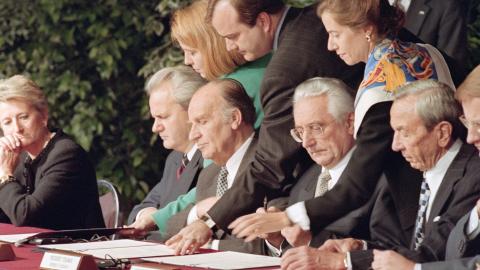
The 30th anniversary of one of the most consequential diplomatic achievements since the end of the Cold War was marked this month. On Nov. 21, 1995, at a secluded US airbase outside Dayton, Ohio, three leaders — Alija Izetbegovic, president of Bosnia and Herzegovina; Franjo Tudjman, president of Croatia; and Slobodan Milosevic, president of Serbia — initialed an agreement that brought an end to the bloody three-year Bosnian War.
Bosnia and Herzegovina emerged from the breakup of Yugoslavia in the 1990s, which began a brutal interreligious and interethnic sectarian war in 1992. Ethnic Serb factions’ targeting of the Bosnian Muslim population, commonly referred to as Bosniaks, accounted for the vast majority of the 100,000 people killed during the conflict. The best-known example of this was the Srebrenica genocide in July 1995, in which Serb fighters murdered more than 8,000 Bosniak men and boys. An estimated 30,000 women and girls were displaced and, in some cases, sexually abused.
But on that day in November 1995, the fighting stopped. The Dayton Agreement is still considered a major diplomatic success and is often cited as a model of how effective diplomacy can produce real results on the ground. Not only did it end the fighting, it also kept Bosnia and Herzegovina as a single state by reorganizing the country into two substate entities: the Federation of Bosnia and Herzegovina, largely Bosniak and Croat, and Republika Srpska, largely Serb.
The peace it brought facilitated the return of refugees who had been scattered across Europe in their millions. The process also started the earliest phases of Bosnia and Herzegovina’s Euro-Atlantic engagement, including closer ties with the EU and NATO. NATO immediately deployed a peacekeeping mission to Bosnia — which was later transferred to the EU — and it remains there today with a strength of between 1,000 and 1,500 troops.
However, despite the fact the killing stopped and the refugees returned home, the subsequent years were not without problems. The political and governance structures produced by Dayton have led to practical problems on the ground. Today, Bosnia and Herzegovina is one of the most decentralized states in the world. It has two federal entities, one condominium (the Brcko District), 10 cantons, 143 municipalities, a weak central government, a complex, multichambered legislative system with robust ethnic vetoes, a rotating tripartite presidency, and multiple layers of judiciary. This complex and decentralized political process has empowered nationalist groups that seek more autonomy and, in some cases, separatism.
A key example is Milorad Dodik, an influential politician and former president of Republika Srpska, who has taken steps to undermine legitimate state structures and has flirted with secessionism or even unification with neighboring Serbia. Knowing this can be a sore point with the West, Russia often uses Serbia and Republika Srpska as a means to put pressure on the EU and NATO. The problems derived from Bosnia’s political system have also stalled the country’s progress toward EU and NATO membership.
The ethnically Croat minority, which accounts for about 15 percent of the population, often feels it is not properly represented in state structures. Meanwhile, other minority groups, such as Jews and Roma, share similar concerns. This has resulted in several discrimination rulings against Bosnia’s constitution by both the Constitutional Court of Bosnia and Herzegovina and the European Court of Human Rights.
Steps need to be taken by Sarajevo to address legitimate concerns about the political process, but some use the situation to discredit the accomplishments of the Dayton Agreement. Although still a fringe idea in policy circles, the notion of scrapping Dayton altogether is gaining traction. This would be a mistake.
The Dayton Agreement is not perfect but it remains one of the greatest diplomatic achievements of the post-Cold War era. And while Bosnia must still undergo significant constitutional reform if it is to become an EU and NATO member state, removing the international oversight that accompanies the agreement would destabilize Bosnia and Herzegovina — and the broader region. Without the Dayton framework, Dodik and his successors would almost certainly seek to leave Bosnia and Herzegovina and either declare independence or pursue a union with Serbia.
There are lessons from Dayton that apply to conflicts today, especially Ukraine. First, outside leadership is needed to get all parties to the negotiating table and craft a credible agreement. In the 1990s, this leadership came from the US under President Bill Clinton. Today, President Donald Trump is attempting to fill this role regarding Ukraine. Whether he will be as successful remains to be seen, but nobody can doubt that he is genuinely trying to bring peace.
Another lesson is that security guarantees matter. Ukraine will not agree to an arrangement that leaves its population exposed to future violence. This is why the peacekeeping mission in Bosnia was so important and why any end to the fighting in Ukraine will require a peacekeeping presence on the ground. This is one of the biggest sticking points for Moscow but it is an issue it will eventually need to confront if it is serious about ending the war.
While the 30th anniversary of the Dayton Agreement passed largely unnoticed, it should remind us of what political will can achieve. Although Bosnia’s political processes since the agreement have not been perfect, Dayton has prevented renewed fighting — or worse, genocide — for the past three decades. To ensure stability for the next 30 years, the international community must continue working with Bosnia and Herzegovina and its neighbors.
Perhaps the greatest lesson from Dayton is that peace is a process, not a single event. As soon as focus is lost, peace can quickly turn back into war — whether in Ukraine, Gaza or elsewhere. Global policymakers would be wise to remember this and look at the Dayton Agreement for inspiration.