














Executive Summary
- Battlefield assessment. The Ukrainian military approached parity with Russia in its pace of territorial gains and the number of offensive operations, while combat activity remained high.
- Ukrainian long-range strikes. Ukraine is institutionalizing long-range strike warfare by establishing a new Long-Range Strike Command, and it is crafting a distinct operational campaign with its attacks across Russia and the Sea of Azov.
- Missile defense. Ukraine is continuing to construct its missile-defense architecture with help from a new European coalition, the Ukrainian defense technology company Fire Point, and the United States’ potential licensing of Patriot missiles.
1. Battlefield Assessment
Heightened combat activity continued to rage across the battlespace last week, with Russia and Ukraine fighting 250 to 300 tactical engagements each day. Once again, however, this intense warfare did not yield major changes to the battlefield geometry in Ukraine.
Kupainsk, Lyman, Kostiantinivka, Pokrovsk, Huliaipole, and Orikhiv remained the war's most fiercely contested flashpoints. Ukrainian officials stated that the country’s forces reached parity with Russia in their pace of advance. They also reported that the ratio of Ukraine to Russia offensive operations is now approximately 40 to 60, a trend that gives Ukraine cause for optimism. Despite this, Ukraine’s long-range strikes—and the sharp decline in Russian refining capacity they have caused—held the greatest potential to affect the course of the conflict.
Developments in amphibious operations also drew attention last week. Open-source intelligence visuals suggest that Ukraine’s 123rd Territorial Defense Brigade used a naval drone to deliver an unmanned ground vehicle to Russian-held territory on the Kinburn Spit, the narrow peninsula jutting west from Ukraine into the Black Sea. An accompanying open-source video shows the ground drone disembarking from the sea drone onto the shore.
2. Ukraine’s Long-Range Strike Capabilities Reach New Heights
Ukraine’s long-range strike campaign achieved significant successes this week, particularly in the Sea of Azov and across the occupied southern areas of the country.
Robert “Magyar” Brovdi, the commander of Ukraine’s Unmanned Systems Forces (USF), stated that during the night of July 12–13, his units struck 15 vessels associated with Russia’s shadow fleet, the aging tanker network Moscow uses to export its energy products and circumvent sanctions. Overall, Ukraine’s USF reportedly struck 105 Russian vessels between July 6 and 13.
Brovdi also reported that his forces struck 11 energy facilities in occupied Crimea and other Russian-held territories. These targets included nine electrical substations, the node connecting the Kuban–Crimea power grid to Russia’s grid, and a gas pumping station. Additionally, Ukrainian forces claimed to have destroyed five Russian air-defense assets: an S-400 launcher, a Tor-M2 system, a Pantsir-S1 system, and two Nebo-U radar sites.
In response, Russia suspended navigation through the Don-Azov Canal and stopped accepting applications for passage through the Kerch Strait. These actions suggest that Ukraine’s strikes are already forcing the Kremlin to enact operational changes beyond those necessitated by the physical damage to individual vessels.
Most of the targeted ships are river-sea tankers, dual-purpose vessels capable of operating in open waters, coastal ports, and along Russia’s inland waterways. They transport petroleum products to occupied Crimea, export fuel to foreign markets, and carry crude into the Black Sea for ship-to-ship transfer onto larger tankers. As a result, Russia’s river-sea fleets operate at the intersection of the country’s military logistics, commercial shipping, and energy-export infrastructure.
To sustain pressure on Russia, Ukraine does not need to sink every vessel it attacks. Forcing ships into prolonged repairs can produce a comparable operational effect at far lower cost. Tankers, ferries, tugboats, and cargo vessels sidelined for maintenance cannot supply Russian forces on the southern front—or generate revenue for their private owners. The campaign also challenges Moscow’s claim that it transformed the Sea of Azov into a secure, internal waterway in 2022 .
Ukraine did not limit last week’s long-range strikes to Russia’s shadow fleet. Overnight on July 12–13, Ukrainian drones also struck multiple regions of Russia, targeting energy and transportation infrastructure supporting Moscow’s war effort. In Stavropol Krai, an unmanned aerial vehicle ignited a major fire at an oil depot near the railway in Vyazniki.
This strike occurred roughly one mile from another depot, owned by JSC NK Rosneft-Stavropolye, that Ukraine struck and set ablaze on July 9. Local footage indicated that the fire at this depot remained active into Monday morning, with at least two storage tanks appearing to be in flames. Additionally, a drone strike in Krasnodar Krai reportedly damaged a transshipment complex at Port Kavkaz that is responsible for shipping petroleum products. This facility has served as a strategically important logistics hub connected to occupied Crimea through the Kerch ferry crossing.
Capitalizing on the growing effectiveness of Ukraine’s long-range strikes, on July 10, President Volodymyr Zelenskyy issued a decree establishing a new unit, the Long-Range Strike Command. The announcement directed the country’s defense minister and commander in chief to nominate the unit’s commander.
The new unit is rare among the world’s armed forces. Kyiv’s newest combat formation underscores the growing importance of striking Russian depth to generate military and political leverage.
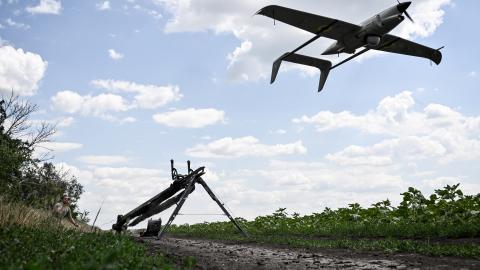
In another boost to Kyiv’s long-range strike capabilities, Germany announced that it will finance the procurement of 50,000 attack drones for Ukraine. The order, which would rank amongst the largest purchases of unmanned strike systems for Kyiv, centers on the Ukrainian company Skyfall. The drones will be equipped with software from the United States–based defense-technology firm Auterion, enabling them to autonomously track and engage moving targets during the terminal phase of flight. It reflects the growing integration of mass-produced Ukrainian hardware with advanced Western software for autonomous systems.
3. Ukraine’s Missile Defense Efforts Gain Momentum and Forge New European Partnerships
Ukraine and nine other European countries established a new anti-ballistic missile coalition, formally launching the initiative at an inaugural meeting in Paris on July 13. The meeting united national leaders, senior representatives from the European Union, the North Atlantic Treaty Organization, and defense-industry executives in a demonstration of solidarity and commitment to technological progress.
The coalition aims to connect Europe’s defense industrial and technological base with Ukraine’s rapidly evolving defense industry to lay the foundation for a new European capability in ballistic missile defense.
Finding a fast, scalable answer to Russia’s ballistic-missile threat remains one of Ukraine’s highest priorities. Although Kyiv continues to depend heavily on military assistance from its partners, two potentially important alternatives to this model are beginning to emerge.
Fire Point first presented plans for its Freya air-defense system in May. The system uses the company’s own FP-7.x interceptor and is designed to integrate commercially available components and radar systems already fielded by Ukraine’s European partners . Kyiv’s second solution for confronting Russian ballistic missiles involves the licensed production of US Patriot surface-to-air missiles in Ukraine, a proposal that President Donald Trump reportedly approved at the recent NATO summit.
The air-defense system designed by Fire Point merits close assessment. The company’s FP-7.x interceptor is structurally similar to the 48N6 missile used in the S-300 and S-400 air-defense systems. But the internal architecture of Fire Point’s interceptor is markedly different. The FP-7.x uses modern electronics, composite materials, an indigenous solid-fuel formula, and a newly developed guidance and flight-control system.
The interceptor’s most distinctive feature is its terminal guidance system. The 48N6 relies on semi-active radar homing through a track-via-missile (TVM) guidance principle. The PAC-2 GEM-T (Patriot Advanced Capability 2 Guidance Enhanced Missile–Tactical) interceptor used by the Patriot system also employs a TVM-based feature. Fire Point, however, uses an infrared seeker supplied by Germany’s Diehl Defense firm. While the 48N6, the PAC-2 GEM-T, and the FP-7.x all rely on radio-command guidance using target data from ground-based radar during midcourse flight, the infrared seeker of the FP-7.x distinguishes itself during the terminal phase.
This distinction raises an exciting possibility for Ukraine and its Western allies. If a version of the FP-7.x could be adapted to incorporate the PAC-2 GEM-T’s semi-active radar-seeker and guidance package, the Ukrainian interceptor could potentially be integrated into the Patriot ecosystem. This development could enable Ukraine to leverage the AN/MPQ-53/65 radar family that forms the core of Patriot batteries.
Fire Point is already taking advantage of available technologies. Rather than developing every subsystem from scratch, the Ukrainian firm is assembling its Freya air-defense system around existing hardware and open-source software produced by leading European defense firms. Fire Point is reportedly considering Hensoldt’s TRML-4D and the Thales Ground Master 400 radars for its early-warning components. It is also considering Leonardo’s Kronos Land radar for its tracking and target-designation features, and Kongsberg’s Fire Distribution Center for its command-and-control capabilities. All these systems are currently connected through NATO’s Link 16 network, a secure data network used by NATO and allied forces.
Full integration of the FP-7.x into the Patriot system is unlikely. The two missiles differ substantially in size and cannot share a common launcher. But it is entirely realistic to explore whether elements of the Patriot system—including radar functions, guidance concepts, and industrial arrangement—can be incorporated into a broader European-Ukrainian missile-defense architecture. Ukraine cannot reproduce its own Patriot. Instead, Kyiv should explore whether it can build a new layered system around what already exists: US-licensed technologies, European sensors and command-and-control systems, and Ukrainian interceptor capabilities refined by the demands of an active ballistic-missile war.
If Ukraine can bring these elements together, Kyiv could lead a European anti-ballistic capability for the new missile-defense environment.
5. What to Look for in the Coming Weeks
As the previous edition of this report noted, Ukraine’s most critical shortages are in missile defense. President Zelenskyy has stressed that Kyiv needs 300 interceptors for its Patriot systems within the next three months. It remains to be seen whether Kyiv’s effort to boost its own missile defense capabilities and expedite deliveries from its Western partners will yield results in the coming weeks.