















Executive Summary
- Battlefield assessment. Ukraine’s deep-strike campaign progressed after an attack on Russia’s largest oil refinery that highlighted Kyiv’s growing ability to reach strategic targets deep inside Russia.
- Ukrainian drones. Russia began placing anti-drone cages on its improved Kilo-class submarines, reflecting mounting pressure from Ukrainian naval drones and first-person view (FPV) launch platforms.
- Ukraine’s missile-defense challenges. Russia maintained its offensive footing while exploiting critical gaps in Ukraine’s ballistic-missile defenses, as Kyiv expressed a need for air-defense systems and interceptor missiles.
1. Battlefield Assessment
Ukraine’s deep strikes reached a new level on July 6. Ukrainian long-range drones struck the Omsk oil refinery, the largest in Russia, in what Kyiv described as one of the farthest-reaching attacks of the war.
Ukraine’s General Staff said the attack triggered a fire at the facility, located roughly 1,700 miles from Ukrainian-held territory near Russia’s border with Kazakhstan. Fire Point, the Ukrainian defense technology company, stated that its upgraded FP-1 drones carried out the raid and described the attack as a record-setting strike for unmanned systems.
The growing reach of Ukraine’s robotic-warfare capabilities is also reshaping the conflict’s naval-warfare dimension. Imagery declassified and released by the United Kingdom’s Ministry of Defence indicates that Russia has fitted the improved Kilo-class submarines of its Black Sea Fleet with anti-drone cages. These Kalibr cruise missile-capable submarines form the backbone of the fleet’s long-range strike capacity in the Black Sea theater. The modification underscores how seriously Moscow views Ukraine’s expanding drone warfare capabilities, particularly against high-value naval assets.
Ukraine has also adapted its signature naval drone, the Sea Baby. Kyiv has transformed the unmanned strike vessel, which helped push Russia’s fleet out of the western Black Sea, into a maritime launch platform for FPV attack drones. These modifications extend Kyiv’s strike options beyond the Black Sea littoral.
Built and operated by the Security Service of Ukraine, the Sea Baby can now carry six to eight FPV drones in side compartments that open during an attack. The modified vessel can also carry thermobaric Shmel rockets. Ukrainian officials are leveraging the craft’s ability to operate closer to Russian military positions than land-based launchers. The concept reflects Ukraine’s broader effort to adapt multiple platforms into FPV launch systems.
Despite these innovations, the Armed Forces of the Russian Federation maintained an offensive footing in land warfare last week. Both Russia and Ukraine experienced elevated combat activity, even compared with the fierce fighting of recent weeks. The Ukrainian General Staff reported fighting as many as 300 tactical engagements in a single day for the first time in months.
Yet no major changes to the battlefield geometry occurred, and Sloviansk, Pokrovsk, Huliaipole, and Kostiantynivka remained the most prominent flashpoints. Additionally, Kupiansk, Kramatorsk, and Orikhiv saw fighting that warrants continued monitoring. Moscow also advanced claims, thus far exaggerated, that the Ukrainian city of Kostiantynivka had fallen.
2. Ukraine’s Struggles Deepen Against Russian Ballistic Missiles
Last week, Russia launched a strike package that exposed critical gaps in Ukraine’s air defenses, especially against ballistic missiles. According to the Ukrainian Air Force, during the night of July 5–6, Russia launched 419 aerial weapons against Ukraine, including 68 missiles and 351 drones. The drone and missile salvo included 23 Iskander ballistic missiles, S-400 interceptors modified for quasi-ballistic missile roles, six Zircon/Onyx anti-ship missiles, 33 Kh-101 cruise missiles, and six Kalibr cruise missiles, alongside Shahed, Gerbera, Italmas, and decoy drones.
The city of Kyiv was the primary target of Russia’s strikes. Ukraine’s air defenses performed effectively against the lower and medium tiers of the attack, including cruise missiles and drones. However, Ukraine did not stop or intercept any ballistic missiles or anti-ship missiles launched in the attack.
Russia is increasingly shaping its deep-strike campaign around the segment of Ukraine’s air-defense architecture with the thinnest margin for error: Patriot-class ballistic-missile interception. After Russia’s attack on July 5–6, a Ukrainian Air Force spokesman stated that Ukraine lacked sufficient Patriot launchers and a steady supply of interceptors. The spokesman’s words illustrate how Russia is exploiting a serious shortage both in Ukraine and across the allied inventory.
Last week’s attack also highlighted a growing asymmetry between Ukraine’s ability to defeat drones and cruise missiles and its ability to defeat ballistic and high-speed strike systems. Without sustained Patriot interceptor deliveries, Kyiv remains vulnerable to Russia’s fastest and most destructive munitions.
Available data indicates that in 2024 Russia produced between 720 to 840 9M723 Iskander ballistic missiles and between 120 and 180 Kh-47M2 Kinzhal aeroballistic missiles. Ukrainian intelligence reporting suggests that Russia has scaled up production of both systems, which are among its most expensive ballistic missiles. Moscow has also converted increasing quantities of air-defense missiles for ground-attack use.
Ukrainian reporting identifies these converted systems as RM-48U variants. The Ukrainian Air Force classifies these projectiles as ballistic missiles because they follow a ballistic trajectory and travel at high speeds. The primary operational value of these modified missiles is likely their ability to saturate opposing defenses.
Whatever their use, the proliferation of low-cost, modified ballistic missiles marks a serious missile-defense dilemma for Kyiv. Even relatively inaccurate converted missiles can threaten cities and infrastructure. Defeating these projectiles requires the same high-end interceptors Ukraine has used against Russia’s most dangerous ballistic missiles.
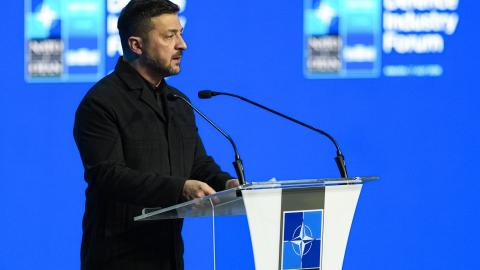
At his press conference before the North Atlantic Treaty Organization summit this week in Ankara, Turkey, Secretary General Mark Rutte urged allies to sustain and expand their air-defense assistance to Ukraine. Rutte warned that Russia’s continuing missile and drone campaigns have made interceptor supply a central test of allied resolve. He also further stressed that air defense remains Ukraine’s most urgent military requirement, noting that Russia continues to launch drone and missile attacks against Ukrainian cities, including another major overnight strike on the eve of the summit.
The timing of this latest Russian strike reinforced the message that Ukrainian leaders have been trying to convey to NATO: Ukraine needs additional air-defense systems and a more reliable, deeper supply of interceptor missiles.
3. What to Look for in the Coming Weeks
NATO’s 2026 summit, which convenes this week, is expected to focus on defense-industrial issues, with the alliance likely to announce new initiatives to sustain and expand military support for Ukraine. In the coming weeks, it will be important to monitor whether these announcements translate into concrete capability packages, particularly in areas where Kyiv has faced persistent shortfalls. Potential developments could include new arrangements related to Patriot interceptor transfers as well as movement on other high-end systems that Ukraine has long sought but not yet received.
Subscribe to Hudson’s Re: Ukraine Newsletter Here