














In this week’s episode of China Insider, Miles Yu analyzes how China is repositioning its policy toward Iran and Venezuela, and how recent geopolitical developments in each country are shifting Beijing’s strategic economic and political interests. Next, Miles examines the United States’ latest National Security Strategy and its response to China’s global strategy, and he details ways Washington can deter China. Finally, Miles reviews the Monroe Doctrine and how some analysts might misread key elements of it when applying it to contemporary US foreign policy.
China Insider is a weekly podcast project from Hudson Institute’s China Center, hosted by China Center Director and Senior Fellow, Dr. Miles Yu, who provides weekly news that mainstream American outlets often miss, as well as in-depth commentary and analysis on the China challenge and the free world’s future.
Episode Transcript
This transcription is automatically generated and edited lightly for accuracy. Please excuse any errors.
Miles Yu:
Welcome to China Insider, a podcast from the Hudson Institute's China Center. I am Miles Yu, senior fellow and director of the China Center. Join me each week for our analysis of the major events concerning China, China threat and their implications to the US and beyond.
Colin Tessier-Kay:
It is Tuesday, January 13th, and in this week's episode we focus on China's region specific security strategies and review US foreign policy doctrine. So this should make for some really great conversation. First, we cover China's strategic approach to both Iran and Venezuela, as both countries have made the headlines for respective reasons the past couple of weeks. And in our second topic, tie in US perspectives for handling China's global strategy going forward. Finally, we discussed the now two-hundred year old Monroe doctrine and its contemporary relevance given recent US involvement in near hemisphere affairs and its geopolitical approach. Miles, great to be with you again this week.
Miles Yu:
Nice to be with you again, Colin.
Colin Tessier-Kay:
So up first today we discuss China's global and strategic security approaches to two countries in particular, Iran and Venezuela. For discussion's sake, let's start with the former here and focus on Iran to start. China's policy toward Iran historically has primarily been based on priorities outlined in the Belt and Road initiative, as Iran plays a pivotal geopolitical role in developing trade routes and provides strategic inroads for China's economic and political interest in the Middle East. So Miles, start us off with some background on China's approach to Iran and some of the more recent relevance in international affairs.
Miles Yu:
Alright, so Iran is one of the group of six bad road countries, right? Another one is basically the group was headed by China. China is the mafia boss, and then the proxies include Iran, Venezuela, Russia, Cuba, and North Korea. So you can see virtually every other countries were under severe sanctions internationally except China. China is the only country that is part of the international free trading system, which allow China to be very rich and to be very powerful economically, and the political as well. So China's basically has the money and economical wherewithal to support sustain all other countries. So you come to Iran. Iran obviously is the biggest destabilizer of the politics in the Middle East. He is the chief sponsor of terrorism. So China knows this and China needs the Middle East constantly in chaos in wars. So that can destruct the United States in particular, and Europeans focus away from Indo-Pacific where China is doing most of its aggression.
So in 2017, China gave Iranians $400 billion of lifeline support through this thing called the China Iran Comprehensive Strategic Partnership. So basically China invest a lot of money to control Iran's infrastructure. Its paramilitary police, so that's Chinese inference. Now, Iran, of course, is a major role in the political area, is to sponsor terrorists like Hamas and Hezbollah. That's one reasons why Israel and the United States basically try very hard through military means to get rid of Iran and its capability to sponsor those terrorist groups. That was basically Midnight Hammer as one prime example. So Venezuela is the same thing. We are going to probably discuss a little more in Venezuela for the rest of the program. Iran, of course, is the main way to break the international isolation. To have a constant supply of revenue is through sale of its oil. China is a primary purchaser of the oil, as a matter of fact is the probably the only meaningful purchaser of oil. China imports about a million and million 1.1 million barrels per day from Iran that constitutes Iran's export oil over 90%. So you can see it's really a crucial link between Iran and China.
Colin Tessier-Kay:
Now, as it concerns Venezuela, you could say the framework is largely similar to that of Iran in terms of China seeking a foothold in the Western hemisphere to further economic and political interests and the former Maduro regime certainly made for mutually beneficial circumstances or rather beneficial circumstances, I should say for China. As we alluded to last week, regarding significant oil debt and critical sourcing of China's natural resource procurement, it seems like Iran might be one of the places China looks to now fill in the gaps with the recent development. So Miles, where does the Venezuela fit into China's global strategy, both historically and now with the change in regime going forward?
Miles Yu:
Again, China here plays a puppet master. Venezuela is a part of this show, so I'm so glad to hear you use the word former mad regime that gave a warm feeling. So Maduro basically is a very interesting kind of guy. He is intrinsically linked to the Chinese regime. I mean a lot of Venezuelans studying China, including his son who studied at the Beijing University. So this is a very, very close relationship. So Venezuela also has oil. It has the world's largest oil reserve so far. One way to sustain the Venezuela regime through constant influx of money is for China to buy Venezuela oil. China as of Maduro's demise by about 85% of Venezuela's oil. That's about somewhere between the number varies. Some month is about 400 barrels per day. Sometimes 700,000 barrels per day from Venezuela. That's substantial. So without Chinese purchase of Venezuela oil, Venezuela regime will be in serious trouble.
Now, this was all done through some kind of arrangement that China entrapped Venezuela into some kind of financial debt to the tune of $50 billion. That's at the time of the Hugo Chas regime. Now, of course, China increased that debt level to $110 billion. So Venezuela basically have to pay China for stuff, and then the way to do it is to sell China cheap oil. Now here's a very important point here. China does not need Iranians and Venezuela oil for its economy because China has this kind of a very integrated and diverse energy security system, whereby China imports it oil from multiple sources, very diverse from the Middle East, from southeast Asia, from Venezuela, Iran of course, but also from United States as well. So China is the world's largest oil importer by far each day they have to import over 11 million barrels per day. So the overall Venezuela oil import to China constitutes less than 5% of China's oil import overall.
So that's very small Iranians, slightly more, but not really that much is around seven or 10% of China's total oil import. So China does not need Iran and Venezuela for oil, but Iran and Venezuela badly needs China's purchase of their oil for region survival. So that's the point. And so sustained region survival under US sanctions is China's ultimate goal to basically prop up all those two rogue regions. And one of the major purpose for that is to fund regional disruption instability and strategic distractions for the United States because both Iran and Venezuela are on the frontline of anti-American movement globally.
Colin Tessier-Kay:
I'd like to tie in our second topic this week as we kind of continue with the theme here, because given China's strategic approach to assert further influence in global affairs, both through regionally specific and targeted foreign policy, let's introduce where the US falls into this equation. Now, we covered the White House release of the 2025 national security strategy towards the end of last year, which among several key points, chiefly addressed several assumptions and misconceptions about China and the fallacies undermining foreign policy of our prior administrations. So Miles, how does Trump 2.0 approach the contemporary dynamic of China's global strategy both towards Iran and Venezuela and their specific interests in both areas?
Miles Yu:
Okay, so that's a very broad question. I think he knows the whole world is watching what the US is doing to counter this kind of movement against the United States. Now, before I answer that question directly, let me just add another layer of China's dealing with the Iran, Venezuela, and to a larger extent Russia as well. Because when China becomes the main and primary purchaser of oil and energy from these countries, China is not just to try to control, try to use them as anti-west anti-US coalition. China also used this kind of arrangement to increasingly push UN dominated settlement because all those transactions have to be done by the Chinese currency UN instead of the US dollars of course, and to use UN as a settlement currency for sanctioned the oil trade. And it serves a very important problem that is to lock counterparties into China controlled financial rails, increasing China's leverage over foreign, foreign and states and the weak US sanction enforcement incrementally rather than symbolically.
So this is very important. If you do business with Venezuela and Iran and all these countries, you would have to use UN as settlement. So you have that kind of thing. Now for the United States, of course we realize, well, we cannot start China of oil, but you can weaponize the systems that move, insure and finance settle oil. So one of the most important methods that the Trump administration as far as I can tell is to cut off China's ability to buy sanctioned oil. But obviously you see in the news that we stopped the shadow fleets, we conduct tanker interests and we go after the insurance port access and trans hubs of both Iranians and Venezuelan oil trade internationally. The objective, of course to make sanction oil operationally expensive, risky, and unreliable for Chinese buyers. The second layer of the US response is to sort of intermediate oil trade under US financial control.
That means that US moves to take control of sanctioned oil sales. Notably, in the case of Venezuela requires transactions to run through US licensed channels and please proceed in the US sanctioned US controlled accounts and the effect is to reassert American jurisdiction dollar rises transactions in practice, even if not rhetorically. So that would serve to deny China the ability to use oil trade as a geopolitical shield for praxis. And there's also not a large larger player here that's Russia. So Trump administration realized that China again played the same role of buying Russian oil to sustain the Moscow regime under Putin without China's lifeline to Moscow could never have gone on for so long in Ukraine, but the Virginia would've collapsed a long time ago. So what tribal penetration is doing right now is to propose to impose up to 500% tariffs on any country that purchased Russian oil.
And so this has a strategic logic that is to transform energy trade with Russia into a economically toxic choice and shift the cost of Russia's war from Ukraine to Russia's customers. And so this is one way to do it too. And also to put a direct pressure on China's oil vulnerability. Now China imports a significant portion of oil from Russia, about 20%. So 70% of Russia's oil sale goes to China, and that's significant. So it's a similar kind of a scale to Iran and Venezuela for its region, even though Iran and Venezuela exports a much larger share, but 70% of Russia oil goes to China, that's quite substantial. So this would threaten Russia's oil access and also threatens sanction supply chains and maritime checkpoints and raise China's risk premium insurance costs and strategic anxiety. So this is also very, very important. This all serve the global strategy under Trump administration.
So anybody who say that China, the Trump 2.0 is very random emotional act on impulse without global framework, it's just not really in the game. Now if you look at this, the Trump administration response to the whole scheme is to put pressure on all of this group of six, et cetera, possibly exception of DPRK, which has been sort of quiet so far to have a unified directional pressure on the China led coalition of bad guys by integrated the following pressure access to put good pressure on China, which is the central buyer and enabler. Russia is financed by China for its war in Ukraine and also basically and Iran as a Middle East, destabilizer and Venezuela. It became sort of has become the western hemisphere disruptor and we'll end that we have end that Cuba is downstream dependency and original amplifier on Venezuela. So why the DPRK? Why is North Korea excluded from this whole pattern? Hard to say, but my guess is that because North Korea has a minimum energy trade relevance because unlike Iran, Venezuela and Russia, North Korea doesn't have oil. So there is it. So that's why I think the Trump administration is doing something that is implicit, but also if you are a strategist, if you watch this geopolitics, it's also very explicit too.
Colin Tessier-Kay:
It's a great point on the strategic assessment, especially as it concerns Russian security interests and their ongoing conflict in the Ukraine and kind of how this single action and plan really has a tremendous ripple effects towards other geopolitical interests in multiple regional spheres. So keeping things within somewhat of the US perspective, looking ahead now, it is very likely that China will escalate its diplomatic complaints and do everything possible to preserve its economic interests as per usual, I think the foreign ministry in Xi Jinping have issued statements condemning US actions in Venezuela, but it's also very unlikely that China will pursue any practical intervention in favor of Venezuela or in the case of Iran either. So while the US intervention in Venezuela may seem to justify some of the more hawkish positions of Beijing officials, all indications are that she's priority will continue to be preserving the ongoing trade negotiations and relative stability achieved in relations with Washington. So I'm thinking of looking ahead on the calendar here, miles, I would venture a guess that China won't take any action that could jeopardize the potential celebration of the bilateral summit between President Trump and XI scheduled, I think in April in Beijing. But where does this kind of leave all leave the US China relationship going forward from here?
Miles Yu:
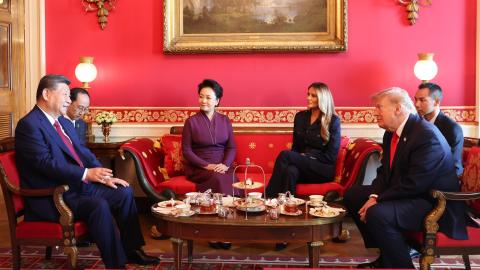
Well, you see that the April meeting between XI and Trump is just an expected event on the calendar. I think President Trump will use that as some kind of deterrence against China's possible misbehavior. It's like, you have a very important uncle to visit your family and your family is totally in total chaos and you want to beat up your neighbors. And so your uncle is coming in April, and so basically you have to behave better. Nothing bad will happen before April. So that's basically what I think is going on. Now you say the China and Russia condemned US intervention in Venezuela. This is very ironic. Russia and China are the two most aggressive, most militant aggressors in the world. I mean, they don't need any kind of a US intervention to beef up their already bellicose stands against its neighbors against the peace. So it is just all phony to me. And I think China and Russia, of course, they act together. And of course, China, Russia, Iran, Venezuela, Cuba, and North Korea, they act together.
Colin Tessier-Kay:
Turning to our final topic today, we close with some more theoretical discourse in international relations and doctrinal analysis with recent US intervention in Venezuela and the capture of Maduro. Almost every subsequent analysis since has been quick to invoke the now 200th century old Monroe doctrine. And even the White House has taken a coining, a new phrase, the Don Row doctrine akin to shifting US foreign policy to securing near hemisphere affairs. But some of the analysis and interpretations have been varied in the reference here. So Miles, given this recent analysis and talk of a renewed US approach to near hemisphere affairs, what are we getting right and what are we perhaps misreading about the Monroe doctrine's relevance to contemporary affairs?
Miles Yu:
I think 99% of people have totally misread the mineral doctrine and its essence mineral doctrine is not isolationism. Mineral doctrine is not about the American's desire to demarcate its sphere of influence in its backyard. Mineral doctrine is active defense while United States is still acting as a global power. So mineral doctrine is not the inward facing isolationism. It is a declaration of protective resistance against external systems threatening. The Western Hemisphere manual doctrine was announced by President James Monroe on December 2nd, 1823. This was in response to wholly alliance desire to restore the monarchical system, to restore the very conservative rule over the already declared independent independence Latin America. So during the Napoleonic War, the French Revolution basically overrun all these monarchies in Europe, most pronounced, or Spain and Portugal. So I mean all the Spanish colonies in the new world Western Hemisphere declared independence in the 1810s, the 1820s with is the unwavering support of the United States.
Because we like democracy, we like independence. So after Napoleon was defeated, holy alliance was established in Soviet in the early 1820s, Russia, which itself a waste hemisphere country because Russia still had Alaska. Russia wants to come to sort of a Latin America. And so the Monroe Doctrine basically says that no, we do not want any European imperialist either Russia or the British to come to the Western Hemisphere because Western Hemisphere is already independent and you cannot come here to recolonize to restore your kings back to the already independence independent West hemisphere. So that's basically a response and anti-monarchical restoration. So later on, of course during Teddy Roosevelt's time, he extended that through the sort Roosevelt coronary and which means that us is going to be hostile ideologically to any other malign penetration from outside. So manual doctrine defines a security parameter, not retreat us opposed to external domination in the Americas and simultaneously accept global engagement and the power projection elsewhere.
So United States is never just a hemispheric country. United States is a global power, and there's nobody more globalist among the founding fathers than James Monroe. Our fifth president Monroe was a very interesting guy. He was Geor Washington's ambassador, then called the minister to France during the revolutionary period. And Monroe saw the French Revolution as a aftermath, as a movement inspired by the American Revolution. Monroe was one of the few founding fathers who saw the United States as a global power significantly, even though United States was a very small country by that time in comparison to European powers, he saw the global universal significance of American democracy. And he was absolutely against Georgia Washington's president, Georgia Washington's Isolationistic foreign policy. And so the two basically disagree with each other. As a result, president George Washington fired James Monroe as American ambassador to France. So Monroe came home very, very upset and wrote a 500 page self-defense of his action supporting the universal ideals of French Revolution and against George Washington's isolationist foreign policy.
I mean, later on he became President Monroe himself is legitimately the most globalist American president among the founding fathers. So if you understand this background, you understand mineral doctrine is not American retreat. It's American exercising its responsibility as a responsible global power and reinforcing its backyard as independent sovereign hemisphere against any foreign intervention. Now having said this, the reason why we talk about doctrine is because Donald Trump during his second term, we are certain Americans dominance in Western hemisphere, not as a colonizer, but as a protector of hemispheric independent sovereignty. We go after China in Panama Canal, we go after Mexico and Canada for its allowing China to use them as a sort of a transshipment venue to dump cheap Chinese goods in the United States. We also use Venezuela as a place to get rid of all the inferences of the bad guys from outside. Now Venezuela, if you look at Venezuela as a military defense system, and this would illustrate my point, Venezuela's defense system consists of three layers.
Number one, its air defense is basically using the Russian system, the particularly S400/S300 air defense system, it's air warning system and its basic training. And the fighter jets are Chinese. And the Chinese JY-27 radar, long range radar used by Venezuela, it is from China. China has given Venezuela tens of billions of dollars on a regular basis, right? And Venezuela also use Iranian made drones. The Shahe drones were widely deployed across Venezuela. They're made by Iran. So you are talking about, of course, Venezuela also use Cubans as this internal security forces. So this is regime that is the nexus of all the bad guys from within the hemisphere, also from without the hemisphere. So that's basically, it's a very, very interesting point. Monroe doctrine is trying to get rid of all of that. So I think that if you understand the Americans restriction of its power as a democracy, as a guarantor of western hemispheric independence and sovereignty, and you'll have a better perspective on mine doctrine.
Colin Tessier-Kay:
Yeah, that's a really great historical assessment there. Especially to give a little bit more context to your reference, the Trump corollary, he, president Trump made comments on December 2nd, the anniversary of the Monroe Doctrine, saying his administration proudly reaffirms this promise under a new Trump corollary to the Monroe Doctrine. So to bring this conversation home for today, let's look forward here one more time from a moment. There have been talks about US intervention in Greenland most recently and making good on comments made as early as last year to secure the territory for US security interests and hemisphere interests as well. So out of this line of thinking miles, where does the Don Rowe doctrine go from here in terms of strategy? Does Greenland now enter the picture as the new priority, or is it elsewhere perhaps in Latin America or the Caribbean? I think we talked about Cuba last week, but keeping with China as the priority focused here, where does this doctrine sort of place the priorities?
Miles Yu:
Okay, so your question sort of prefaced with an anniversary note that Donald Trump announced his doctrine on the 201st anniversary, actually 223rd anniversary on December 2nd, 2023, the 200th anniversary of reduction. You know who else made a very major announcement? Maduro Nicholas on that day announced his intention to annex two thirds of Guyana next door. That basically is a major warning to many countries, definitely to the United States as well. That would mean that Venezuela during invade a neighboring country, rallying some countries left on countries like Columbia and Brazil against other countries like Ecuador and Peru, even Argentina, who do not like this. So you become, if that plan or to carry it out, and you are going to see Latin America to become another Gaza, another Middle East, it's going to be very endless. So to answer your question, you put about the Greenland. Now Greenland of course is not just a idle ice cap over there, the largest Iceland island over there. Greenland is essential for Americans. I mean, we made it very clear in the age of ICBMs, in the age of great power competition, and I think the Russia and China have expressed a very strong interest in getting hold of that period, that island for hemispheric defense and for the defense of NATO, United States will feel urgent to have that. Now, of course, you can always argue about the methods with which to acquire land like that. So Denmark really acted up and say, this is the infringement upon Denmark’s sovereignty.
Let's just put some hard facts on the table. Denmark, you know what? Copenhagen in Denmark is farther away from Greenland than New York City is. If you look at the map, and Denmark really does not have a very strong colonial policy toward Greenland. Greenland is, and I think Denmark said, we're not going to sell our territory to anybody. The irony is that the last time United States acquire foreign territory through purchasing is from Denmark. The American Virgin Island was sold to the United States by Denmark just about over a hundred years ago. So I mean, this does not really have a historical memory from the point of view of the United States. So I think you can be negotiated and if you can put this defense of Greenland into the overall parameter of NATO defense and hemispheric defense, and I think they will have some kind of settlement going on.
Now, there is also an argument that there is a 1951 treaty between United States and Denmark over Greenland that is, United States is allowed to have all kinds of defense mechanisms built up in Greenland in the context of an anti-Soviet expansion. But that's different from owning it because the whole purpose of a US expression is a view of having Greenland is to preclude other countries like Russia and China from similar kind of deal. So it's about ownership, it is about sort of exclusion of other countries into that land. So I think, I don't know what going to, what's going to happen, but I think this week the leaders of Greenland and Denmark will come to Washington DC to deal with them and to deal with this issue with American leadership. Hopefully, we'll have a very satisfactory result to all.
Colin Tessier-Kay:
Yeah, that's a great point. We're going to stick with that too. But unfortunately, that's all the time we have for this week's conversation. Always love it when we can get back to the fun IR theory talk, and I'm sure we'll get back to it again soon. But for this week, thank you to our listeners for joining us. And thank you Miles as always, for lending us your time and expert insight. Looking forward to next week's conversation.
Miles Yu:
Alright, see you later.