













In this week’s episode of China Insider, Miles Yu covers NVIDIA Chief Executive Officer Jensen Huang’s recent trip to Beijing as the United States investigates the company’s potentially illicit sales to China in violation of export regulations. Next, Miles analyzes the People’s Liberation Army Navy’s CNS Fujian—its latest aircraft carrier—and what this means for China’s naval capabilities. Finally, Miles reviews Taiwan Vice President Hsiao Bi-khim’s recent address at the European Union’s Inter-Parliamentary Alliance on China’s annual summit in Brussels.
China Insider is a weekly podcast project from Hudson Institute’s China Center, hosted by China Center Director and Senior Fellow, Dr. Miles Yu, who provides weekly news that mainstream American outlets often miss, as well as in-depth commentary and analysis on the China challenge and the free world’s future.
Episode Transcript
This transcription is automatically generated and edited lightly for accuracy. Please excuse any errors.
Miles Yu:
Welcome to China Insider, a podcast from the Hudson Institute's China Center. I am Miles Yu, senior fellow and director of the China Center. Join me each week for our analysis of the major events concerning China, China threat and their implications to the US and beyond.
Colin Tessier-Kay:
It is Tuesday, November 11th and we have three topics this week. First, we cover NVIDIA's, CEO, Jensen Huang's, recent visit to Beijing and the larger impact of Nvidia and other companies in the AI race between the US and China. Next we take a look at China's latest aircraft carrier to enter service the CNS Fujian and the impact this might have on China's naval warfare capabilities. Lastly, we review Taiwan Vice President Hsiao-Bi Khim’s unprecedented address in Brussels at the IPAC plenary in the European Parliament and unpack the larger meaning and impact behind her speech. Miles, great to be with you again this week.
Miles Yu:
Nice to be with you again.
Colin Tessier-Kay:
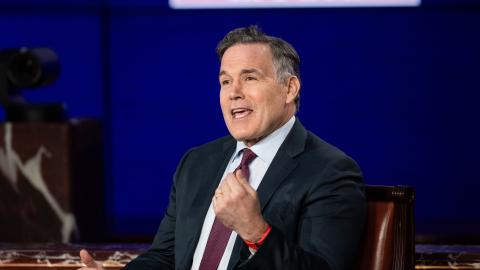
So up first today we got NVIDIA CEO Jensen Huang visited Beijing last Thursday, a day after the US government announced an investigation into the company and whether it violated export control and other trade rules with sales to China. During his visit, Huang met with several Chinese economic policy and trade officials as part of the China Council for promotion of international trade. And leading up to the visit NVIDIA promised early last week actually to start the timeline here, a $500 billion investment in AI infrastructure to the US which a day later raised concerns over licensing restrictions for sales to China and eventually prompted the House Select Committee on the CCP to open the investigation here. So Miles, a lot of dominoes in the span of only a few days, can you walk us through what's been going on with NVIDIA currently and what Jensen Huang is intending to do with his trip to China?
Miles Yu:
Jensen Huang is a not an ordinary individual. He is the head of the world's largest company, NVIDIA, which has the capitalization of over $5 trillion. That is a gigantic behemoth, so that’s number one. Number two, he is also an individual who has been in this sort of graphic cards GPU business for a long, long, long time. So he has a very extensive connection and investment partners inside China, and also he's from Taiwan and I think he has a lot of connection in Taiwan as well. So Taiwan is the place where the most advanced chip making is happening. So Jenson Huang is a nexus of the leading technology that really decides the future of our contemporary life. So he's very important. So Mr. Huang is also a man of enigma. He is a technical titan, a technology titan, but also he has a very peculiar if not naive politics. So, he goes to China, and everything that goes to China, it has intrinsically the national security concern involved. So this is basically what your prelude indicated and we're going to probably use in this time to dissect some of the nuance details.
Colin Tessier-Kay:
And so while there are many companies at various stages of the supply chain involved in the AI race between the US and China, advanced software and chip manufacturers are typically under the brightest spotlight, and NVIDIA is perhaps the most valuable of these companies. So our listeners might remember back three years ago, following the initial wave of export controls to restrict Chinese chip procurement, NVIDIA intentionally lowered the capacity of one of its chips, the H20 to meet threshold requirements and became a Chinese specific product. So since then Jensen Huang has insisted on China's essential role in the AI market globally and has gone as far as to suggest that China is actually ahead in the current AI race. So Miles, I'd love to get your assessment here on what the current AI market landscape is and who holds the current advantage between the US and China?
Miles Yu:
Definitely United States is holding the advantage. Jenson Huang's remarks about the AI technology in China and in the US has been very conflicting. I mean one day he said China is a century behind, and then another day he says “Oh, we are five and ten years ahead of China.” So it's very interesting. I think this actually is a fundamental problem. The problem that Mr. Huang is conflicted with is the problem of the dilemma of corporate interest versus national interest. To him there's no difference. I mean this is very troubling because about a week ago he was asked in the AI race, doesn't matter if China wins or US wins, he said, no, it doesn't matter. This is a really, really naive and a myopic view because if China wins the AI, there would be no NVIDIA pretty soon. So, this is really, it matters.
And I think that Mr. Huang also, ever since he's been talking about this kind of a sense of China's tremendous advancement in AI technology and the subtext is that China's so advanced, it'll be futile for the United States to conduct export control. In other words, whatever NVIDIA is making in Silicon Valley in the United States, we should just ship it to China and occupy the markets. This is a very dangerous - export control is a matter of national security is absolutely vital. And so I don't know exactly where Mr. Huang stands on the surface, he said of course we want to go there because it is futile actually to stop China from advancing because they are unstoppable. This is a very dangerous thought, and I think there's no question China has made tremendous advancement in AI technology, but Mr. Huang and NVIDIA themselves are major culprit for China's AI rise.
Mr. Huang’s lieutenant for 14 years. He was the Vice President of NVIDIA in Silicon Valley, his name's Zhang Jianzhong his English, James Zhang. So in 2020, after 14 years serving as Mr. Huang's Vice President in Silicon Valley, Mr. Zhang just left the United States and went to China. They're setting up a sort of competitor and the very powerful AI firms called the More Threats now. More Threats is basically competing with NVIDIA and now surpasses NVIDIA in some aspects. So I think Mr. Huang is really haunted by the ghost of his own Frankenstein. That's the More Threat in China. And there's been report that NVIDIA China office shared the same address with the More Threats of NVIDIA’s Frankenstein. So I think this is a very, very troubling. So I'm not surprised that Congress, the China Committee, is actually investigating the ties between NVIDIA and More Threats because it is not about export control, it's more about sort of a sanction and more about national security.
I think this is a very important message. And I also think that the idea that Chinese are unstoppable in AI race is just bologna. It is the same kind of rhetoric coming from the mouth of the Chinese propaganda machine that is the CCP is unstoppable, China is unstoppable, it's nothing but capitulation. And I think that Mr. Huang may, I emphasize unwittingly, parrot the line of Chinese propaganda. So because I think Mr. Huang failed to understand fundamentally the structural flaws of China's AI eco-environment. So you cannot say, well, because if NVIDIA and many of the other Silicon Valleys including Apple behave and put a national interest ahead of their own corporate interest, China will be miles behind the United States not nanoseconds behind us.
Colin Tessier-Kay:
Yeah, that's certainly a concerning development. Do you have any idea, Miles, whether NVIDIA has kind of been the spotlight here over the last week for obvious reasons and developments, but there are many other companies involved in the supply chain like we mentioned. I think AMD and their CEO, Lisa Su and other companies is like, is NVIDIA kind of alone in the concerns here or are there other companies that should be of concern for the US government right now?
Miles Yu:
Well, because of NVIDIA's leading prominence in Silicon Valley, Mr. Huang is a chief lobbyist to the White House to ease even cancel Americans export control to China, particularly his own chips. This is very dangerous, this is extremely dangerous. And Mr. Huang has even gone so far to call the so-called the China Hawks, which really do not exist because everybody who dealing with China now is considered Hawk because of Chinese reality. It is the threat is really, really important and he called them unpatriotic. I mean this is just ridiculous. And I think Mr. Huang is motivated by NVIDIA's desire to march into Chinese market through corporation with its own creation, the more threats and other Chinese companies. This is corporate globalism, which is very dangerous to the national security of the United States. And I think I mentioned earlier we have to understand the CCP is not unstoppable.
The CCP has some very structural limitations, particularly when it comes to the AI race. Think about this, look at the rise and the rapid fall of DeepSeek. China's answer to Open AI and ChatGPT because the Chinese political culture, technological culture does not tolerate truth and transparency, and artificial intelligence is primarily relying on big data. China collected enormous amount of data, but also the Chinese government is the most notorious distorter of data. So for political purposes, they just can really distort and misinterpret all the data. And that's why DeepSeek has future. DeepSeek came to the world with great fanfare, and everybody was scared, but now very few people use it. It's render completely useless for most of the customers outside of China. And another thing is we have to understand that China dominates artificial intelligence. At least they try to dominate the artificial intelligence and other technologies in order to sell their products to the world in a very monopolistic way.
If there are alternative western products such as NVIDIA's own products, then China will be severely contained. Just look at the China's electric vehicles. China's electrical vehicles were heavily subsidized by the government. That's why it's very cheap and technologically is very advanced, but it occupies a very small share of global markets because every major country, including EU, the trading block is prohibiting Chinese made EV’s from entering their markets. That's why EU occupies less than 10% of global EV market. So that is telling. So if we band together to realize the particular danger of a Chinese model of technological development and then Nvidia will shine. So I don't know why this is so hard to see.
Colin Tessier-Kay:
Yeah, let's stick with those policy analysis and recommendations here to round out the topic because from the perspective of the US government and the international community - and allies in the international community, what can we do to maintain the current disparities in the AI race? In your assessment Miles, are current export controls effective in curbing Chinese production, and what other channels of leverage are left to explore here?
Miles Yu:
Oh, export choice is crucial. I mean, China obviously has make an economic stride and technological stride. There's no question about that. But that development in China is critically dependent upon Western innovation and technology. That's why one of the most important tools the US government and US society as a whole have against the Chinese threat is really to through export control. And we did that very, very effectively during the Cold War, but that's because we have a collective mechanism to conduct export control to the Eastern Bloc. Collectively, no country, no company could get away with doing something sort of hanky panky with the Soviets, with these eastern communist regimes. So that's one reason why it's effective. So now United States is leading a way to conduct export control for its own national security. And I think in a lot of companies, a lot of other countries try to make an exception.
Those exceptions have harmed American national security very, very greatly. Just look at these ideas about tariffs. I mean United States levy heavy tariffs on Chinese steel and aluminum because China is dumping all over the world, particularly in the United States, destroying Americans steel and aluminum industry. So, since Obama years, and we levy heavy, heavy tariffs on China steel and aluminum, but then there was a lot of friendly countries, Australia, France, England, they all come to the United States asking for exemptions. We did that in 2018 under the first term of the Trump administration. That was a mistake. That's why at the beginning, very beginning of second term of the Trump administration, we saw that we get rid of all the exemptions. Everybody, every country that does Chinese betting through transshipping of Chinese steel and the aluminum to the United States will get rid of, will be without their exemptions. And that's basically what's fair.
Colin Tessier-Kay:
Turning to our next topic today, we cover the latest news from the PLA Navy as the new CNS Fujian aircraft carrier entered service last Wednesday, actually in a ceremony that was attended by Xi Jinping, the carrier boasts several advanced capabilities that stand to boost PLAN blue water capabilities and advanced surface warfare capacities. So, Miles, to start us off here, what should we know about the CNS Fujian and why does this new vessel matter to PLAN maritime strategy?
Miles Yu:
Well, as you say, I mean this is a China's way to tell the world the Chinese ready for blue water navy to contest the power of the US Navy, which is number one in the world. I look at this whole process, if you understand any of the ethos and motivations of China's weapons development, which is heavily influenced by political ideology, which is to buttress the CCPs sense of infallibility and invisibility. So the party for its own existence needs constant reassurance of triumphs and great achievements. Carrier fruit is one of the most tangible conspicuous symbol of power and power projection. So if you look at this, you look at Chinese carrier development, it fits into this political culture perfectly. So if you look at the first Chinese carrier, which is the CNS Liaoning gave China the big power status, but they did it despite China's backward naval architecture and ship designs.
And China wanted to push ahead to indicate how powerful, how invincible party is. So you know the Liaoning story, I mean 1999 China bought the Soviet design, half-finished, a shell of this carrier called a Varyag, which was then in Ukraine. So, China spent $20 million and use a phony company in Hong Kong and they spent several times more on transit and docking. And then about 10 years later, China retrofit and made it barely float with the limited sea trials and without an operational airway even. So, they rushed to claim victory and launch it in September 2012. Why is September 2012? Because that's just about the time Hu Jintao, the former party chief of China, Xi Jinping's predecessor, was about to end his tenure. So, in order to glorify Hu Jintao and his CMC Central Military Commission chairmanship, so launch that just weeks before he handed over to Xi Jinping. Xi Jinping took over and the first thing he did was state “I'm going develop more carriers.”
So, Xi Jinping and navy people told them, you know what, to match the United States of carrier power, you got to do more. One of the most advanced features that US carrier fleet has is this thing called electric magnetic catapult, which then was being developed through the US as a J4. So, Xi said, let's do it. And he had no idea what was involved. So, this is a political decision. He wanted to do it regardless, just show how powerful, how awesome the party and himself would be. So, and you look at this, the new ship channel, the third carrier is called the Fujian. Why Fujian? Because that's where Xi Jinping's power base was. He was Fujian party chief there. Most of the people he used in his current regime or have Fujian connections. So, this is very much like all communist party leaders. In Soviet years, you have Khrushchev. Khrushchev’s power based in Ukraine because he was a longtime party chief in Ukraine.
So, it's very much like Fujian, like Khrushchev in Ukraine. So, Xi Jinping himself decided on electromagnetic catapult, a technology only the US can handle and it's still not really completely mature yet for the United States even. So that's one reason you saw President Trump on the carrier in Tokyo Bay last month and he watched the launch of the aircraft from the deck of the carrier through this steam operated catapult. He said, oh, I like the steam power. It's very much more reliable. So even United States has some difficulties with that. China yet wants to go ahead because this is a symbol of China's technological advancement. So, it's not a work of greatly forward mentality. If you know the history of Chinese Communist Party, it was launched in a hurry, it was a rushed job last week. Most obvious one is it's conventionally powered, it's not nuclear powered.
If you use the electromagnetic catapult, it's going to consume enormous amount of electricity for its constant launch frequency and conventionally powered proportion is hard to have sufficient power to sustain the huge demand for electricity on the ship as big as Fujian. Fujian has about 80,000 tons of displacement. I mean it's far short of the 11 operational US nuclear powered aircraft carriers. I mean the Nimitz class carrier, any one of our Navy carrier fleets would definitely beat the Fujian by a long shot. So, my overall take about Fujian is that there are a lot of technical glitches that have not been solved, and they do not have very good aircraft airway. So, because Chinese aircraft and basically the J-15 and J-35, that kind of chunky and very unimpressive to me. So overall my take about Fujian is its operation ready, not quite combat ready yet.
And I might want to add one more thing. It's very interesting, excuse me. The launch ceremony is also very peculiar. This whole thing was basically marked the gigantic triumph of a Chinese carrier technology as promoted by the Chinese state media, particularly the gung-ho xenophobic global times. But Xi Jinping himself was absent at this launch ceremony. Now this ship's home port is in Sanya, is in Hainan Island. It is under the command of the South fleet of Chinese Navy who are absent at the ceremony. It's the Chinese navy chief, he's not there. And also, absent was the commander of South Fleet as well as the commissar of South Fleet. They were absent. So, this is very peculiar. So, I would not be surprised. This would definitely indicate another round of purges including those guys, Navy Chief Commander of South Fleet, because after all many of these similar counterparts in other theater commands were also being purged just last month.
Colin Tessier-Kay:
Yeah, that's right. And there's going to be a few more probably on the way in the future months here. But it seems, just to sum up everything here - a very comprehensive analysis - it seems the biggest development has been the electromagnetic launch system, which compared to the predecessors, like you mentioned, the CNS Shandong and the Liaoning carriers, which have ski jump runways, which for our listeners looks exactly as it sounds: it's a curving upward end of the launchpad to launch the aircraft. But the significance of this is that it allows the flagship carrier now for the PLA Navy to store fixed wing aircraft and enhance operational capacities in blue water vessel capacities. But ultimately it sounds like it is not going to alter the calculus on the US perspective for Indo-Pacific deterrent strategies. But I guess the one question Miles to round out this topic that I'm sure a few folks are kind of wondering here, whether or not is China already building a fourth carrier to add to the fleet? And the big question on people's minds here is: what is the chance the next carrier for the PLA navy will be nuclear powered?
Miles Yu:
Well, I hope China will spend a lot more money building their own fleet because they have more miles, miles to go to catch the lethality and operational effectiveness of the US carrier fleet. We've been doing this for a long, long time at a great expense and we're very careful. Each carrier, when it's built, takes years and a lot of money and also goes through rigorous, rigorous, rigorous sea trials and before it was delivered into service. So, I don't think China has that kind of a political culture. And technologically they're behind just talking about the carrier fleet. And carrier fleet is the fundamental tool of power projection. That's why nuclear proportion is very important. You can go for 20-25 years without refueling. If you have a conventional power carrier. And if you do not have a system of a network of overseas provision stations, basin station repair, a system like the US always do globally and the carrier basically maintain nothing but the littoral vessel.
You just sail around China's coastal area and for promotional purposes, China has three carriers so far. I think at least two of them are just training ships, training vessels. They're not really operationally super effective. Do they have the capability to launch and retrieve? I think they do. But when you compare that kind of capability with the Americans, with the vast experience of our carrier development, I think China has a way to go mean. So, this is something that we can be very, very sure of. Does China have a surprise? Yes, China always surprises us, but our job is to see how impressive and how defective, how limited their weapon developments are. And all signs indicated that they have made tremendous progress from a very low point of view, but they still have a way to go.
Colin Tessier-Kay:
That would certainly track. So, turning to our final topic for today, Taiwan Vice President Hsiao Bi-Khim, delivered an unprecedented address at the Inter-Parliamentary Alliance on China’s Annual Summit or IPAC in the EU parliament. The unprecedented qualification is due to this being the first ever address delivered by a senior official of Taiwan's government in the EU legislature, which has never happened in a country, much less an international forum that does not officially hold diplomatic relations with Taiwan. So, Miles, the nature of the address wasn't the only significant matter. What did the Vice President cover in her speech and what are the key takeaways we should know from this event?
Miles Yu:
Well, the messages have been familiar to many in the world about Taiwan and Hsiao Bi-Khim is the vice president. She speaks perfect English and she was, as a matter of fact, Taiwanese ambassador, ambassador or equivalent to the United States when I was working for the State Department. So, I knew her very well. And I think what she said was that Taiwan is not alone. Taiwan has friends. What Taiwan stands for is not just some kind of parochial issue in Western Pacific, what Taiwan stands for is global peace and a global model of governance championing for democracy and freedom. So that's all the familiar phases. So, as you indicated correctly, it's not what she said that mattered the most, it's the fact that she was able to go to Brussels and stand in the hollow halls of the European lawmakers. And that is really important because the Chinese government was furious with this.
They threatened the EU diplomats and EU parliament, but then those people were not really, did not bow down, shall we say. And I think the Chinese diplomacy is basically warrior wolf, wolf warrior diplomacy full of a lot of insults and threats. And I think it's a sign of desperation. Taiwan is getting more and more recognized by the international community, particularly the alliance of democracies. Most people look at the Taiwan China spot not as the issue of a territorial dispute, who owns home, who belongs to whom, whether Taiwan is promised or not. Rather they have a look at the Taiwan issue almost entirely from the point of view of tyranny versus freedom, dictatorship versus democracy. And I think that's a very, very correct perspective. This is a very important thing. And also send a very strong signal to China that Taiwan indeed is not isolated. China always tries to pin the blame for Taiwanese desire, for self-determination, self-governance on the United States. So, we're the Black Hand or we're the instigator for Taiwan independence. All of these announcements, they just do not really understand the Taiwanese people's own feelings and their desire for popular sovereignty. And this one actually the big blow to China from Taiwan was not really rendered from Washington DC or Angeles or San Francisco, whether from Brussels, from the heart of the European continent. And that's why it's very important to stress the symbolism of Taiwan being supported not only by the Americans, but also by Europeans.
Colin Tessier-Kay:
Yeah, one of those key elements in her address is something that has been a Taiwan government talking point for quite some time now. But like you mentioned, it's not about the juxtaposition of Taiwan in reference to China and the quest for self-determination. It's really that Taiwan is a vital component of global prosperity and an advocate for democracy worldwide, not just in the face of the communist China threatening to invade. They really stand to provide a much greater benefit to the global community as an active contributor. So, Miles, I'd love to ask, what is the significance of this speech in the context of Taiwan status in the international community? Because historically there have been several occasions of including Taiwan in certain international forums and events, sometimes to provoke China or act as a counter to coercive developments from the mainland. So, in reference to this event, might this lead to more official relations between the EU and Taiwan, or are there still significant structural barriers to a more robust relationship between the two?
Miles Yu:
I think philosophically and intellectually, even ideologically Taiwan is already recognized by world democracies. What we need is formality. Now that is basically the matter of political courage, and I think there's only a few Senior Western leaders who are willing and courageous enough to say the obvious. That is, we have to diplomatically recognize Taiwan. Now, China will always try to phrase this issue of Taiwan and China from the point of view of reunification, which is just a total, total garbage because Taiwan has never been part of the People Republic of China. That's just undeniable fact since 1949, not one inch of Taiwan's territory has ever been administered by Chinese government. Secondly, Taiwan sovereignty has nothing to do with the KMT struggle, and the former Republic of China fled to a government, fled to Taiwan. Taiwan sovereignty and a sense sovereign independence really came from its time when it started the democracy and the freedom in late 1980s and particularly since the first democratic election in 1995-1996.
And by the way, China always say Taiwan historically belonged to China. That is also kind of gobbledygook because international law never recognized the legitimacy of historical rights as justification for annexation and territorial demand. So most obvious cases are 2016, the Hague Tribunal ruling against China's claim in the South China Sea and ruling saying that China's demand claim for the South China state is completely illegal. So of course, I think China wants to have Taiwan because China wants to finish what they call unfinished revolution of liberation of 1949 when the Chinese Communist Party was so triumphant, they basically defeated the nationalist government. And the only thing that could not really do, has not done is to completely subjugate the group of people who fled to Taiwan. So, Taiwan is part of what is an intrinsic part of Chinese Communist party is ideology of liberation. So, this is a very, very important for us to keep in mind.
So most importantly, the US government has never acknowledged and agree to China's claim that Taiwan is a part of China. You can go through all those three communicates cases, six assurances, Taiwan relations act, all the documents you see that United States bear just merely acknowledged China is claiming Taiwan as part of it. We never said we agree with you or did not agree with you. All we said is that this matter has to be settled by both sides of the people along the Taiwan Strait, Taiwanese have to agree to China's claim, and this is our bottom line, right? Another thing, of course, we absolutely opposed to any resort to use of force to settle this problem. So that's why United States does not recognize Taiwan as part of China. So, this has to be made clear.
Colin Tessier-Kay:
Well, I think that's a great place to leave for this week's conversation. Thank you to our listeners for joining us again this week. And thank you Miles as always for lending us your expert insight and analysis on these critical issues. Looking forward to next week's discussion.
Miles Yu:
Alright, I can't wait.