

















Below Joel Rayburn assesses the United States’ military options for striking Iran and advancing American regional interests.
Objectives
The strategic objectives will determine the targeting. For the United States, strategic objectives appear to be:
- Eliminating the Iranian nuclear program once and for all
- Ending the threat of Iran’s ballistic missile program and arsenal, as well as its drone program
- Compelling the Iranians to stop sponsoring their terrorist proxies abroad
Those are the vital national security interests for the United States. They’re also the vital interests that the Israelis, Europeans, and Arab states share.
The Trump administration may decide, or may already have decided, to add another strategic objective, which would be to degrade the Iranian regime’s ability to crack down on its own population. If that has been added as a strategic objective for the campaign, then it would dictate an additional set of targets, which would be very different from the ones associated with the objectives above.
As for how to conduct the campaign, the initial priorities will have to be:
1. Disrupt the Iranian regime’s command, control, and communications; suppress or destroy its meager remaining air defenses; and defeat any threat that Iran’s navy might pose to the US fleet
2. Eliminate the regime’s ballistic missile and drone capability, which is the regime’s primary means of conducting counterstrikes and imposing costs to coerce the US and Israel.
Disrupting the Regime
In the very first wave of attacks, the US would want to blind the regime and ensure Tehran cannot communicate internally or maintain situational awareness. The US should prevent regime leaders from being able to understand what is happening to them so they cannot effectively deploy whatever meager defensive capabilities they might have left after last June.
Targets in this initial phase would be:
- Senior regime leadership facilities
- Critical communications hubs
- Critical transportation infrastructure, such as military aircraft and air bases or airports that Iran would use for military purposes
- Broadcast and information sharing infrastructure
- Integrated air defense systems, in the following order:
- Communication infrastructure that allows integration between systems
- Radars that these systems use to detect incoming aircraft
- The air defense missile systems themselves
Iran does not have much air defense infrastructure left after last year, though they have been trying to reconstitute their air defense capabilities in the interim.
Eliminating the Missile Threat
The next priority would be the Iranian missile strike capability. The key here is to locate and destroy Iranian missile launchers, both short- and medium-range. The launchers are vital because while the Iranians may have considerable missile stockpiles, they cannot use them if they lose their launchers. After last June’s confrontation with Israel, the Iranians had an estimated 95 medium-range missile launchers left. They probably reconstituted some of their capability and could have upward of 200 (one estimate from the Jewish Institute for National Security of America puts it at about 260). Whatever the case, the Iranians will have far fewer than the 480 medium-range launchers with which they began the 12-day war. This means their ability to overwhelm Israel’s missile defenses with their medium-range missiles is diminished compared to last year’s salvos.
More dangerous in the immediate term will be Iran’s short-range ballistic missile arsenal, which can reach US bases in the Gulf, Iraq, and Syria, as well as targets in the Strait of Hormuz. It is unknown how many of these missiles (though likely thousands) or launchers (likely about 100) are in Iran’s arsenal. The US will have to prioritize destroying these stocks in the first hours and days of a confrontation to protect US and Gulf allied forces. Luckily for US targeters, the vast majority of these short-range missiles are clustered in western Iran, allowing them to more easily reach Gulf and American targets. So finding them should be a fairly straightforward matter. And of course, as soon as a launcher deploys a missile, its location is detected and it can be struck, provided the US and its allies have the forces on station or missiles ready to counterstrike.
The Israelis were able to reduce the missile threat to a manageable level within the first four or five days of the 12-day war. US forces could likely reduce the missile problem to a manageable level even faster. Essentially, the US targeters will have to find and destroy about 300 short- and medium-range missile launchers as quickly as possible while blinding the regime and eliminating its air defenses.
Follow-on Target Priorities: Nuclear Sites and Sponsorship of Terrorism
Once the US has air supremacy and the Iranians cannot respond with missiles, Washington can strike the remaining targets—including fixed nuclear sites—with less urgency. The only potential exception would be if the Iranians are in the process of recovering highly enriched uranium, usable centrifuges, or other vital equipment that Operation Midnight Hammer buried last summer.
Beyond eliminating nuclear, ballistic missile, and drone sites, the US should also diminish the regime’s ability to support terrorist proxies. Achieving this strategic objective would be a matter of coercing the regime into discontinuing support for—or even taking direct action against—the proxies themselves in Lebanon, Yemen, and possibly Iraq.
An alternate path to this objective would be for Washington to convince and empower Jerusalem to eliminate these proxies. It may be that the Israelis already have a war plan that involves destroying more of Hezbollah while the United States (maybe with Israel’s backing) attacks Iran proper. Otherwise, ending Iran’s support for its terrorist proxies would be a matter of forcing an Iranian capitulation through overwhelming military pressure.
In the broader picture, if the US is going to force the Iranians to surrender or capitulate, it should do so while the military operation is still going on. Alternatively, the White House should negotiate directly with either the regime leadership or the rump regime leadership, if some of the key figures are eliminated. The drawback of the operation last June came when the US-Israeli military operation ended before the Iranian regime was forced to capitulate. The time to negotiate with an adversary like Iran is when warplanes are still flying, not after. The United States should bear that in mind this time around.
If, as part of this targeting campaign, the US eliminates or foments the overthrow of top Iranian leadership—as the Israelis did to the IRGC leadership last summer—the White House will hopefully be prepared to identify which remaining Iranian regime leaders have the power to make a lasting capitulation deal.
Degrading the Regime’s Crackdown Ability
It is unlikely that the US will be able to completely eliminate Iran’s ability to crack down on its population without escalating further. But to degrade the regime’s crackdown ability, the US would have to strike the major regional Basij that the regime uses to control the population, as well as Islamic Revolutionary Guards Corps (IRGC) bases that support Basij operations in those areas. The US is largely aware of the location and nature of these bases, especially after the regime deployed its forces against the Iranian population in January.
The US could strike those bases and any assembled forces there, as well as their communications capabilities and their weapons storage. Striking targets like that, along with blinding the regime and degrading the regime’s ability to move its own forces from place to place within the country, would most likely open a large window of opportunity for popular uprisings, especially in peripheral areas where the population is already inclined to rise, such as Iranian Kurdistan.
The US might also want to disrupt any reinforcing elements coming from Iranian proxies, especially in Iraq. In January, thousands of Iraqi militiamen reportedly crossed the border to quell protests in several Iranian cities under IRGC command. Large convoy movements of these kinds of militia forces would be detectable at or near border crossing points, and the US could disrupt those movements with airstrikes or drone strikes. The Israelis demonstrated this tactic against Hezbollah reinforcements when Bashar al-Assad’s forces were in the process of falling back in December 2024. North Atlantic Treaty Organization forces also conducted similar operations against Muammar Gaddafi’s forces as they approached Benghazi during the Libyan Civil War.
It is unlikely the Iranian regime can handle simultaneous external and internal pressure. Uprisings would likely result in the Iranian opposition taking control of significant parts of the country if the regime is paralyzed.
Economic Pressure and a Tanker War
Whether the US campaign ends up being an extended one, Washington should stop Iran’s oil exports to disrupt Tehran’s cash flow until the Iranian regime has fully capitulated. That means hindering Iranian oil tankers from exiting the Gulf and interdicting those that are already on the high seas, if they can be pinpointed. In other words, the US should institute a blockade on Iranian vessels.
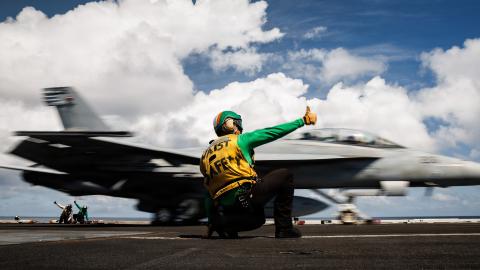
Military planners can expect the Iranians to try to rerun a tanker war in the Gulf, focused on the Strait of Hormuz. This means, in addition to the operations outlined above, US and allied naval forces will have to fight and win against the IRGC Navy and its shore batteries in the earliest phases of war to limit the duration of any disruptions of commercial traffic in the Strait of Hormuz and the Gulf itself.
It is unlikely that the Iranians will be able to put up a lengthy fight on this front. They did not hold out for long in 1988, and US capabilities have advanced considerably in the intervening decades while Iran’s have remained frozen in amber. The IRGC Navy can mount suicide-type attacks, but not for very long. Iran’s shore batteries and their anti-ship cruise missile launchers would probably not survive very long either. But this is another front of the war that the US will have to contend with in the early stages.
Iranian Attacks Against Soft Targets
Finally, the White House should consider what the Iranians might do beyond the near theater.
They can strike American and Israeli targets using whatever sleeper networks they might have in place, and they can hit soft targets both near and far. But this will not be enough to deter Washington and Jerusalem, and the further from Iran these soft targets are, the less capable the Iranians are of striking them. US and allied targets in places like Iraq will be more vulnerable, and the Iranians have numerous strike options.
Iran will be able to do some damage in Lebanon as well, via Hezbollah, though that will be subject to the pressure the Israelis may be putting on the terror group. And while Tehran has shown that it can do some damage in one-off attacks in Europe and Latin America, it has not demonstrated any meaningful ability to threaten the United States itself.
The Iranians will also likely try to launch an uprising in the West Bank. But they failed to do that for the entirety of the post–October 7 war, so it is unlikely they would be able to sustain such an operation under these circumstances.