















Below Hudson Senior Fellow Can Kasapoğlu examines Iran’s effort to rebuild its arsenal after the 12-Day War
Executive Summary
- The aftermath: Iran’s ballistic missile program suffered heavy losses to Israeli strikes during the 12-Day War. But many critical systems survived.
- Reloading: Tehran is working to resupply its ballistic missile arsenal in preparation for another round of conflict.
- ICBM ambitions: Iran’s ambitious space programs indicate that the Islamic Republic is also pursuing an intercontinental ballistic missile capability that can reach the continental United States.
- Axis of adversaries: China is a critical enabler of Tehran’s ballistic missile production ambitions, and cooperation between North Korea and Iran also bears monitoring.
Iran’s Ballistic Missile Deterrent in the Aftermath of the 12-Day War
Since the conclusion of the 12-Day War on June 24, 2025, Tehran has worked assiduously to restock its arsenal and enhance its capabilities. The Islamic Republic is rebuilding its stocks of ballistic missiles, pursuing an intercontinental strike capability, and gearing up for the next round of hostilities. These efforts threaten European North Atlantic Treaty Organization members, America’s allies in the Middle East (Israel and the Gulf Arab monarchies), and the mainland United States.
Three developments have been driving Tehran’s actions. First, recent exchanges with Israel have affirmed two aspects of Iran’s strategy: (a) that hiding missiles and launchers underground can ensure that at least a small number survive even the heaviest strikes and (b) that mass salvos can either penetrate or attrit US and allied air and missile defenses. Second, Iran’s missile industry has at least partially weathered sanctions, mainly thanks to support from China and North Korea. Third, Iran’s space program has given Iran’s Islamic Revolutionary Guard Corps (IRGC) cover to pursue the development and acquisition of intercontinental ballistic missiles (ICBMs) capable of targeting the continental US. President Donald Trump’s recent statements indicate a willingness to support Israeli military action if Iran continues to enhance its ballistic missile arsenal.
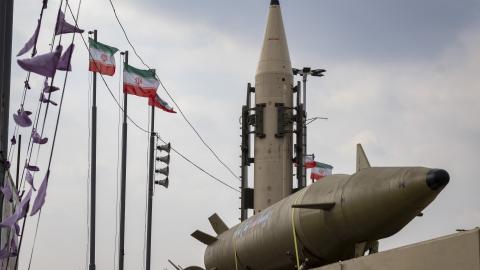
Tehran views its ballistic missile force as a strategic priority and is prepared to absorb heavy diplomatic and economic penalties to restore and expand it. High-ranking Iranian officials have repeatedly noted that the Islamic Republic will pursue its long-range strike deterrent no matter the cost. Israeli estimates suggest that Iran possesses around 2,000 ballistic missiles, including short- and medium-range systems capable of striking regional targets.
During the 12-Day War, the Israeli Air Force exploited the semi-permissive airspace over Iran to preemptively strike Iranian ballistic missiles still on their transporter-erector-launchers (TELs). Nonetheless, Iran’s subterranean basing architecture, referred to as “missile cities,” managed to preserve some of its ballistic missile stockpiles. Estimates suggest that the IRGC began the war with 480 TELs and ended it with roughly 100.
Reloading for the Next Conflict
The Islamic Republic hopes to build its missile force back to its previous heights. Iranian officials, including Foreign Minister Abbas Araghchi, have ruled out making any concessions on the development of the nation’s ballistic missile arsenal and have adopted increasingly hostile rhetoric on the issue.
In fact, recent indicators suggest that Iran is already rebuilding this program despite the reimposition of United Nations sanctions. In September 2025, open-source intelligence sources spotted an unusual contrail over Semnan Province, east of Tehran. The pattern suggested it was the ascent of a rocket. Iranian authorities did not identify the cause of the phenomenon, and state media outlets made no reference to the event.
Commercial satellite imagery collected before the incident revealed that the circular launchpad at Imam Khomeini Spaceport, roughly 145 miles from Tehran, had been painted blue, with the red, white, and green markings of Iran’s flag adorning its perimeter. Images from after September 18 showed a change in the launchpad, including discoloration consistent with thermal exposure.
The extent of this damage became clearer in higher-resolution commercial satellite imagery released several days later, which revealed pronounced scorch patterns across the surface of the pad. The burn marks closely resembled thermal signatures observed following previous Iranian launch events, where engine exhaust and flame impingement had burned and deposited residue onto the pad during liftoff. Experts judged the scale and texture of the scorching to be consistent with the use of a solid-fuel propulsion system, as launches involving solid-fuel motors are known to leave distinctive residue patterns associated with burning aluminum oxide particles.
Uncoincidentally, the IRGC has reportedly resumed importing large quantities of solid-propellant precursors, signaling an effort to regenerate its depleted missile capabilities. Leaked intelligence assessments revealed that in 2025, Iran imported tons of sodium perchlorate, likely from China, through the port at Bandar Abbas. This compound is a critical component of solid-fuel missile motors; the quantities Iran is alleged to have imported would supply several hundred medium-range ballistic missiles. Maritime intelligence tracking has identified a small fleet of cargo vessels repeatedly plying routes between China and Iran for some time, some employing concealment measures consistent with efforts to evade sanctions. Several of these ships have been linked to Iran’s state shipping apparatus and have previously drawn scrutiny.
ICBM Ambitions: Iran Boosts Its Space Launch Capabilities
The Islamic Republic’s development of its space program—and concomitant pursuit of intercontinental ballistic missiles—is also cause for concern.
In April 2020 the IRGC Aerospace Force conducted its first launch of a military satellite, sending the Noor satellite into orbit roughly 273 miles above Earth. This was the first time Iran’s Revolutionary Guards—not the country’s civilian space agency—had conducted a successful orbital launch. The satellite was propelled into orbit by the Qased launch vehicle, a three-stage system that combines a hybrid propulsion architecture of liquid and solid stages that is derived directly from existing Iranian missile and space launch infrastructure.
This configuration mirrors the design of an ICBM. The Qased’s first stage was likely powered by a Ghadr medium-range ballistic missile motor, further reinforcing the conclusion that the launch relied on repurposed military technology.
In July 2025 the Islamic Republic tested its space launch capabilities for the first time since the 12-Day War. These tests, also involving the Qased satellite carrier rocket, continued Tehran’s efforts to refine technologies that apply directly to long-range missile development. While Iranian state media characterized the test as a technical evaluation of satellite performance, the underlying military implications are significant.
Under the leadership of Supreme Leader Ali Khamanei, the Islamic Republic is now doubling down on the development of its indigenous space launch infrastructure, with plans to put multiple satellites into orbit in addition to those it launched from Russia in December 2025. Central to Iran’s space-based efforts is the near completion of a new launch complex, Chabahar, on the country’s southeastern coast. Iranian authorities have indicated that this new facility is approaching operational readiness and is intended to support a range of missions, including the deployment of Earth-observation satellites and experimental platforms linked to Iran’s expanding military space program. Among the systems slated for launch are multiple domestically produced satellites, including updated variants of the Zafar and Kowsar programs, as well as test components associated with the Soleimani satellite constellation.
The technical overlap between satellite launch vehicles and long-range ballistic missile systems has long been a point of concern for the West, particularly given Tehran’s parallel investments in propulsion, guidance systems, and multistage rocket design. Since the first Trump administration, the US has assessedthat Iran’s allegedly civilian space launch program gives it a viable pathway for developing ICBM capabilities.
The United Kingdom, France, and Germany came to a similar conclusion. Last year, the three nations released a joint report alleging that Tehran’s use of Ghaem-series space launch vehicles to put the Soraya satellite into orbit was a cover to test ICBM-related technologies. Iranian sources have echoed this allegation.
Iran’s renewed launch technology development continues to blur the line between peaceful space activity and ICBM capabilities, sending a threatening signal in an already unstable strategic landscape.
The Continued Iranian Threat to the US and Its Allies
Continued Iranian ballistic missile development gravely threatens the US and its global allies.
Through direct action and proxy warfare, Iran has already used its missile warfare capabilities to impose significant strain on Israeli and American missile defense inventories. During the Israel-Iran clashes in April and October 2024, the Arrow anti–ballistic missile system, jointly funded and produced by Israel and the United States, performed well. But the sheer volume of Iran’s missile salvos stressed the system, as the IRGC’s missile forces launched roughly 200 ballistic missiles at Israel in October 2024 alone. Iran had learned from its April attacks that scaling up its salvos and employing its highest-end missiles significantly improved its odds of overwhelming Israel’s stock of Arrow batteries and interceptors.
In October this approach came close to succeeding. Thirty-five of the approximately 200 missiles Iran launched may have reached Israeli territory. Many of these projectiles landed near the critical Nevatim Airbase, which hosts Israel’s F-35I Adirfifth-generation combat aircraft.
Israel’s missile defenses were sufficiently stressed that the US had to rush one of its Terminal High Altitude Area Defense (THAAD) systems to the theater. During the 12-Day War, US forces reportedly expended around 150 THAAD interceptors and 80 SM-3 interceptors in the defense of Israel, depleting roughly 25 percent of the entire US interceptor stockpile. US forces also deployed an undisclosed number of Patriot interceptors to defend America’s Al Udeid Air Base in Qatar. Compounding this, the US Navy used roughly 200 SM-2 and SM-6 interceptors defending against the Tehran-backed Houthis in the Red Sea.
Iran’s development of an ICBM would represent a significant escalation. While these systems would not pose an existential threat to the United States, even a limited ICBM capability would bring all of Europe and much of the continental United States within Iran’s coercive reach. The credible ability to threaten several US cities could increase the political and strategic costs of military action in the Middle East, giving Tehran leverage over Washington.
Furthermore, cooperation between North Korea and Iran could severely strain Washington’s missile defense systems. This threat is further amplified by Iran’s nuclear ambitions. Experts have already highlighted the possibility of Pyongyang transferring nuclear warheads or related proliferation materials to the Revolutionary Guard. No matter how rudimentary, any Iranian nuclear launch capability would pose a grave threat.
These scenarios may seem unlikely for now. But history suggests that when confronting Iran, prudence lies not in preparing for what is most likely, but in guarding against what is most dangerous—and therefore most consequential if ignored.