

















Mention China to a typical foreign-policy “expert” on the left or right, and they’ll describe it as a formidable adversary with a chance to challenge the U.S. But that conventional wisdom is way out-of-date: Communist China’s war on the U.S. has already begun. The trick is that Beijing is trying to make sure Americans never realize they’re under attack.
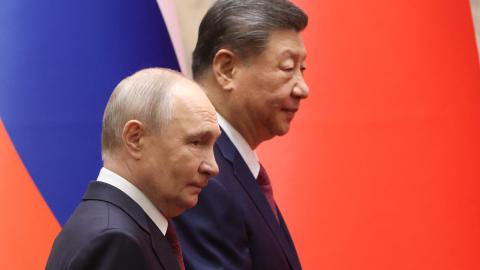
The Chinese Communist Party (CCP) is working to undermine the U.S. across economic, technological, informational, diplomatic, and gray-zone military domains. Especially since Xi Jinping’s rise, Chinese leaders have committed to diminish American superpower without triggering a U.S. military response. The Chinese don’t want a shooting war today, or ever, if they can help it. Instead, they’ve chosen to erode the foundations of American power by coercing U.S. allies, commandeering global supply chains, and bending international institutions toward Chinese interests. Beijing wants to do all this while keeping the U.S. reactive, fragmented, and unsure about how seriously to take the threat.
China’s most destructive maneuver has been to subvert the miracle of free-market capitalism by turning international investment and trade into a weapon against the U.S. and its democratic allies. Through subsidies, forced technology transfers, and state-directed investment, the CCP has planted itself on choke points in global manufacturing. That includes rare-earth minerals, battery components, active pharmaceutical ingredients, solar panels, steel and aluminum, and even advanced technologies like cutting-edge sensors.
This is not normal competition. It is a coordinated strategy to attack U.S. vulnerabilities. The scramble during the Covid-19 pandemic for face masks and other medical supplies made predominantly in China revealed the threat that Beijing can pose—as did the shady origin of the virus near a Chinese lab. Supply-chain dominance is an economic weapon the CCP has built carefully through decades of manipulation.
China is also waging the most expansive espionage and intellectual-property theft campaign in history. Thousands of U.S. companies, universities, and laboratories have been infiltrated or targeted. These are not isolated incidents but a systemic effort to accelerate Communist China’s technological rise by stealing the fruits of American innovation. The CCP understands that whoever controls the commanding heights of artificial intelligence, quantum computing, next-generation semiconductors, and advanced materials will dominate the global balance of power.
Militarily, the U.S. is not at peace with China, even though shots have not yet been fired. China’s military, the People’s Liberation Army, conducts frequent coercive operations in the Taiwan Strait, East China Sea, and South China Sea. China’s aggressive buzzing of U.S. and allied aircraft, unsafe naval maneuvers, and escalating gray-zone pressure on Taiwan are part of its effort to normalize Beijing’s dominance and force the U.S. to accept a new regional status quo. This graduated pressure is designed to avoid crossing the threshold of open conflict while steadily achieving tactical and strategic gains. The same is true of China’s support for Russia, Iran, and North Korea—partners and proxies in Xi’s aggression.
China’s information warfare is even more pervasive. Through censorship, cyber operations, propaganda, the TikTok algorithm, and manipulation of Chinese nationals overseas, Beijing seeks to shape American public debate, weaken confidence in U.S. institutions, divide the electorate, and delegitimize democratic alliances. The CCP views information dominance as essential to national power—more fundamental than missiles or tanks. If it can shape perceptions, influence elites, and distort the American public sphere, it can achieve strategic objectives at minimal cost.
Diplomatically, Beijing has pursued a systematic effort to erode U.S. alliances at the expense of its political leverage. Developing countries in Southeast Asia, Africa, and Latin America repeatedly face the same offer: loans, infrastructure investments, and trade deals that appear mutually beneficial but are designed to boost Chinese influence. Beijing has been busy building port security systems overseas with high-tech spy systems baked in, giving the CCP biometric data on port employees and the ability to surveil shipping traffic and internal communications. Over time, these tools limit governments’ willingness to align with Washington, speak out about China’s human rights abuses, criticize Beijing’s assertiveness, or cooperate with the U.S. on security matters. The CCP does not seek to develop partnerships. It is creating an anti-American bloc to advance its own interests.
America’s failure to recognize that China is already fully engaged in a confrontation with the U.S. is Beijing’s greatest strategic advantage. Democracies want peace and are slow to mobilize, particularly when the threat does not take the dramatic form of tanks crossing a border. But waiting for a crisis can lead to a quick defeat. If the U.S. delays action until Taiwan is invaded or another kinetic event, Beijing will have already shaped the global environment to its advantage.
Recognizing that we are already at war with Communist China does not mean advocating immediate armed conflict. But it does require the U.S. to respond with measures appropriate to the scale of the challenge. It means strengthening alliances, upgrading military technology, and protecting America’s infrastructure and political and information systems. Some of these defensive measures are in progress, but they can’t come too soon.
Americans love peace, but today the necessary first step is recognizing that we are at war. Seeing and saying this does not create war. It cannot be politically incorrect to say, “We are at war with the CCP.” In fact, it is politically necessary.
The second step is dramatically speeding up basic defensive measures already underway. But defense alone is a path to defeat. The CCP’s multi-domain assault, which will soon be aided by artificial intelligence, includes lines of attack that are faster and more numerous than a “blocking” posture can meet.
Modern warfare strongly favors offense, and military powers beat their foes by achieving a decisive “overmatch.” That means America needs to start working on a final crucial step. It needs its own multifront strategy—a comprehensive, asymmetric, offensive plan to diminish Communist China’s power to make war.
Some will bristle at the argument above, as if seeing our situation for what it is makes it worse or even creates the risk of conflict. Actually, it is the U.S. status quo that is increasingly dangerous, and possibly unsustainable. Xi is betting we will not understand the true danger until it is too late to counterattack and reestablish deterrence. It is time to plan carefully. It is time to mobilize rapidly. With the great genius of Americans and the added capacities of our technology, we can win. It is time to fight back.