















A decade after Donald Trump’s descent down an escalator in his New York City apartment building in 2015, it can no longer be denied, either by friend or foe, that we are living in the Age of Trump, and that his shadow will be cast over the first half of the 21st century for as long as historians write their chronicles. But what does this even mean? Trump makes it difficult to discern. We cannot tell what, for him, is a core conviction rather than a negotiating point. He pivots so rapidly between seemingly contradictory positions that his policy framework has become a Rorschach test for the various factions within his coalition. Nevertheless, as we enter the second decade of the Age of Trump, we can begin to define the fundamental values that are undergirding his administration, especially in the realm of foreign policy, even if it often seems as though Trump is allergic to any kind of core principle. But even that, if true, is a matter of values. It’s just a question of what he values and what he is willing to put on the line for it.
Trump began as a candidate in revolt against Democrats and Republicans and all the niceties and rituals that had been established to help mediate the spaces between the parties. Trump-era values are therefore, at least in part, a critique of the animating principles of the past—but how far back in the past?
The predecessor to the Age of Trump was the “post–Cold War era consensus,” and the critique Trump and his supporters make of it is, to put it mildly, robust. The collapse of the Soviet Union brought with it a generation of American hegemonic dominance across the globe that seemed, on balance, quite satisfactory to those involved in creating and perpetuating it. But it was unsatisfactory to Trump and many of those he represents. They rail against the consensus’s supposed preference for “endless wars” and against an economics seen as favoring the interests of shareholders and great wealth over the concerns of the working class and Main Street.
But Trump’s doings and undoings are more than merely a reaction to the triumphalism of the period, including the notion that we had reached the “end of history.” The objections extend back to the basic elements of the post–World War II liberal order itself. Though this order was largely American in origin and a product of the unprecedented global dominance of the United States across all measures of power in the aftermath of World War II, for many it has become a euphemism for a system that allowed our allies a free ride on our defense dollar and the entrenchment of trade rules that allowed foreign countries to place barriers to entry on American-made products while the United States opened itself up to a flood of imports grounded in cheap labor abroad. Even after the Cold War, the United States maintained a disproportionate security burden, while NATO allies shirked defense commitments to boost their domestic welfare programs. American-led interventions in Kuwait and the former Yugoslavia went off smoothly in the earliest post–Cold War years, but the failures in Iraq and Afghanistan created a crisis of confidence and fueled debates about American military presence abroad.
Meanwhile, the economic model that em-erged at the end of the 1970s—with Margaret Thatcher’s ascendancy in the UK, the beginnings of U.S. deregulation in the late Carter administration, and finally the election of Ronald Reagan in 1980—is viewed with deep skepticism despite the fact that the American economy has grown sevenfold over the past four decades and remains the worldwide engine of innovation and productivity. The model, some in the Trump camp argue, led to American manufacturing moving offshore in pursuit of low-cost labor. That produced cheaper goods for American consumers but shuttered U.S. factories and thereby hollowed out middle- or working-class lifestyles across the country.
During that same time, they point out, American strength was being degraded from within. Progressive elites have grown increasingly committed to a worldview that rejects classical liberal and Judeo-Christian values in favor of a self-loathing disrespect toward Western heritage and culture. The very notion of “human rights” went from serving as an international bulwark against another Holocaust and a rallying cry against Communist totalitarian oppression to a weapon used to advance progressive policy preferences—from new forms of marriage to radical notions of gender identity, as well as twisted conceptions of “oppressed versus oppressors” used to justify or excuse anything from antiwhite bigotry to Pakistani grooming gangs in the UK to the heinous attacks of October 7. The values-based case for preserving the postwar liberal order rings hollow when Christians are arrested in the United Kingdom for praying silently outside abortion clinics at the same time that Islamists march freely down British streets chanting anti-Semitic and anti-Western hate, or when free speech is censored under the guise of fighting disinformation and “hate speech” as defined by leftist NGOs.
For these and other, less seemly reasons, more radical elements of the Trump coalition claim that anyone who speaks in favor of maintaining the “postwar foreign policy consensus” is just part of a shameful and entropic “uniparty”—members of a camp pushing for an international order determined to constrain U.S. freedom of action abroad and diminish American sovereignty in favor of the interests and values of a global and “globalist” class.
But even if, as its defenders argue, this order still manages to provide more benefits than any available alternative, it is hard to dispute that its returns have begun falling short relative to the investment of American blood and treasure. How did we manage to reach a point where the nation that established and has led this order is now seeing such diminishing returns? The answer lies in the underlying animating value at the heart of America’s grand strategy for the past century—and ultimately at the heart of the Age of Trump’s critique.
The United States has treated its role as a global superpower much differently than past hegemons. For nearly a century, a fundamental assumption underpinning American grand strategy has been the belief that it was possible (and desirable) at some level to replicate on the international stage what the American experiment aims to do domestically—“to form a more perfect Union.”
For all of its very real triumphs, American foreign policy throughout much of the 20th century and into the 21st century suffered from a misguided, idealistic hubris—certain that our American way was establishing the conditions for permanent peace and stability across the globe. It was within reach; we had only to pave the road. After defeating existential threat after existential threat at significant cost, from Nazi Germany and Japan to the Soviet Bloc, our strategic priority in victory was not to prioritize our own sovereignty and enlightened self-interest but instead to look for ways to foster global cooperation and harmony. Rather than concentrating on identifying and preparing for the inevitable rise of the next great threat, our time and energy were spent trying to create a world in which new threats would not emerge.
Woodrow Wilson was the first to begin advancing this vision of a glorious future—believing that our World War I victory had created an opportunity to secure world peace by creating collective security arrangements grounded in binding multilateral commitments, with the aid of a new international body. Wilson hoped an elite expert class could help set international rules and standards to enable countries to transcend the messy notions of national interests and balances of power in the joint pursuit of the greater global good. Should any threat to this new order arise, each country was expected to jump to its defense, regardless of where the threat originated. Of course, Wilson and fellow idealists believed there would be little need for any such enforcement, because states would adhere to it, being rational actors who wanted good things. Wilson envisioned a self-sustaining order whose foundation lay in the power of institutions and law, rather than what we have come to call “hard power.”
In the end, Wilson’s vision was a resounding failure. Nations were not amenable to being told by an international bureaucratic elite working at his League of Nations what their interests should and should not be, nor were they interested in enforcing multilateral collective security commitments that did not take their concrete national interests into consideration. Wilson’s idealism was no match for the hard realities of power and conflict, and critics like Senate Majority Leader Henry Cabot Lodge were rightly skeptical of the proposition that open-ended universal commitments had an automatic claim on precious American blood and treasure.
Two decades later, as World War II was coming to its end, Franklin Roosevelt tried a different approach. Rather than trying to avoid the problem of national interests, Roosevelt bet that the victorious Allied powers would all see it was in their interest to maintain a stable, peaceful global order. Recognizing this required actual power, he came up with the “Four Policemen” idea, according to which four of the most powerful nations emerging from World War II—the United States, the Soviet Union, the United Kingdom, and China—would work together as enforcers, a concept later echoed in the formation of the United Nations Security Council.
The problem this time was that the United States and the Soviet Union had vastly different views on what that global order should look like, given their fundamentally incompatible ideologies and core values. It took the likes of Republican Senator Arthur Vandenberg—who as a young newspaper editor championed Lodge’s opposition to Wilson’s League of Nations idea—to find common ground with President Harry Truman in shifting American foreign policy to deal with the Soviets as the adversaries they were rather than the permanent allies Roosevelt naively hoped they could be.
By the time Francis Fukuyama put forth his “end of history” thesis in 1989, however, it did seem to many that this time could be different. With the United States emerging as the sole superpower, great-power competition seemed relegated to the past, and thanks to the triumph of democratic capitalism over Communism, it appeared there also was finally an answer as to how nations could organize their affairs in a universally satisfying manner, one capable of unlocking the full potential of the postwar liberal order.
Capitalism and free trade made it possible to envision the interests of nations playing out in a constant series of win-win interactions, fostering strong incentives for peace as a means of maintaining economic prosperity and encouraging the transition of the likes of Russia and China into liberal democracies and responsible global partners. And since, according to the “democratic peace” thesis, mature democratic states do not make war on each other, this would only further reinforce a permanent global peace. American post–Cold War strategy, then, was to ensure this progression continued apace. That it would happen was rarely questioned; the only real doubts were how quickly it would happen and how much work it would take to convince holdouts.
Yet just as with Wilson and Roosevelt, the post–Cold War promise of a universally accepted democratic capitalist system solidifying a permanent global peace came crashing down, in part due to the machinations of a radical Islamist terrorist and the 19 hijackers who brought the fantasy of universal democratic and Western consensus to a fiery end on a sunny September morning. The war that began in 2001 came to an ambiguous end two decades later with our pullout from Afghanistan, an event many think gave the Soviet Union’s dictatorial successor in Russia an implicit green light to start a war on the European continent for the first time in nearly 80 years.
And then there’s China. For not only has the liberal order failed to meet the expectations of Trump and his supporters, but as was true in the aftermath of World War I and World War II, another great-power threat has emerged in Beijing from a nation with the desire and increasing capability to significantly harm our interests—ironically, and inexcusably, thanks in large part to our help.
In a misguided effort to push China toward political liberalization, the United States went to great lengths to bring China into the international economic system. But far from following the rules, China went to great lengths to cheat and steal to gain every economic and technological advantage possible. At the same time, it began conducting what is widely believed to be the largest peacetime military buildup in history, all while significantly ramping up information warfare and malign influence operations aimed at the United States and our allies. Underlying all of this is a desire not just to gain a competitive market advantage or achieve regional hegemony, but to recast the global order in Beijing’s favor—and to the detriment of American interests and values.
In spite of the best intentions of American politicians, history returned with a vengeance—great power confrontation in a fight for global dominance, wars of aggression, economic uncertainty, competition for critical resources. And with the return of history came the Age of Trump.
At its core, the Age of Trump’s foreign policy is in part a rebuke of the idea that history will end, that the universal principles that animate our nation will be universally accepted, and that peace and stability will be everlasting. The question is what to do about this reality. How should this dark and skeptical view inform American foreign policy and America’s place in the world going forward? And how, if at all, do our founding values fit into this future?
A small but vocal Trump faction seeks an Age of Trump that eliminates all vestiges of the postwar liberal order and looks instead to the isolationist, or at least anti-interventionist, spirit that existed prior to World War II. Given how history actually played out, it is easy to forget how strong that current of thought was. Even after having been attacked by Imperial Japan on December 7, 1941, with war in the Pacific a certainty, it was not clear until Hitler declared war on the United States a few days later that we would join the fight against Nazi Germany. From its foundation in 1940, the America First Committee, which claimed 850,00 members—and whose chairman, Robert Wood, was a former general and then-chairman of Sears, Roebuck and Co.—held large rallies against going to war in Europe. It dissolved the day Hitler declared war. The committee’s present heirs seem perfectly comfortable letting American power diminish if doing so furthers the cause of a new Age of Trump characterized by non-intervention.
However, there are two significant reasons why even attempting to make the Age of Trump an isolationism redux will fail. First, Trump’s own actions and policies have made clear at this point that, while he views nearly everything as negotiable, he is not an isolationist and is perfectly willing to use American power to intervene abroad in service of American interests. The narrative that the muscular foreign policy of his first term was just the product of secret Never Trumpers in his administration has been resoundingly crushed by his actions in the second term. One does not send stealth bombers to obliterate Iran’s nuclear facilities or conduct a major military operation to arrest Venezuela’s illegitimate dictator in his bed and bring him to trial in the United States on narco-terrorism charges if there is any squeamishness about the use of American power.
Second, and every bit as important given that Trump has just a few more years in power, his voters actually overwhelmingly reject a United States that has accepted decline and isolation. Polls consistently show that Trump voters are far more hawkish and supportive of a strong U.S. presence on the global stage than the isolationist faction has sought to delude us into believing. Trump voters, including those within his most loyal MAGA camp, have no problem recognizing China, Russia, and Iran as adversaries, and they continue to recognize the value of those allies like Israel who pull their own weight and provide a benefit to American security and prosperity. Trump supporters overwhelmingly prefer a United States willing to confront adversaries rather than a United States that has accepted a supposedly inevitable decline. And even as they may dislike elements of the current postwar order, they have no desire to see a Chinese global order take its place or see someone else’s values and principles dictate global norms. There is a reason why Trump campaigned on slogans like “Make America Great Again” and “peace through strength”—that’s what his voters actually want.
So two things appear to be simultaneously true. Yes, there is a real discontent in the Age of Trump with how the postwar order has evolved in the post–Cold War era. There are real frustrations that the current order has not only required too much of the United States, but that many of its most influential thinkers are now advancing principles and values fundamentally contradictory to those upon which our nation was founded and that form the bedrock of Western civilization. At the same time, neither Trump nor the majority of his supporters wants to forswear U.S. global leadership in favor of a simplistic pre–World War II isolationism that meekly accepts the decline of American power.
In the end, what the Age of Trump’s protagonists seem to want is for the United States to start actually acting like a global power. That means ensuring that any global order we lead and sustain definitively serves the interests of the American people and reflects our founding values and principles. They have no problem with American intervention per se—they simply (and quite reasonably) want American power to be used successfully and in furtherance of America’s enlightened national interest. The goal is not retreating from the world or destroying all vestiges of the order that we helped build, but to remake it as necessary to ensure it is consistent with our national purposes. And if that is indeed the kind of foreign policy this era will pursue, the Founding Fathers provide a worthwhile blueprint for the future—and a bridge back to the moral core of our nation’s founding.
The truth is that the Founding Fathers would have felt far more at home in the rough-and-tumble Age of Trump than the heady early days of the post–Cold War period with all its unrealistic wishcasting. While they were animated by the belief that each person possesses unalienable rights flowing from an intrinsic, God-given dignity, the Founding Fathers did not share the impractical idealism of Wilson or Roosevelt. These 18th-century men refused to harbor unrealistic expectations about human beings and the way politics and power work. While they espoused principles universal in nature, the Founding Fathers were under no illusion that their principles would ever be universally accepted. They knew that their claims would meet resistance; most kings, including the colonists’ lawful sovereign, George III, had little use for dignity-grounded arguments that undermined the legitimacy of royal authority. The question of the vindication of the founding principles of the United States of America was therefore never separate from the need to defend them—and win them—by force.
The Declaration of Independence was not a suicide pact. Revolution is a risky business for those rebelling. Failure means a date with the hangman. But those who signed the Declaration had a plan. The Declaration was not merely a statement of principle and a catalogue of the abuses of the colonies by the crown. It was a strategic document as well.
The commander of the Continental Army, George Washington, had in mind a drawn-out war for independence, one that would avoid a decisive engagement between his force and the formidable British army and its German hireling auxiliaries, the Hessians. Washington sought to make use of the vast territory of the colonies to wear down the British to the point that they’d give up.
But that was not the only aspect of the American power-based strategy for independence. The United States needed, and through the Declaration sought and soon obtained, a willing ally capable of assisting with “boots on the ground” and substantial naval power, of which the United States had none.
France was the key. French strategists anticipated that the power balance in their long-running rivalry with Britain would tilt decisively in favor of the latter if Britain retained its colonies in the New World. Assisting the colonies in their struggle for independence would have the short-term benefit of tying up British forces there and, in the long run, if successful, prevent the British crown from making use of its assets and resources in America in the struggle for position in the Old World. For France, the future of Europe ran through the American Revolution.
The problem was that France couldn’t overtly support the Continentals in the sovereign territory of its British rival so long as the conflict remained at the stage of the tiny 1775 battles of Lexington and Concord. As the historian Larrie D. Ferreiro argues in his 2016 book Brothers at Arms, this was the problem the Declaration of Independence solved. Once the Continental Congress took decisive action, there was no turning back. The equation for France changed. Providing military aid to an independent country was a different proposition from interfering in internal disputes on someone else’s sovereign territory.
While France immediately started providing clandestine support to the Continental Army, the formal French-American alliance against Britain awaited the Continental Army providing the French with proof of concept for the viability of the military endeavor. That came in fall 1777, with the Battles of Saratoga in New York, which ended with the surrender of a surrounded and outnumbered British force of more than 5,000. The French would go on to play a critical role in the war’s final battle at Yorktown in 1781, where their naval forces deprived the British of their anticipated access to the Chesapeake Bay, and the Marquis de Lafayette and the Comte de Rochambeau led French troops alongside Washington’s Continental Army to victory over British General Charles Cornwallis. His surrender effectively ended the war and vindicated the Declaration.
France was not acting altruistically in support of the American Revolution. It was deploying its power in pursuit of its interests, namely, a weakened British Empire humiliated by the loss of its American colonies. The Continental Army had something bigger to strive for, not only independence and survival but also the principles Jefferson set forth in the Declaration. Without the power to defend them by prevailing against the Crown, the principles by themselves might have lived on to inspire others to take them up and fight for them. But with power, they marked the beginning of the United States and its advance to the pinnacle of global power in support of ideas grounded in equal God-given human dignity and the rights that flow from it.
This combination of power and principle, present at the creation of the United States and continuing to animate its growth and vitality for 250 years and counting, remains a reliable guide for American leaders and policymakers in the Age of Trump and beyond. It’s a legacy Americans have made for themselves. The nature of politics is to produce ugly outcomes. What’s unusual is a good outcome, and the United States by 2026 has produced more of them than history has recorded for any other polity, not merely because of our values but also because of the way our power sustains them.
The Age of Trump’s protagonists are right to vehemently reject the voluntary and unnecessary erosion of American power. The challenge is whether they can build something positive—whether they can retain the needed emphasis on power to secure American interests while remaining true to the founding principles that have made and continue to make our nation great.
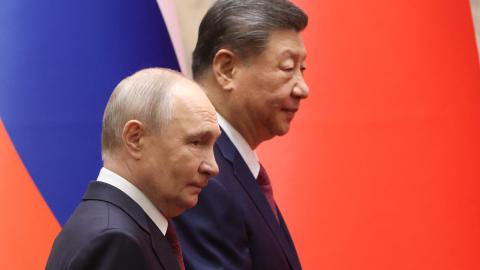
Doing so will require clarity on several fronts. First, the United States does not merely face strategic competitors, but enemies. These enemies do not need to be manufactured—they have made themselves and their intentions clear. China is leading an anti-American bloc that includes Russia, Iran, North Korea, and (at least until his arrest) Maduro’s Venezuela, all united around a single goal, which is to bring the United States to its knees. China is ultimately not interested in securing a better trade deal or being placated with a sphere of influence, as ironically, Trump and some of his advisers seem to believe. China wants a Washington subservient to Beijing, and it knows it can count on its revanchist partners in a campaign to harm American interests and standing.
Second, while American foreign policy must be completely oriented toward denying and degrading the threat from this Chinese bloc, we must be realistic about what success means. While America’s 20th-century experiences with great-power clashes resulted in outright victories, history shows us that this is not necessarily the norm. We instead should expect decades, or even centuries, of the kind of long struggles seen throughout European history, where success more often looks like consistently tipping the scales in one’s favor rather than a decisive defeat that catapults us back into the status of uncontested global hegemon. This means steeling the American people and orienting our defense and economic policies on a timeline lasting decades while unabashedly employing hybrid-warfare tactics to weaken and undermine the enemy regimes—as they are doing to us now.
Relatedly, even if we did secure a more decisive victory reminiscent of World War II or the Cold War, we should not make the mistake of assuming that such a victory will be permanent. For every Japan that becomes a useful ally, there is the Soviet Union that simply morphs into the same adversary in a different form.
Third, our interests are best served when we both set and enforce the rules. The postwar order’s failures are lessons that must be learned and not repeated. We should not allow our adversaries into an order we lead. We should require even our allies to shoulder a fair burden, and we should hold them to account when they abandon shared values and principles. Preserving an order in which America remains predominant will require a lot of work. It will be far harder than throwing up our hands and walking away, as our enemies would like and as the isolationists among us dream of doing. But our order is far preferable to a world dominated by the Chinese Communist Party.
And fourth, the Age of Trump must be one that faces up to the “clash of civilizations” framing articulated by Fukuyama’s great antagonist, Samuel P. Huntington. It’s not just that our allies sometimes need cajoling to recommit to shared civilizational values; we also need to remind ourselves why we fight our enemies. Our national interests are morally superior to those of our adversaries because the values that inform them are morally superior. The principle animating our nation from the beginning is the unshakeable belief in the dignity of every human, and it is fundamentally incompatible with the values that animate the Chinese Communist Party, Putin, or any of our other adversaries. We know from history that our values will never be universally accepted but will always be under various forms of attack. Rather than running from this reality, the Age of Trump can and should use it as the glue that again marries principle with power.
We did not know it then, but Trump’s escalator entrance was the start of a sobering return to reality. History is clear: No peace is permanent, and human beings are incontrovertibly imperfectible. Conflict and war between states will never be relegated to the ash heap of history, and international relations will always be a nasty fight for supremacy, one in which the winner gets to shape the future according to its interests and values. The test for the Age of Trump is whether it ultimately will repeat past mistakes and abandon either principles or power (or both), or whether it will reconnect power to America’s founding values and lay to rest the dangerous delusion that power is unnecessary or self-sustaining.