



Iran is moving along three parallel paths of regime change, each racing on its own timetable and together defining the country’s historic moment.
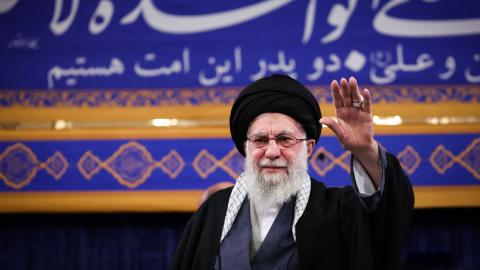
The first is biological and inescapable. The political system’s apex is occupied by an aging supreme leader whose mortality has become the regime’s most visible expression of decay. Ali Khamenei is nearing 90, and if Iran’s society or an Islamic Revolutionary Guard Corps (IRGC) soft coup does not remove him, nature almost certainly will.
Yet the passing of Khamenei would not, by itself, usher in democracy. Over decades, the IRGC, a US-designated Foreign Terrorist Organization, has positioned itself to inherit the state, paving the way for a post-clerical order. This future would more closely resemble a military dictatorship than a republic.
A third post-revolutionary trend presses from below. The social contract between the regime and most of Iranian society—especially the young—has eroded beyond repair. Here, American political-military choices matter most. Should Washington openly align with popular pressure, it could become a decisive accelerant.
Two wildcards remain: whether the conventional military, Artesh, chooses neutrality or sides with the street against the Guards, and whether Iran’s dormant ethnic fault lines awaken to fracture the struggle entirely.
The Decay of Ali Khamenei’s Body Politic
Death by aging, medically, is not a single moment but the gradual surrender of the body’s adaptive systems: a slow retreat rather than sudden collapse. This biological reality carries a critical political meaning in Tehran. Geriatric medicine defines aging as the exhaustion of cellular repair: telomeres shorten, mitochondrial efficiency wanes, stem-cell renewal weakens, and chronic inflammation erodes resilience.
Over time, cardiovascular flexibility hardens, immune surveillance dulls, and neural margins narrow, quietly and relentlessly. When this logic is translated into power politics, Ali Khamenei’s greatest vulnerability is not popular revolt, elite defection, or foreign coercion, but biology itself. Iran’s absolute regime change is unfolding not in the streets but at the cellular level, governed by a physiological downfall immune to ideology or repression: Khamanei is dying.
Although the IRGC is neither ideologically uniform nor internally frictionless, to date, they have remained fundamentally loyal to Ali Khamenei, a loyalty rooted less in devotion than in mutual dependence. When Khamanei is gone, the Guards will want more, which brings us to the second regime change.
An IRGC Military Dictatorship
The second trajectory revolves around Iranian political machinations and the prospects of a military dictatorship replacing the theological tyranny. As clerical authority erodes and reformist politics lose relevance amidst a highly securitized agenda, the Islamic Revolutionary Guard Corps has steadily accumulated power, filling the vacuum left by pious exhaustion. This trend peaked during the 12-Day War with Israel, since Khamanei transferred his powers to the IRGC and helplessly took refuge in an underground bunker to avoid American or Israeli assassination.
The Revolutionary Guards have long ceased to be merely a parallel military. The IRGC is a self-financing power structure that fuses battlefield experience, economic capture, and regional penetration into a single system of rule. Born in the turbulence of the 1979 Revolution and intended to suppress counter-revolutionary threats, the corps were hardened by the Iran-Iraq War. Post-war reconstruction elevated the engineering and construction arm, Khatam al-Anbia, into the country’s dominant contractor.
Regional crises then completed the transformation. In the 2000s, power vacuums in Iraq and Yemen, and the civil war in Syria, allowed the Revolutionary Guards, under Qasem Soleimani’s orchestration, to run the Shia Jihad via sectarian militias, hold a tight grip over the oil exports, including smuggling schemes, shadow tankers, front companies, and sanctions-evasion networks. The Guards also oversee the country’s strategic weapons deterrent: drone and missile warfare, as well as the military-grade nuclear program.
Once the supreme leader passes, there won’t be a very powerful ayatollah around that can match the stature of Ruhollah Khomeini, the revolutionary leader and founder of the state, and Khamenei, the successor who ruled Iran for decades. The power vacuum in the clerical dimension of the Islamic Republic has been reinforcing the Guards’ claim to be the country’s ultimate oppressor. Should the system survive Khamenei’s passing, it is unlikely to remain a theocratic tyranny in its current form. Instead, Iran would drift toward a military dictatorship cloaked in revolutionary symbolism—less Qom, more Pyongyang—where uniforms matter the most.
Iran’s Fading Social Contract
The third vector is societal and the most volatile. The social contract between the regime and the bulk of Iranian society, particularly the young, has frayed beyond repair. The Islamic Republic and Iran are two different entities in the eyes of the protestors. For years, advocates of the nuclear deal—especially along the Obama policy line—warned that any military action against Iran’s nuclear infrastructure would rally the population around the state.
That assumption has collapsed in the wake of the 12-Day War. Rather than unifying the nation, military coercion has further exposed the regime’s hollowness. In a striking reversal of once-mandatory reverence, young Iranians now tear down posters of Qassem Soleimani, the regime’s fallen icon of Shia jihad.
Iran has structural shortfalls epitomized by its water and currency freefalls. But make no mistake: they are not more serious than North Korea’s malnutrition crisis in the 1990s, Stalin-era Soviet famines, or Hafez al-Assad era Ba’athist Syria’s sectarian oppression. Dictatorships are chronically prone to such problems, but they do not guarantee their collapse. An organized minority can triumph over disgruntled masses for generations. North Korea is the best example. At this juncture, American intervention—or restraint—will be decisive. Another military power that can make a difference is Iran’s conventional military, the Artesh. If the military decides to protect the people, not the regime, events can unfold very differently.
Which Future Awaits Iran Now?
In the end, Iran’s post-revolutionary future will be decided less by slogans than by forces that operate quietly and without mercy: biology, military, and demography. Regime changes may be sparked in the streets, but states are ultimately reshaped by who controls the guns when time runs out. Tehran now stands at that threshold.
Last but not least, one should keep in mind: Iran is not a monolithic Persian entity. The return of the Shah’s rule or a symbolic monarch with a parliament may appeal to the streets of Tehran. Being caught between zealous Persian oppression and democratic Persian assimilation would not necessarily make non-Persians, such as the Baloch and the Azerbaijani Turks, happy. Once the music stops, these people might just recognize a moment of the dissolution of the Soviet Union, rather than the fall of the dictatorship.