
















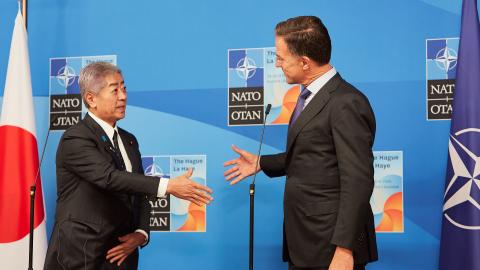
As NATO prepares for its upcoming summit in Ankara in July 2026, debates over the scope of the alliance’s global partnerships — particularly with the Indo-Pacific Four (IP4), comprising Australia, Japan, New Zealand and South Korea — have gained renewed urgency. The absence of IP4 leaders at the 2025 NATO Summit in The Hague, alongside reports of US reluctance to formalise the IP4 role at the Ankara Summit, highlights an emerging pattern of selective engagement.
NATO’s engagement with the IP4 has shifted from tentative dialogue to cautious operationalisation. Yet the trajectory of this partnership is neither linear nor assured. It is shaped by two intersecting dynamics. One dynamic is the gradual retrenchment and reprioritisation of US strategic commitments. Another is the emergence of more hedging-oriented European approaches to China and the Indo-Pacific. Together, these trends are transforming the NATO-IP4 relationship from a symbol of alliance globalisation into a more selective and functionally driven form of minilateral cooperation. This push and pull between US pressure for greater burden-sharing and European reluctance to escalate tensions with China forms the central dynamic shaping NATO-IP4 cooperation.
From strategic curiosity to functional cooperation: the rise of minilateralism
NATO’s initial engagement with its Indo-Pacific partners was largely political. In the early 2010s, cooperation centred on shared values, consultations, and crisis management, often framed around global security governance. The post-2014 deterioration of relations with Russia and, more decisively, the post-2022 strategic environment have changed this calculus.
China’s growing strategic profile has been central to this shift. NATO’s identification of China as a “systemic challenge” has catalysed a re-evaluation of geographic boundaries and operational priorities. At the same time, Indo-Pacific partners increasingly view NATO as a relevant actor, not in the sense of a military force in Asia, but as a node within a wider US-centred alliance system.
The result is a transition from dialogue to cooperation, particularly in the domains of maritime security, emerging technologies, and resilience in the global commons. Examples include NATO-IP4 cooperation on cyber defence exercises, coordination on supply chain resilience, and information-sharing on critical technologies such as artificial intelligence and quantum systems. Joint statements have further emphasised maritime domain awareness and resilience against hybrid threats. This reflects a broader trend in contemporary security politics towards issue-specific, flexible arrangements that complement, even as they complicate, formal alliance structures.
The NATO-IP4 partnership exemplifies a wider shift towards minilateralism: a form of small-group, issue-specific cooperation among like-minded states designed to bypass the inefficiencies and political constraints of large multilateral institutions while avoiding the rigidity of formal alliances. These institutions have proven too politically constrained to address emerging security challenges, particularly those involving China, while traditional alliances remain geographically bounded and politically sensitive. Minilateral formats — whether NATO-IP4, the Quad, or EU-led security partnerships — offer a pragmatic middle path, enabling cooperation among like-minded actors without requiring consensus across all alliance members or full institutional integration.
For Europe, minilateralism has been particularly attractive. European states are neither passive followers of US strategy nor autonomous strategic actors capable of shaping Indo-Pacific security on their own. Instead, they occupy an intermediate position as “middle powers”, leveraging niche capabilities such as naval diplomacy, regulatory influence, and technological expertise to shape outcomes at the margins of great power competition. The NATO-IP4 framework fits squarely within this pattern. It allows European allies to engage in the Indo-Pacific without formalising a global NATO role that many remain reluctant to endorse.
US retrenchment, European hedging, and China’s response
The evolution of NATO’s Indo-Pacific engagement must be understood in the context of shifting US strategy. Washington’s approach has combined a stronger rhetorical and military focus on the Indo-Pacific with growing pressure on European allies to assume greater responsibility for Euro-Atlantic defence. This is reflected in US calls for higher NATO defence spending targets — driving the revised commitment to 5 per cent of GDP — reduced forward presence expectations in Europe, and an emphasis on enabling allies rather than leading operations. At the same time, US support for NATO-IP4 engagement has been uneven. It has been strong in strategic documents, but more cautious in practice, particularly where Indo-Pacific cooperation risks overextending NATO or provoking China unnecessarily.
This dynamic creates what might be described as “goal displacement” at the periphery of the US alliance system. Allies are increasingly tasked with roles that extend beyond their traditional regional mandates. European NATO members are expected to contribute to Indo-Pacific stability, while Asian allies are drawn into Euro-Atlantic contingencies, particularly in relation to the war in Ukraine. The NATO-IP4 partnership reflects this dual pressure: it is less about NATO projecting power into Asia than about integrating the peripheries of the US alliance system into a more cohesive network. However, differences in threat perception, capacity, and political will continue to constrain deeper integration.
If US retrenchment pushes towards greater cross-regional integration, European hedging pulls in the opposite direction. European Indo-Pacific strategies are increasingly visible, but they also remain cautious and often ambiguous: a reflection of a fundamental tension in Europe’s position within US-China competition. On the one hand, European states share US concerns about China’s role in reshaping international order, particularly in areas such as maritime security, cyber governance, and critical infrastructure. On the other hand, they remain economically interdependent with China and wary of escalating confrontation.
As a result, Europe’s Indo-Pacific engagement has emphasised selective presence rather than sustained commitment. Naval deployments, for example, serve both signalling and diplomatic functions: France’s regular Indo-Pacific patrols, Germany’s frigate deployments, and UK carrier strike group operations demonstrate commitment but stop short of sustained force. Similarly, European participation in technology and standard-setting initiatives reflects an effort to shape rather than decouple from global networks — particularly through initiatives in digital governance, artificial intelligence, and critical infrastructure.
Within NATO, this translates into a cautious approach to the IP4 partnership. While there is broad support for cooperation on non-traditional security issues such as cyber defence, space, and critical technologies, there is less consensus on expanding NATO’s operational footprint or framing China as a direct military adversary.
China’s response to NATO’s Indo-Pacific engagement is a critical part of the equation. From Beijing’s perspective, NATO’s outreach reinforces concerns about encirclement and the extension of transatlantic security structures into Asia. Rather than seeking direct confrontation, however, China has pursued a form of defensive revisionism — incremental efforts to reshape the status quo while avoiding actions that would trigger full-scale counterbalancing. This includes activities such as island-building in the South China Sea and the gradual expansion of maritime presence in contested areas such as the Arctic, calibrated to remain below the threshold of open conflict.
In this context, NATO-IP4 cooperation carries both risks and opportunities. It may exacerbate Chinese threat perceptions, particularly if framed as an extension of NATO’s military role. At the same time, its focus on functional cooperation, especially in areas such as maritime governance and crisis management, offers potential avenues for managing competition short of conflict.
NATO-IP4 cooperation: scope and limits
Maritime security is emerging as a central pillar of NATO-IP4 cooperation. The maritime domain links the Euro-Atlantic and Indo-Pacific theatres, encompassing critical sea lines of communication, contested spaces such as the South China Sea, and emerging areas of competition such as the Arctic. For European actors, it offers a flexible entry point: freedom of navigation-style naval deployments, participation in regional exercises such as the US-led Rim of the Pacific (RIMPAC) and cooperation on maritime domain awareness and rules-based maritime security initiatives. For NATO as an institution, maritime cooperation provides a relatively low-risk way to engage in Indo-Pacific affairs. Yet it also highlights the limits of current cooperation: European contributions remain episodic, and coordination with Indo-Pacific partners is still developing.
The evolution of the NATO-IP4 partnership therefore reinforces two broader trends. The first is the growing interdependence of Euro-Atlantic and Indo-Pacific security; the second, the fragmentation of the alliance system into overlapping, functionally driven partnerships rather than a single hierarchical structure. Together, they raise fundamental questions about coherence and effectiveness.
NATO’s engagement with its Indo-Pacific partners reflects both ambition and restraint. As US strategy increasingly prioritises the Indo-Pacific while delegating greater responsibility to allies, NATO-IP4 cooperation is likely to deepen selectively — focusing on functional areas such as technology, maritime security, and resilience — rather than evolving into a fully institutionalised global alliance framework. At the same time, European hedging and Chinese threat perception will continue to constrain deeper integration. This may ultimately be a strength rather than a weakness: in an era of great power competition and institutional uncertainty, adaptability may prove more valuable than formalisation.