












Russian President Vladimir Putin has steadily scolded his officials and demanded an explanation for a stagnant economy and a historically high first-quarter budget deficit.[1] His advisers suggested urgent measures, but even warnings of economic desperation may be understating the problem. When looking at years of economic and demographic trends, combined with strain from the war effort, collapse becomes a simple and undeniable equation: heavy output combined with limited demographic and economic replenishment capacity produces a trajectory of precipitous decline.
The Russian Federation is running a war effort on a population and an economy that cannot support it. Even before the war and the COVID-19 pandemic, Russian demographic trends were concerning, due to an aging population, with people 65 and older expected to reach 24 percent of the population by 2050, high death rates, low birth rates,[2] and life expectancy statistics that rank Russia’s survival trajectory on par with Haiti.
Russia’s outlook is bleak. Three decades as a net mortality society—compounded by 35,000 wartime casualties a month in 2025 and birth rates continuing to decline—leaves little prospect of demographic recovery (see figure 1).
Figure 1. Russian Population by Age Groups
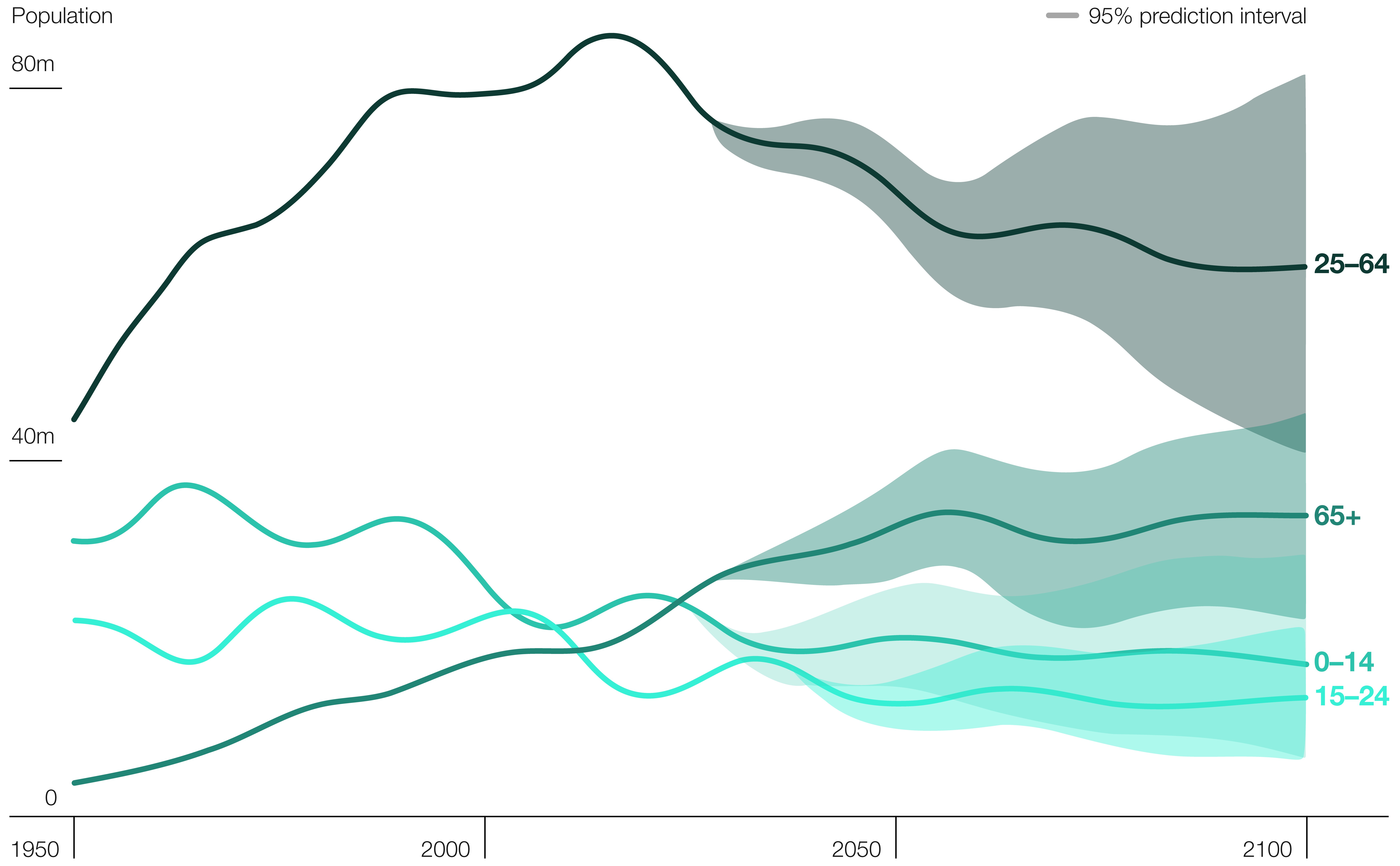
Source: World Population Prospects 2024 (United Nations Department of Economic and Social Affairs, 2024).
Additionally, the two leading factors behind Russia’s abysmal life expectancy numbers, cardiovascular disease (CVD) and violence, are rising. Causes for CVD, most notably alcoholism, are at their highest levels since 2016. When considering the massive losses from the war, a steady brain drain, a large migration wave with a historically high outflow after the 2022 invasion,[3] and minimal immigration, tough choices lie ahead for the declining power.
Economic factors exacerbate these problems. Russia funnels money into its defense sector, diverting funds from manufacturing and industrial sectors that offer societal returns and boost economic vitality. Labor shortages make economic productivity an even more pressing challenge.[4] A stagnant technology and innovation ecosystem and rapidly depleting sovereign wealth fund signal long-term decline. The wartime effect is best observed by accounting for regional budgets: Russia has sought to portray relative stability by drawing on its National Wealth Fund (NWF) and has instead delegated spending burdens to regional authorities.
This attempt to offset federal costs has reached a boiling point. The Moscow Times reported that Russia is restricting spending from the NWF after depleting almost two-thirds of the fund’s liquid assets. A Janes report assesses that at the current rate of drawdown without replacement, NWF liquid assets will be fully depleted by 2030. Regional budgets can’t carry this burden, and “the combined deficit of Russian regional budgets will grow by 27% to 1.9 trillion roubles ($25.4 billion) in 2026.” The war effort has strained regional authorities, due, in large part, to challenges in meeting federal quotas for recruitment bonuses and payouts (sometimes up to 10 percent of regional budgets). Regional budget deficit reveal recruitment challenges more than official recruitment numbers, and local government entities can no longer afford to increase bonuses. This problem is exacerbated by a lack of foreign investment in revenue-generating sectors, putting the burden on the Russian Federation to fund itself with money it doesn’t have.
Ultimately, the regions need help from an overstretched federal government if they wish to sustain the war effort and avoid economic collapse. The federal government doesn’t have much to help them with because it has depleted its NWF to execute Putin’s war. Russia does not have the structural factors that would enable it to rebuild and remain a great power, such as a healthy workforce, a growing population, a productive manufacturing sector, innovation capability, and the ability to attract foreign investment.
As economic sanctions continue to bite and Putin digs his heels in Ukraine, the Russian people understand that Putin is executing this four-year war for territorial gains the size of Pennsylvania at his country’s expense. The Iran war has led to a mild oil surge that helps Moscow, but approval ratings, weak economic numbers, and open criticism from officials indicate that the breaking point may be near. Whether imminent or not, Newton’s first law of motion reigns supreme: unless a stronger and opposite force is applied, Russia’s movement toward decline will continue. Creating a sufficiently strong and mitigating force to reverse Russia’s course looks increasingly impossible. Future Russian leaders will have Putin to thank.
Endnotes
- Vitaliy Shapron, Crisis Trends in the Russian Federation’s Budgetary System (Center for Defense Reforms, April 20, 2026). ↑
- “In 2024, 1.22 million people were born: only slightly more than the all-time recorded low of 1.21 million in 1999. That year won’t hold the record for much longer: the number of births will decline by 3–5 percent each year, and slow growth can only be expected to resume after 2029–2030.” Abylkalikov, “Russia’s Current Demographic.”
- “In 2024, 1.22 million people were born: only slightly more than the all-time recorded low of 1.21 million in 1999. That year won’t hold the record for much longer: the number of births will decline by 3–5 percent each year, and slow growth can only be expected to resume after 2029–2030.” Abylkalikov, “Russia’s Current Demographic.” ↑
- “Staff shortages in key sectors (construction, transportation, trade, and agriculture) are already slowing economic growth. At the end of 2024, Russian companies were short about 2.2 million workers, and almost 70 percent of companies were experiencing labor shortages.” Abylkalikov, “Russia’s Current Demographic.” ↑