09
December 2016
Past Event
The New Peace Agreement in Colombia

The New Peace Agreement in Colombia

Past Event
Hudson Institute, Washington, D.C. Headquarters
December 09, 2016
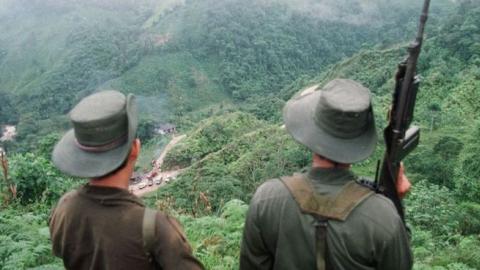
Two armed soldiers belonging to the Revolutionary Armed Forces of Colombia (FARC) monitor the Berlin pass, near Florencia, in the southern Caqueta province of Colombia, March 7, 1998. (PEDRO UGARTE/AFP/Getty Images)
Caption
Two armed soldiers belonging to the Revolutionary Armed Forces of Colombia (FARC) monitor the Berlin pass, near Florencia, in the southern Caqueta province of Colombia, March 7, 1998. (PEDRO UGARTE/AFP/Getty Images)
09
December 2016
Past Event

1201 Pennsylvania Avenue, N.W., Suite 400
Washington, DC 20004

Speakers:
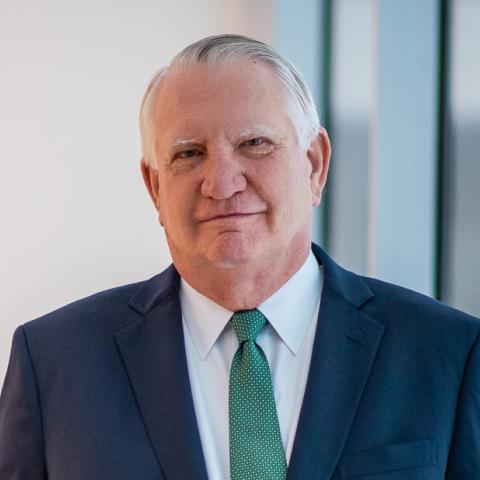
Former President Álvaro Uribe

Senator of the Republic of Colombia and former President of Colombia (2002-2010)

john_walters
John P. Walters

President and CEO

For more than half a century, Colombia has been embroiled in an armed conflict with the left-wing Revolutionary Armed Forces of Colombia (FARC) rebel group. In October, a peace deal to end the insurgency was rejected in a nationwide referendum. Over the years, repeated attempts at peace talks and a negotiated settlement have failed. In mid-November, the government of Colombia tried again, proposing a new peace agreement meant to address the concerns of those who rejected the original deal. This new deal was ratified by Colombia's congress on November 30, but the question remains—will it work?

Will the latest agreement be able to produce a stable and lasting peace, or does it risk the country's social and economic stability? Does the deal go too far in placating the perpetrators of crime and terrorism, supporting impunity for war crimes and preventing imprisonment for guerrilla leaders, as well as granting them political rights? How will it impact the international drug trade, used by the FARC as a means of financial support? What impact will the agreement have on Colombia's domestic politics, as well as on the rest of Latin America and the United States?

On Friday, December 9, Hudson Institute's Center for Latin American Studies hosted a conversation with former president and current Sen. Álvaro Uribe of Colombia and Hudson's John P. Walters on the Colombian peace process and the implications of the latest agreement.

Related Events
19
May 2026
In-Person Event | Invite Only
Environmental Agendas, Geopolitical Ends: Climate Policy and Great Power Competition
Featured Speakers:
Michael Doran
Zineb Riboua
Brenda Shaffer
Sam Cooper
Getty Images
19
May 2026
In-Person Event | Invite Only
Environmental Agendas, Geopolitical Ends: Climate Policy and Great Power Competition

To examine this emerging challenge, Senior Fellow Dr. Michael Doran will convene a conversation with Research Fellow Zineb Riboua, Professor Brenda Shaffer—Research Faculty Member at the US Naval Postgraduate School and Senior Fellow at the Atlantic Council—and Sam Cooper, an award-winning investigative journalist focusing on China-Canada relations.

Getty Images
Featured Speakers:
Michael Doran
Zineb Riboua
Brenda Shaffer
Sam Cooper
20
May 2026
In-Person Event | Invite Only
A Conversation with Under Secretary of State for Public Diplomacy of the United States Sarah B. Rogers
Featured Speakers:
Sarah B. Rogers
Zineb Riboua
Eric Schmitt
Michael Doran
Getty Images
20
May 2026
In-Person Event | Invite Only
A Conversation with Under Secretary of State for Public Diplomacy of the United States Sarah B. Rogers

Please join the Hudson Institute for a conversation with Under Secretary of State for Public Diplomacy Sarah B. Rogers and Hudson Research Fellow Zineb Riboua on how the United States is adapting its public diplomacy tools to advance its interests abroad, counter censorship, promote free speech, and leverage artificial intelligence to deliver more effective, targeted messaging.

Getty Images
Featured Speakers:
Sarah B. Rogers
Zineb Riboua
Eric Schmitt
Michael Doran
21
May 2026
In-Person Event | Hudson Institute
Georgia at a Geopolitical Crossroads: Iranian Influence and Strategic Competition
Featured Speakers:
Luke Coffey
Giorgi Kandelaki
John P. Walters
Congressman Joe Wilson
Ian McGinnity
Moderator:
Matthew Boyse
Tbilisi residents protest after the Georgian Dream government announced a suspension of negotiations on EU candidate status until 2028, as police detain demonstrators during a crackdown in the capital on November 28, 2025. (Photo by Sebastien Canaud/NurPhoto via Getty Images)
21
May 2026
In-Person Event | Hudson Institute
Georgia at a Geopolitical Crossroads: Iranian Influence and Strategic Competition
Tbilisi residents protest after the Georgian Dream government announced a suspension of negotiations on EU candidate status until 2028, as police detain demonstrators during a crackdown in the capital on November 28, 2025. (Photo by Sebastien Canaud/NurPhoto via Getty Images)
Featured Speakers:
Luke Coffey
Giorgi Kandelaki
John P. Walters
Congressman Joe Wilson
Ian McGinnity
Moderator:
Matthew Boyse
22
May 2026
Virtual Event | Online Only
The Western Hemisphere’s Energy Moment
Featured Speakers:
Daniel Batlle
Francisco Monaldi
Getty Images
22
May 2026
Virtual Event | Online Only
The Western Hemisphere’s Energy Moment

Join Hudson Institute as Adjunct Fellow Daniel Batlle interviews Francisco Monaldi, director of the Latin American Energy Program at Rice University’s Baker Institute for Public Policy and one of the foremost authorities on energy and political economy in the region, for a wide-ranging conversation on Latin America's energy future and what it means for the hemisphere and for US interests.

Getty Images
Featured Speakers:
Daniel Batlle
Francisco Monaldi