

















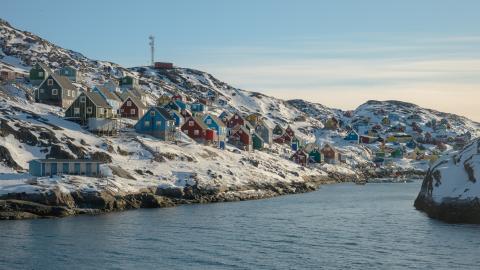
Greenland, an overseas territory of the Kingdom of Denmark located in the Arctic, is back in the news after the governor of Louisiana, Jeff Landry, who is also US President Donald Trump’s special envoy for Greenland, paid a visit to the island this month.
He received a cool reception from locals, with video clips on social media showing awkward exchanges with residents of the capital, Nuuk.
He was appointed special envoy in December, in the aftermath of the White House suggesting that the US wanted to annex the territory. Trump first floated the idea of acquiring Greenland during his first term, but after strong criticism at home and in Europe he quickly dropped it. The idea resurfaced late last year when he refused to rule out the use of military force to acquire the island.
At the World Economic Forum meeting in Davos in January, the secretary-general of NATO, Mark Rutte, was able to work behind the scenes to cool temperatures over this issue and begin a process of consultations between Greenland, the US and Denmark. Since then, the debate had calmed — until Landry’s visit last week.
Trump is right to raise the importance of Greenland for America’s national security. In fact, because of its location the island is important for the security of all of North America.
Greenland serves as a key location for early airborne warning and missile-defense capabilities. It is already home to a very important US military base in the north, and during the Cold War the island played a key role in monitoring Russian naval activity moving from the Arctic into the North Atlantic.
Greenland is also believed to be rich in rare earth minerals and other natural resources. However, due to environmental and logistical restrictions, these resources remain underdeveloped and will likely stay that way for the foreseeable future.
Much of Greenland is covered by an ice sheet measuring about 1.7 million sq. km, approximately the size of Libya. At its thickest point, the ice sheet is more than 3 kilometers deep. Also, no two towns in Greenland, which has a population of only about 57,000, are connected by road. For now, this means large-scale resource extraction is difficult, expensive and, in many cases, not profitable.
The US has had a military presence on Greenland since the Second World War, when American forces landed there to keep it out of the hands of Nazi Germany. During the Cold War, the US maintained a large presence on the island, only for this to be reduced in the 1990s, much like America’s military footprint across the rest of Europe.
However, Trump’s desire to acquire Greenland is unwise and unnecessary, for a few reasons.
Firstly, Denmark is a model US ally. It meets NATO spending targets. It has been willing to deploy troops for US-led military operations in places such as Afghanistan and Iraq, in large numbers and without restrictions on what its forces could do, including in some of the most dangerous areas.
At Trump’s request, Denmark has bolstered its investment in Arctic security. It is also a leading European supporter of Ukraine. This matters for the White House at a time when many in Washington are demanding that Europe does more for its own security.
Suggesting that the US should annex part of Denmark sends exactly the wrong message. At a time when Washington wants European allies to step up, it makes little sense to antagonize an ally that is already doing so.
Secondly, the US is already able to achieve what it needs in the territory under existing agreements it has with Denmark and Greenland itself, so there is no need to try to annex it.
If Washington wanted to increase its military footprint on the island, it could do so through the current arrangements. There is nothing stopping US mining, shipping or commercial aviation companies from doing business in Greenland, other than the fact that, right now, it is often not profitable from a business standpoint.
Perhaps most importantly, the priority in the transatlantic community should be cohesion and unity, especially inside NATO. Peace talks between Ukraine and Russia have faltered, and many in Europe are already questioning America’s future role in the continent’s security. Suggesting that the US might invade and annex territory belonging to a NATO ally does not help.
Even though Landry’s visit had its awkward moments, there were no major diplomatic incidents and, on balance, no serious harm was done. This now creates an opportunity.
Trump is right to talk about the increasing security concerns in the High North. There is no doubt that Greenland plays an important role in North American and transatlantic security. Russia remains active in the Arctic. China has long shown interest in Greenland’s resources and strategic location. Rising temperatures are opening up new maritime routes and increasing the outside interest in the region. These are all legitimate reasons for Washington to pay more attention to Greenland.
But instead of threatening to invade or annex the island, the US should work with Denmark and the Greenlandic government to bolster the territory’s security. It should deepen defense cooperation, increase situational awareness in the Arctic, and explore ways to improve infrastructure on the island.
It should also work with local authorities to increase business connections between the US and Greenland and explore ways to bring more American investment to the island when it makes commercial sense.
This is the best way forward. Trump has started a discussion about Greenland’s importance that was long overdue. Now the challenge is to turn that discussion into a serious policy that strengthens America’s security, respects Denmark’s sovereignty, supports Greenland’s people and keeps NATO united.