












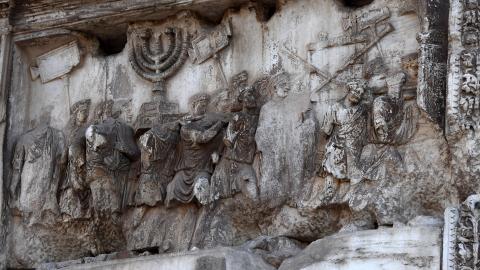
Near the Colosseum in Rome stands the Arch of Titus, built by the Emperor Domitian in 81 A.D. to honor his brother as a god. The triumphal monument testifies to the divine power of Titus by memorializing his defeat of the monotheistic Jews 11 years earlier. A relief panel shows legionaries marching in procession, carrying sacred objects looted from the Second Temple during the destruction of Jerusalem: the seven-branched Menorah, the Table of Showbread, the ritual trumpets. On the base of the arch, a modern visitor has scrawled three words in Hebrew: Am Yisrael Chai. “The people of Israel live.”
Two thousand years ago, a Roman emperor built an arch to commemorate the defeat of the Jews. Today, Rome is a museum. The Jews survive. Israel has been reborn in its ancestral land.
Empires rise and fall. The Jews alone among peoples are eternal. Their survival is one of history’s great mysteries. Conquered, dispersed, and persecuted, a small tribe endured across millennia. From antiquity to the modern age, Jews moved from empire to empire, barred from land ownership, excluded from politics, and confined to narrow professions while pressured to convert. In times of eased repression, many assimilated, while others adapted and flourished. With repression’s return, survival again took precedence. A faithful remnant preserved communal cohesion and carried tradition forward without territory, army, or state.
To explain the mystery of Jewish survival, European observers have repeatedly reached for supernatural causes. Their accounts tend to fall into two camps. The first interprets Jewish endurance as demonic. Its most influential exponent was Martin Luther, who insisted that “the devil … has taken possession of this people,” leading them to worship not God but “their gifts, their deeds, their works.” Accusing them of usury, deception, and moral corruption, Luther concluded that “no heathen has done such things and none would do so except the Devil himself and those whom he possesses, like he possesses the Jews.”
The second camp retained the supernatural frame but reversed its moral valence. Instead of demonic possession, it discerned divine design. St. Augustine argued that the continued existence of the Jews after their defeat by Rome served a specific function within Christian history. God preserved the Jewish people so that they might remain living custodians of the Scriptures, whose antiquity and integrity underwrote Christian claims about prophecy and fulfillment. For that reason, Augustine insisted, the Jews were to be neither exterminated nor gathered back to their land and restored politically. Citing Psalm 59, he emphasized that Scripture does not say only, “Slay them not, lest they forget Your law.” It adds, “Disperse them.” Survival without dispersion would have frustrated the divine purpose. Scattered among the nations, Jews endured as witnesses—preserving the texts of the old covenant while, through their continued subordination, testifying to the triumph of the new.
America rejected Europe’s supernatural framework altogether. The Puritans identified with the Israelites of the Hebrew Bible and saw America as a second Promised Land. They did not treat the Jews as cursed enemies. The covenant they imagined was shared, not hierarchical. Meanwhile, the Enlightenment had stripped Jewish survival of theological mystery altogether, grounding civic life in the equality of individuals before the law. From its founding, the United States absorbed Jews into public life as fellow citizens rather than symbols—neither demonic nor providential, but equal participants in a common political order.
Contemporary evangelical Zionism continues to celebrate the shared covenantal bond between the United States and the Jewish people. For evangelical Zionists, Jewish survival and Jewish sovereignty express providential intention unfolding in history. Biblical promises such as “Whoever blesses Israel will be blessed, and whoever curses Israel will be cursed” are taken as divine commands. Israel’s survival, in this view, stands before the United States as a covenantal test. John Hagee, founder of Christians United for Israel, states the view plainly: “The day America turns its back on Israel is the day God will turn His back on America.”
This theology remains influential, but it does not exhaust the American answer to the mystery. At the turn of the 20th century, Mark Twain offered a different explanation—secular, historical, and resolutely unsentimental. In his 1899 essay “Concerning the Jews,” Twain asked a practical question: How did a small, stateless people survive where empires failed? His answer looked to conditions, incentives, and habits formed under pressure—an explanation rooted in human capital shaped by history.
Across centuries, Twain observed, Christian societies drove Jews from land, agriculture, crafts, and political life. Stripped of territory and denied physical security, “the Jew” was left with “the one tool which the law was not able to take from him—his brain.” Survival depended on cultivating portable skills, especially those demanding intellectual discipline, calculation, and foresight. Repeated exclusion sharpened those capacities over time. What persecution could not extinguish, it refined. The result was a form of human capital that endured without borders, did not decay with exile, and compounded across generations.
Although the Jews were few in number, their talents were many. Chief among these were business and money management. Their “commercial importance,” he wrote, was “extravagantly out of proportion to the smallness of [their] bulk.” New York supplied the most visible proof: “The immense wholesale business of Broadway … is substantially in [Jewish] hands.” Exclusion had driven Jews into trade; survival demanded competence. But the same disproportion appeared far beyond commerce—in “literature, science, art, music, finance, medicine, and abstruse learning.” A people compressed by law and custom had expanded intellectually, producing a surplus of ability that no single field could contain.
Twain treats these outsize talents as neither a sign of demonic possession nor a menace to non-Jews, but a decided benefit to their fellow citizens. Commercial success, in his account, testifies not to vice but to civic virtue. “The basis of successful business is honesty,” Twain writes; “a business cannot thrive where the parties to it cannot trust each other.” The Jews are model Americans: people who value their freedom and use it responsibly. They are “quiet, peaceable, industrious” and “unaddicted to high crimes and brutal dispositions.” Their presence in crime statistics is “conspicuously rare.”
The Jewish home, Twain writes, is “a home in the truest sense,” governed by mutual respect and “reverence for the elders,” which he calls “an inviolate law of the house.” Responsibility does not stop at the family door. The community assumes responsibility for its own. “The Jew is not a burden on the charities of the state,” Twain observes, because “when he is incapacitated, his own people take care of him”—and they do so “with a fine and large benevolence.” Jewish charitable institutions, he noted pointedly, were “supported by Jewish money, and amply.”
The American chapter of Jewish history removed the final constraint on Jewish productivity. “In the United States,” Twain observes, Jews were “created free in the beginning.” Where Europe closed trades and erected legal barriers to protect less capable competitors, America offered an open field. The result was that skills long compressed by exclusion flowed outward—into commerce, finance, science, medicine, and culture—enriching the society that absorbed them. What had been refined under pressure now compounded under freedom.
If anything required management, in Twain’s view, it was not Jewish talent but the resentment it provoked among the less talented. Jews were hated, he argued, because they outperformed their neighbors. In Russia, Germany, Austria, and England, “the Christian cannot compete successfully with the average Jew in business” and therefore demands protection by law. When non-Jews fail in competition, they seek redress in regulation. When resentment hardens, religious persecution follows. Antisemitism, in Twain’s account, is a predictable reaction to unequal outcomes in a level playing field.
History forged a tiny people with wildly outsize capacities—a reserve of human capital disciplined by exclusion, refined by competition, and transmitted across generations. “The Jew saw them all,” Twain wrote of the great empires, “beat them all, and is now what he always was,” showing “no weakening of his parts, no slowing of his energies, no dulling of his alert and aggressive mind.” The pattern endures: Accumulated talent, once released, yields disproportionate returns.
For Twain, it was clear that Jewish brains were an American national asset. Today’s would-be oracles profess themselves to be less sure, seeing unequal results as proof that the Jews are up to their old tricks, European-style. Tucker Carlson and his growing circle of populist broadcasters have learned that resentment toward the Jews sells. Many Americans rightly suspect that unaccountable concentrations of power—bureaucracies, corporations, elite networks—have distorted public life and hollowed out institutions meant to answer to the people. Carlson takes that legitimate suspicion and fixes it on a single explanatory target. He does not indict elites in general. He indicts the Jews.
Carlson’s handling of the Jeffrey Epstein case is a revealing example of his method: taking a wider critique of elites and redirecting it toward the Jews, while letting his own kind off the hook. For many Americans, Epstein has come to symbolize a depraved elite that evades accountability while enforcing moral standards on others. His network spanned business, politics, academia, media, and royalty—figures such as Bill Gates, Bill Clinton, Prince Andrew, and senior academics at institutions like Harvard University. It was a world of power that operated by its own rules, outside the bounds of decency. Israelis were present in that world as well, including one of their former prime ministers, Ehud Barak.
In Carlson’s telling, the Israelis are not one group among many. They sit at the center as the prime movers who direct these scandals toward their own nefarious, particularist ends—with the other (mainly Christian) participants as their dupes. In July, speaking at the Turning Point USA Student Action Summit in Tampa, Florida, Carlson turned the Epstein scandal into a Mossad conspiracy. “What the hell is this?” he asked. “You have the former Israeli prime minister living in your house. You have had all this contact with a foreign government. Were you working on behalf of Mossad? Were you running a blackmail operation on behalf of a foreign government?” He then asserted that his insinuations are universally believed by people in the know: “By the way, every single person in Washington, D.C., thinks that. I’ve never met anyone who doesn’t think that.”
Placing Mossad in the frame does more than allege foreign involvement. It reorganizes responsibility. If Epstein ran a blackmail operation for Israeli intelligence, then presidents, billionaires, academics, royalty, and media figures did not act independently; they answered to someone above them. What begins as a story of elite corruption and depravity becomes the discovery of a hidden hand. Jews cease to appear as participants in a decadent system and reappear as its managers. Carlson updates Protocols of the Elders of Zion for the digital age.
Against this kind of quasi-medieval spell casting, it seems almost meaningless to point out that Ehud Barak never “lived” in Epstein’s apartment. Nor does Mossad run blackmail operations on U.S. soil or against American public figures. The risks of such operations being exposed—and blowing up the U.S.-Israel relationship—would vastly outweigh any conceivable benefit.
To build a blackmail operation around a man who flaunted his wealth and connections to powerful figures, including a former president of the United States and his presidential-candidate wife; who advertised his fondness for underage girls; and who operated out of a mansion in the center of Manhattan, blocks from the largest FBI field office in the country, would violate nearly every rule of basic intelligence tradecraft at once.
Yet the utter implausibility of Carlson’s Epstein accusations was the point: The system really is that corrupt. And to hear Carlson tell it, visible Jewish success itself is proof of corruption. Take, for example, his repeated attacks on Bill Ackman, a wealthy hedge-fund manager, an outspoken supporter of Israel, and an advocate of the U.S.-Israel alliance. Instead of arguing with Ackman’s views, he denies the legitimacy of Ackman’s success. “Bill Ackman is worth $8 billion,” Carlson said on a podcast appearance. “But I know Bill Ackman. He’s kind of dumb. He’s not ever created anything. He’s totally noncreative.” Describing short-selling as “the act of destruction,” Carlson went on to portray Ackman’s fortune as evidence not of performance but of systemic fraud. “It’s almost a humiliation exercise,” he said. “It’s like we’re going to take someone as stupid as Bill Ackman and give him $8 billion. … The whole system is rigged.” He then pressed the point rhetorically: “How do these people wind up running our biggest institutions?”
Who, then, “gave” Ackman his fortune—and why does Carlson describe it as a humiliation exercise? The answer is implied. Ackman, the audience is invited to believe, did not rise through intelligence, judgment, or performance. His success was conferred from above. When Carlson refers to “these people,” he does not mean elites in general. He is pointing to a specific category: prominent Zionist Jews elevated because they hold the right views and serve the right interests. Wealth becomes a signal of alignment and tribal belonging, not achievement.
Epstein and Ackman are not isolated cases. They illustrate a recurring logic, which Carlson used most recently to explain the naming of Bari Weiss as head of CBS News. As the founder of the most successful startup news operation since Twitter, Weiss was firmly a part of the new information age elite. At the same time, she also boasted an impeccable 20th-century establishment résumé that included a degree from Columbia University and prior editorial jobs at The New York Times and The Wall Street Journal. As a self-proclaimed Zionist lesbian from a middle-class family in Pittsburgh, her biography positioned her automatically on neither the left nor the right. At 41, Weiss would therefore appear to be a plausible-enough choice to chart a new path for a legacy news business, especially in television, where viewers and correspondents alike trend scarily close to retirement age.
For Carlson, though, Weiss had no apparent qualifications for the job whatsoever: She was “an idiot” whose résumé and talents wouldn’t have allowed her to “rise above secretary.” The explanation for her appointment lay therefore not in her business success, establishment credentials, outsider positioning, or relative youth, or the combination of any or all of those attributes, but in the conspiratorial maneuverings of wealthy Zionists who are fixated on controlling the news in order to shape U.S. policy toward Israel.
Again and again, Carlson has platformed guests and produced segments arguing that Jews—often through Israel—exercise hidden control over decisive decisions in American foreign policy. He has repeatedly hosted Darryl Cooper, who argues that Winston Churchill—not Adolf Hitler—was the true villain of World War II. In this telling, Churchill was bankrupt, financed, and controlled by wealthy Zionists, who maneuvered the United States into war. Carlson also aired a documentary segment suggesting that Israeli intelligence had foreknowledge of the Sept. 11 attacks and exploited the ensuing public outrage to again propel the United States into war—this time in Afghanistan and Iraq. He has given airtime to economist Jeffrey Sachs, who claims the United States has fought wars in Iraq, Syria, Lebanon, Libya, Somalia, and Sudan “on behalf of Israel,” with Iran as the final target in a decades-long push to “remake the Middle East.”
The picture that emerges is consistent and comprehensive: America governs itself only in form. Power resides elsewhere. When challenged on this worldview, Carlson retreats behind a familiar defense: He is “just asking questions.” In a recent speech, answering criticism over Israel and the American Israel Public Affairs Committee, Carlson portrayed himself as facing a mortal threat. “And my point is, you know, I’m 56. My kids are grown. I’m just not afraid of you at all. I don’t hate you or anyone else. I love this country. I’m going to be here till I die. I have an absolute God-given right to ask these questions, and I’m going to keep doing that, period. And you can shoot me or put me in jail, but the questions won’t go away,” he avowed.
His closest allies reinforce the sense of danger by claiming that disagreement with Israel puts them at mortal risk. Last June, Rep. Marjorie Taylor Greene invoked the assassination of John F. Kennedy. “There was once a great president that the American people loved,” she wrote. “He opposed Israel’s nuclear program. And then he was assassinated. I am for peace. I oppose war, including wars Israel wages. Should I feel that my life is in danger now too?”
Months later, after demanding the release of the Epstein files, Greene again insinuated that Israel or its minions might kill her, the way they killed JFK. “If something happens to me,” she posted, “I ask you all to find out which foreign government or powerful people would take heinous actions to stop the information from coming out.”
Candace Owens, too, has repeatedly claimed that Israeli intelligence has carried out or planned assassinations against American figures, JFK included. After the death of Charlie Kirk, Owens suggested Israeli involvement, tying it to what she described as his shift in stance against Israel. In November, she announced that assassins were targeting her personally. “I would again like to stress,” she posted, “that there was a French female assassin but also a male, Israeli assassin that were selected to kill me. These are joint state operations.”
For Owens, opposition to Israel is more than political; it is theological and reaches well beyond the bounds of earth. “I’m Catholic. I believe in demons,” she said on her show last July, when she described Israel as “a demonic nation” and Benjamin Netanyahu as “very clearly a demon.” Anyone who supported Netanyahu, she added, was “part of a totally demonic enterprise.” Addressing Ackman by name, she framed him as a participant in that enterprise and posed a question aimed directly at him: “So what are you going to do now? Kill us all?”
Demons also occupy a central place in Carlson’s own understanding of the world. In a 2024 interview with John Heers, Carlson described waking in the night unable to breathe, bearing what he said were physical claw marks on his body, which he attributed to “a spiritual attack by a demon.” The experience, he said, convinced him that the presence of evil was real and led him to begin reading the Bible intensively. Carlson emphasized that he was not offering theology or asking to be believed, only recounting what he said happened to him.
Needless to say, claims like these draw on a much older way of seeing the Jews than the one embraced by Mark Twain, who himself explained why they are spread so easily now. “If the statistics are right,” Twain wrote, “the Jews constitute but one quarter of 1 percent of the human race. … Properly, the Jew ought hardly to be heard of; but he is heard of, has always been heard of.”
Online populism thrives on the claim that shadowy forces control public life and that only a few brave figures dare to confront them. Jews are prominent across media, law, finance, and culture. They are easy to see. They are obviously successful, as individuals, but also voluble in their opposition to antisemitic attack. When attacked, they answer. That combination—visibility, professional leadership, and public responsiveness—creates the illusion populist broadcasters crave of a vast network that appears unified, powerful, and threatening.
Antisemitic broadcasters allege that a vast, shadowy Jewish network manipulates American politics from behind the scenes—coordinating media, finance, and government to enforce conformity. Jewish individuals and institutions respond, often rightly naming the charge as antisemitic. The attacker then points to that response as proof that the network exists.
But contrary to their public theatrics, the dangers of such activity are minimal—at least to them. Jews are too few, too politically divided, and too decentralized to exercise the kind of coordinated power these accusations imagine. There is no Zionist Comintern to punish or murder dissenters. Outside a narrow set of professional precincts where antisemitism still carries severe cost, there is no real danger of losing work. Yet the absence of real retaliation does not weaken the story; it strengthens it. The broadcaster confronts a supposedly vast and dangerous adversary, bares his breast upon the barricades, and descends unharmed, in full view of the public. The appearance of courage is produced without the burden of risk.
The Jews survived, Twain argued, because they were a small people with outsize capabilities. Carlson points to those same traits as evidence of hidden power and demonic intent. An American asset becomes an American liability. The blessing is renamed a curse.
What Twain was describing was an alliance, whether he used the word or not. Without treaties or formal commitments, the United States bound itself to the Jewish people through open institutions, legal equality, and a tolerance for uneven outcomes. The arrangement was cultural rather than contractual—and it proved decisive.
The value of the alliance Twain identified became unmistakable under the existential pressure of World War II. When Nazi Germany, in the name of racial purification, expelled Jewish scientists from its universities and research institutes, it cast out precisely the minds that would determine the future of physics, chemistry, medicine, and warfare. American leaders did not ask whether Jewish excellence posed a danger. They asked how to harness it—and placed Jewish brains at the center of the Manhattan Project.
Albert Einstein warned President Franklin Roosevelt in 1939 that Nazi Germany was pursuing nuclear weapons and that the United States risked catastrophic strategic surprise if it failed to act. Leo Szilard conceived the chain reaction and pressed the government to act. J. Robert Oppenheimer organized and led Los Alamos. Hans Bethe solved core theoretical problems. John von Neumann contributed decisive work on implosion physics and later computing. Germany expelled this talent. America absorbed it—and converted what one system cast out as racial contamination into decisive power.
The atomic bomb was the most visible payoff. But the transformation ran far deeper. Jewish refugees reshaped American medicine, chemistry, economics, engineering, and computing, strengthening universities, research labs, and industrial firms and training the American generation, Jewish and not, that would dominate postwar science and technology.
The Manhattan Project stands as the clearest illustration of a broader reality: A large republic, open to Jewish talent and confident enough to bind it to its security needs, turned concentrated human capital into a national asset. That same capacity—recognizing excellence, shielding it from suspicion, and integrating it into national institutions—became one of the United States’ decisive global advantages.
Today, however, that advantage is under threat. On university campuses, transnational progressivism increasingly codes Zionism as racism and treats Jewish particularism as illegitimate. The result is not only rising antisemitism but also the blocking of a major channel for Jewish creativity—and with it, a source of American intellectual, scientific, and creative power.
Meanwhile, isolationists have developed an alternative vision of the Manhattan Project—one that treats the United States’ most successful act of strategic mobilization not as a triumph of national survival, but as a moral catastrophe.
In a series of interviews over the past several years, Carlson has returned repeatedly to the United States and the atomic bomb. Nuclear weapons, he says, are “demonic.” Their origin, he argues, cannot be traced to any intelligible moment of human discovery; even the Manhattan Project, in his telling, fails to explain where the technology really came from. “The closer you look,” Carlson remarks, “the stranger the story becomes.” Did literal demonic forces intervene in history and place the bomb in human hands?
August 1945 marks the moment of rupture. When the United States dropped atomic bombs on Hiroshima and Nagasaki, Carlson argues, it crossed a civilizational line. America became, in his words, “officially secular.” Man declared himself God. “There was no God but us.” To defend the bombing—to argue that it was justified, necessary, or good—is, Carlson insists, itself evil. The implication is clear: The moment America most successfully harnessed Jewish excellence for national survival was also, in this telling, the moment it killed its religion—and damned itself.
Among states, Israel occupies the position that Jews occupy among peoples: It produces capabilities far beyond what its size alone would predict, a fact now central to the strategic debate. Under persistent threat, Israel’s human capital sharpens itself for survival, generating intelligence, scientific, and technological capabilities with a level of precision, speed, and operational daring that larger, more insulated societies rarely require—and often cannot replicate.
The Mossad-assassin scenarios advanced by Carlson, Marjorie Taylor Greene, and Candace Owens invert reality. They implicitly acknowledge that Israel possesses unusual operational reach—but they fundamentally misrepresent how that reach is exercised. Israeli intelligence services do not operate on American soil. They do not target American nationals anywhere in the world. Beyond that, they take extraordinary care in the planning and the execution of their operations to avoid actions that would disrupt, embarrass, or complicate American interests. Where possible, they do the opposite: They assist, defer, and align with American priorities. In practice, Israel is not an unaccountable actor exploiting American power, but one of the most responsive and disciplined intelligence partners the United States has ever had.
In August 2020, the CIA identified Abu Muhammad al-Masri—al-Qaeda’s deputy leader—as living openly in Tehran under Iranian regime protection and asked Israel to carry out the operation. Israeli operatives assassinated al-Masri and his daughter Miriam, the widow of al-Qaeda figure Hamza bin Laden, on a street in the Iranian capital. Al-Masri had played a central role in the 1998 U.S. embassy bombings in Kenya and Tanzania that killed more than 200 people. Israel executed the operation without U.S. personnel on the ground and without public American attribution.
States rarely endanger their own operatives for another nation’s objectives. When they do, it reflects a level of subordination and trust that is unusual in international politics. Israel’s assassinations on behalf of the United States fall squarely into that category—yet are rarely acknowledged as such.
A similar asymmetry governs U.S.-Israel relations in the private sector. Israel’s population is about 10 million, yet it sustains thousands of active technology companies and startups. It invests roughly 6% of GDP in research and development—the highest rate in the world. Mandatory military service functions as a national talent-identification system, channeling young Israelis into units specializing in cyber and electronic warfare, signals intelligence, data analysis, and applied AI. After service, these engineers emerge with experience operating under pressure at the edge of technological possibility.
Israel cannot fully scale what this talent produces. Its domestic market is small, capital pools are limited, and geography constrains growth. As a result, Israeli technological innovation flows outward—overwhelmingly into the American system, which can absorb, scale, and deploy it globally.
That transfer occurs through large, strategic acquisitions that fold Israeli innovation directly into the core of American industry. In 2017, Intel acquired Mobileye for $15.3 billion, bringing Israeli autonomous-vehicle and computer-vision technology into the heart of U.S. semiconductor strategy. In 2025, Google agreed to acquire Wiz for $32 billion, integrating Israeli cloud-security research into American infrastructure deployed worldwide. That same year, Palo Alto Networks purchased CyberArk for $25 billion, absorbing Israeli expertise in identity security and privileged-access management into American cybersecurity platforms.
Major U.S. technology firms such as Google, Intel, Nvidia, and Microsoft have established substantial R&D centers in Israel. The country hosts more than 400 multinational R&D facilities, employing roughly one-third of its technology workforce—an unmatched level of per capita concentration. The result is a durable division of labor: American firms conduct cutting-edge research locally in Israel and deploy it globally at scale.
American firms acquire Israeli startups, scale them, and deploy them worldwide, giving the U.S. industry early access to technologies shaping competition in AI, semiconductors, biotechnology, and cybersecurity—fields that will determine economic and military outcomes in strategic competition with China and against transnational terror networks.
Israel also functions as an irreplaceable combat laboratory for American weapons systems. The Pentagon conducts extensive testing to assess performance in realistic conditions, but no exercise can replicate sustained enemy fire, rapid adversary adaptation, depleted stockpiles, or the organizational stress that exposes real limits. Israel supplies what no test range can: data generated in actual combat.
The Israelis deploy U.S. platforms in the field. They identify weaknesses and develop solutions that American forces can adopt without bearing the cost of combat. The F-35 is the clearest example. Israel has accumulated combat experience with the aircraft that’s unmatched by any other operator. The resulting lessons and improvements on range, survivability, payload, and integration have already flown directly back to the United States as capability upgrades and avoided research costs.
This is the context in which the roughly $3.8 billion per year in U.S. security assistance should be understood. The money is earmarked primarily for American firms through procurement, but its strategic return is not captured by balance sheets. Israel converts the assistance into an engine of operational development, field testing, and technological upgrading whose benefits accrue directly to U.S. forces. Israeli missile-defense innovation and combat experience—the Iron Dome, Arrow, and the emerging laser layer—feed American homeland-defense architectures. Israeli systems such as Trophy active protection, along with advances in interception economics and combat medicine, have already saved American lives and reduced costs.
The aid also functions as a binding mechanism, anchoring Israeli military-technical innovation within U.S. production lines, doctrine, and supply chains. If the United States were to abandon that framework, Israeli firms would not stop innovating; they would market globally, including to American competitors. The assistance ensures American priority access to a uniquely dense reservoir of military innovation that would otherwise diffuse beyond U.S. control.
President Trump has recognized Israel as his primary ally in the Middle East. He has, on occasion, clashed with it publicly. But he returns to it for two simple reasons: Israel fights, and it is exceptionally responsive to American concerns. It solves problems that other American partners cannot—or will not—because they do not fight.
At the Doha Forum, Carlson dismissed Israel as “a completely insignificant country,” treating its small population as evidence that it is a burden. The relationship is indeed asymmetrical—but the imbalance runs decisively in America’s favor. Israel depends on the United States. The United States draws sustained advantage from a small partner that produces more than it can ever fully deploy on its own. The alliance endures not because of sentiment or ideology, but because it delivers disproportionate returns to the larger power that has learned how to use what a smaller, exceptionally capable partner produces.
Carlson is far more than a media figure. Vice President JD Vance openly associates with Carlson, has expressed gratitude for Carlson’s role in lobbying President Trump to select him as his running mate, and employs Carlson’s son, Buckley, as deputy press secretary. Donald Trump Jr. publicly embraces Carlson as a friend and ally. Though President Trump has disagreed with Carlson publicly—most noticeably over Iran policy—he continues to defend the relationship, and Carlson continues to find his way into the White House. Citing Carlson’s reach, Trump noted that one interview with him drew millions of viewers.
Carlson, however, clearly regards himself not as a MAGA mouthpiece but as an independent political actor. He has described himself as part of a small cadre “sincere in their opposition” to neoconservative foreign policy and “able to change the country’s orientation”—a cadre that, he said, includes Vice President Vance. In Carlson’s lexicon, neoconservative is synonymous with “support for Israel,” whose alliance with the United States he openly opposes. Israel, he claims, has hijacked American power, luring the United States into conflicts—starting with the Iraq War—that serve foreign rather than national ends. Now it seeks to drag the United States into war with Iran. Anyone advocating confrontation with Tehran is cast as an “enemy” of American interests. “I despise Christian Zionists more than anyone else on earth,” he says.
This argument runs aground on a fundamental error. The contest with Iran is part of a broader contest between the United States and China’s coalition—Russia, Iran, and North Korea. That contest spans all regions and all domains of national power. Regardless of America’s preferences, China has locked the United States into a struggle over technology, resources, production, and strategic position.
Over the past two decades, Beijing has pursued a deliberate strategy to reshape the international system and displace American preeminence. It has carried out a crash military buildup without historical parallel, modernizing and expanding its forces while developing global strike capabilities. Simultaneously, it has concentrated state power on the industries that will determine 21st-century advantage: artificial intelligence, semiconductor manufacturing, and advanced energy systems. These are not commercial sidelines, but dual-use foundations of national power.
What would the world look like the day after America follows Carlson’s advice? Carlson assumes that if the United States abandons Israel, Israel will simply become neutral—a kind of Middle Eastern Switzerland. That assumption does not comport with the realities of the Middle East, where all local states depend on great-power backing. The iron laws of power dictate that if Washington shuns Israel, Jerusalem will migrate—toward China. Concrete capabilities would vanish from the American system only to reappear in the rival system. What China would gain is not simply technology, but a qualitative leap in strategic capability.
Israel possesses what China lacks: combat-tested innovation. No other advanced technological state generates continuous, high-intensity combat data across all domains of national security simultaneously. China has scale, industrial capacity, and the ability to mobilize state resources; Israel has breakthrough innovation and the ability to iterate rapidly under fire. China has mastered imitation and absorption of Western technology; Israel operates from first principles, translating abstract theory into operational systems that work in combat.
China would receive the benefit of Israel’s 50 years of integration into Western military, technological, and intelligence architectures. It knows how those systems function—and where they fail. If these capabilities were redirected to Beijing, the effect would not be simply additive but transformative. The United States would face a rival unlike any it has confronted: a state that combines China’s scale with Israel’s operational genius, China’s industrial capacity with Israel’s technological edge, and China’s strategic ambition with Israel’s intimate knowledge of Western vulnerabilities.
Three areas illustrate how this transformation would unfold.
The first is cyber. Apart from the United States, a handful of states operate at the highest level in cyberspace, and Israel is one of them. Its capabilities span offense, defense, intelligence integration, and rapid adaptation under constant attack. What makes Israel uniquely valuable is operational telemetry—the data generated by weapons systems, sensors, networks, and decision-making processes during combat. This is not theoretical knowledge but real-world performance data: how systems behave under stress, how operators adapt, where assumptions fail, and which fixes work. For China, which has invested heavily in hardware but lacks exposure to sustained combat, access to Israeli operational lessons would fill a critical gap.
The second area is technology. Israel’s economy is a system of innovation that excels at breakthrough rather than scale. Its strengths—artificial intelligence, cybersecurity, semiconductor design, autonomy, applied mathematics, and electronic warfare—map directly onto the sectors China has identified as decisive for 21st-century competition. For decades, Israeli innovation has flowed into American firms and platforms, strengthening U.S. technological primacy. If Carlson and his cohort were to succeed in redirecting that flow, China would gain what it has struggled to produce on its own: the ability to move from imitation and absorption to first-principles development. Israeli engineers, deeply familiar with Western architectures, would accelerate China’s efforts to bypass export controls, harden its platforms, and optimize performance under constraint, while America loses those capacities.
The third area is military power and intelligence. Israel fields one of the most technologically advanced and operationally experienced militaries in the world. Its systems are refined in combat. Missile defense, active protection systems, drones, electronic warfare, precision targeting, and cross-domain integration are areas where Israeli experience is unmatched. If the United States were to lose these capabilities and they were to migrate to China, the effect would be cumulative. Chinese forces would gain both technologies and operational concepts shaped by constant conflict. Israel’s intelligence services integrate human intelligence, signals intelligence, cyber operations, and regional expertise at a level few states can match. Even limited realignment would enhance China’s understanding of U.S. operations, supply chains, and alliance structures, strengthening Beijing’s ability to operate in the Middle East, secure energy routes, and contest American influence.
The strategic result would be nothing less than a catastrophic shift in the balance of power in the Middle East. With Israeli intelligence networks, military capabilities, and regional expertise redirected to Beijing, the United States would lose its position in the region that holds the world’s largest concentration of oil and natural gas reserves. China would gain it.
The contest the United States now faces is unlike any it has faced before. The Cold War pitted the free innovation economy of the West against the command economy of the Soviet Union. Moscow never embedded itself deeply in global systems of trade, finance, science, and technology. Its antisemitism and dogmatic communist ideology imposed a ceiling on how far it could exploit Jewish talent. The Soviet state could mobilize individual brains—the MiG fighter jet bears Mikhail Gurevich’s name, testimony to one Jewish engineer’s genius—but antisemitism and ideological paranoia prevented the Soviets from building the kind of open, collaborative ecosystems that sustain innovation over time. Brilliant individuals produced breakthroughs; the Soviet system could not institutionalize or scale them.
China is different. Embedded in the global economy, it weaponizes supply chains, research networks, and technological exchanges in strategic competition with the United States. It aspires to absorb the forms of excellence its own system struggles to generate. That is what makes Jewish and Israeli capabilities especially attractive. China is seeking precisely the qualities that Jewish communities and Israel have produced again and again under pressure: systems thinking and the ability to translate theory into operational advantage. The Soviet Union could never fully exploit those possibilities. China potentially can—but only if the United States, in a fit of foolishness, forces their reallocation.
Time and again, great powers that expelled or demonized a small people with outsize talents have paid a lasting price. Those that learned how to absorb and use that talent gained power.
In 1492, as Columbus sailed west, Ferdinand and Isabella ordered the expulsion of the Jews from Spain. Financiers, physicians, translators, merchants, and scholars were driven out. Spain retained territory and treasure for a time, but the expulsion locked the kingdom into long-term decline, increasingly dependent on extractive colonial wealth and progressively less capable of innovation.
Others moved quickly to exploit Spain’s mistake. The Ottoman Empire, under Bayezid II, absorbed Jewish refugees expelled from Iberia and settled them across Constantinople, Salonika, and other commercial centers. Jewish talent strengthened Ottoman trade networks and state capacity. Bayezid is said to have mocked Ferdinand for impoverishing his own kingdom to enrich his rival. Whether the remark was ever made, the policy spoke for itself. That policy coincided with the 16th century, the high point of Ottoman power and prestige.
The same pattern repeated itself in northern Europe. The Dutch Republic rose as a commercial and financial power by welcoming Jewish merchants, financiers, and printers fleeing Iberian and later Central European persecution. Amsterdam became a hub of trade, credit, and information. Jewish capital, skills, and networks were integrated into a political order that rewarded enterprise rather than extraction. The result was rapid accumulation of wealth and influence disproportionate to the republic’s size.
The United States did not merely follow the example of the Ottomans and the Dutch; it systematized it. From its founding, the American order combined open institutions, legal equality, and access to capital at continental scale. Jewish talent entered that system not as a protected class or a tolerated minority, but as free participants in a competitive society. The result was productivity: a political economy confident enough to absorb Jewish excellence without treating it as a conspiracy.
The alliance with the Jews—first as a people, later as a state—has always been a test of political maturity. Jews are few, visible, and unusually capable; Israel is small, exposed, and unusually effective. A great power that fears and resents talent will make bad strategic choices and will pay dearly for them. That cost remains largely unacknowledged in a debate increasingly dominated by people riddled with resentments and wrestling with demons.
History, including American history, has already run the experiment that Carlson and his cohort are foisting on us. The empires that labeled Jewish talent as a threat lie in ruins. To repeat their mistakes would be an act of colossal stupidity at odds with our history and traditions. The founders of our republic knew better.