
















It’s a terrible time to be a classical music fan in New York City.
The New York Philharmonic’s official season ended last weekend, and after its ceremonial final concerts in the city’s parks—occurring as we speak—the storied orchestra will go dark until September.
But we won’t be missing much. New York’s music scene, I’m sorry to say, has suffered decades of systemic abuse.
Take, for example, the newly renovated David Geffen Hall, the physical home of the New York Philharmonic. A decade and $550 million later, it has all the worldly charm of an airport lounge in Dubuque. Actually, strike that: The good folks in Iowa decorated their regional transportation hub with fetching wood ceilings and stone walls, a much more attractive proposition than the cigarette ash–gray carpets and doctor’s office–chic chairs that currently adorn New York’s premier temple of classical music. And the acoustics in any given Iowa airport are better than Geffen Hall’s, too.
And if, for whatever reason, you entered Geffen Hall at any point in the last seven years, the music you experienced was likely just as flat as the building. Approaching the Philharmonic like a certified public accountant approaches a corporate balance sheet, its director, Jaap van Zweden, fashioned an orchestra that was technically proficient, accurate, and mind-bendingly soulless. Under van Zweden’s baton, quipped the critic Daniel Gelernter, “the orchestra is no longer sloppy. Now it’s merely unmusical.”
Meanwhile, as a business, classical music is not for the weak these days; according to the National Endowment for the Arts’ most recent survey of public engagement with all available art forms, classical music attracts a mere 4.6 percent of American adults, a 47 percent decline from five years ago. Add to that staggering operational costs, a deficit of about $8 million, and an audience that demands an impossible mix of innovative new works and beloved staples, and you’ll understand why leading the New York Philharmonic is a job reserved for individuals not only of tremendous talent but also of exceptional personality.
Thank goodness, then, that when the next season starts in September, a new musical director is coming to town.
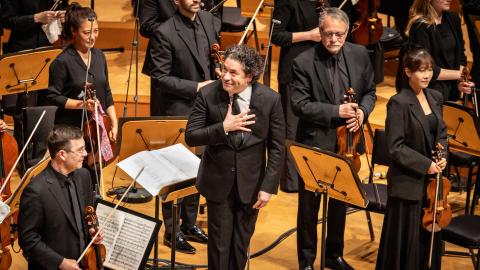
His name is Gustavo Dudamel, and hallelujah, he is as ready as can be. At 45 years old, he spent the last 17 years conducting the Los Angeles Philharmonic, and has lost nothing of the vibrancy he’d shown since winning his first major conducting competition in 2004, when he was 23.
This much was clear to those fortunate among us who got to see him conduct the New York Philharmonic earlier this year. You could tell something groovy was up even before the music started: In attendance weren’t just the usual antiquated bores who totter into Geffen Hall because it’s just what pallid patricians of their social milieu do to pass an evening, but New Yorkers of all ages, ethnicities, and financial flexibilities. And when Dudamel lifted his baton and tore into Beethoven’s Eroica, magic was afoot. Because the Eroica, as one critic astutely noted after the performance, is one of those celebrated works that can, when approached too reverentially, come off as too long and (dare we say it?) too dull to be truly transcendent. But Dudamel was unburdened by the piece’s history; he cared only about its notes, and he had the musicians play them briskly, crisply, with an energy and passion and joy that had more than a few members of the audience bopping in their seat, as if they were watching not Beethoven but the Rolling Stones.
How, then, might Dudamel re-musicalize the New York Philharmonic? The question has haunted his storied predecessors. When Gustav Mahler escaped antisemitic vitriol in Vienna to take over as musical director in 1909, for example, he was hailed as the orchestra’s great savior, the celebrated composer who would sprinkle some of his Old World charm on New York’s all-too-new music scene. He worked his way through a grueling season of 46 concerts, grew frustrated as audiences and musicians alike balked at demanding works, and lost his employers a tidy sum of money in dwindling ticket sales. He also had to contend with another celebrity conductor, his frenemy Arturo Toscanini, waving the baton next door at the Metropolitan Opera, and was irked to have too many evenings devoured by galas, gatherings, soirees, and other social demands. He rushed back to Vienna to vent to his therapist, one Dr. S. Freud, but it was too little and too late: He died in May 1911, at only 50 years old.
Kneeling at Mahler’s deathbed was his acolyte, Bruno Walter. It’s impossible to know what warning the old man might’ve whispered to his young student, but decades later, when Walter himself was offered the job of leading the New York Philharmonic, he politely declined, agreeing to serve merely as “musical adviser” and lasting just two years before saying his goodbyes.
And then, finally, came Leonard Bernstein.
If you’d like to know what made Bernstein inimitable, watch Bradley Cooper channeling the conductor in his biopic, Maestro. Bernstein, Cooper innately understood, managed to transform everything he touched—the Philharmonic, yes, but also the classical music scene writ large, and musical theater, and music-loving New Yorkers of all walks of life—by embodying his art completely and without reservation. He wasn’t there to offer a take on music, or to champion some specific taste preference or ideological conviction, or to make a point about what should matter and why. He was there to let the music rush through him, and to make his listeners, newcomers and educated old hands alike, feel its beauty and its potential to change their lives.
Which brings us back to Gustavo Dudamel.
When Dudamel first stepped into Los Angeles’s Walt Disney Concert Hall in 2009, I was concerned. He was 28 at the time and already feted as a celebrity, a reputation that only increased a few years later when Gael Garcia Bernal was tapped to play a Dudamel-like character on the Amazon Prime show Mozart in the Jungle. Along with many music lovers from Manhattan to Malibu, I wondered if the limelight would not singe, or altogether dry out, Dudamel’s vivacity.
It never did. Throughout 17 seasons leading the Los Angeles Philharmonic, Dudamel appeared completely undaunted by the excess of renown constantly humming about him. He championed new works by contemporary composers, like the Mexican Gabriela Ortiz. He rocked Stravinsky’s Rite of Spring. He celebrated the work of filmdom’s master composer, John Williams. And he approached all with the same all-consuming passion, warmth, and enthusiasm.
Some critics, of course, were miffed, noting that Dudamel had not “grown” as an artist, by which they meant, presumably, that he hadn’t morphed into a milksop who concerns himself with the souring opinions of mediocrities. Others complained that he was insufficiently inventive, an approach that expects classical conductors to display the same physical vigor as triathletes. But those of us fortunate enough to see him preside over Beethoven’s Ninth, say, understood right away that we were in the presence of something very rare: a conductor who, like Bernstein, pulsated with joyous, sublime music.
And boy, do we need this vibe in New York.
A few years back, I was duped by ecstatic reviews into seeing a supposed wunderkind, Finnish Klaus Mäkelä, conduct Tchaikovsky’s Pathétique. And pathetic it was: Praised for having empathy for and listening to his musicians, the 26-year-old presided over an orchestra that played with all the urgency and splendor of a background outfit at a smallish suburban wedding reception. The patrons streaming out exchanged subdued words of careful praise, aware that blunt, inconvenient truths were no more in fashion at Geffen Hall than they were anywhere else occupied by progressive, politically correct New Yorkers. But none looked moved.
Dudamel can change all that. In fact, he’s quite likely the only one who could. Because classical music, like all other cultural industries, has spent the last decade or so in a tailspin of ideological frenzy, much more inclined to obsess over allegations of racism, sexism, cultural appropriation, and other woke touchstones than over good, old-fashioned excellence. The result was cats like Mäkelä, building their reputation on being nice and delivering nothing too memorable or exciting or lively along the way.
Dudamel, too, was celebrated, of course, by a cultural machine that made more of the color of his skin than it did the content of his character—the first Latino genius composer from the global South!—but for 17 seasons in Los Angeles, he seemed completely oblivious to such ideological inflammations. In both his selections and his approach to pieces, he’s made it very clear that the only sentiment that moved him was the beauty of the music: A great composer deserved a passionate performance, be they a young woman from Mexico City, a genius Russian émigré from the previous century, or the man who came up with the theme to Jaws.
Soon, the same spirit will animate New York’s hushed concert halls.
Things, of course, can still go wrong. Dudamel may yet discover, like his predecessors, that New York is simply too much for anyone seriously interested in music rather than petty politics, wage disputes, and social engagements. But as the New York Philharmonic takes to the city’s parks to play its traditional last concerts of the season, there are plenty of reasons for classical music fans everywhere to rejoice: The most brilliant force we have is about to take our biggest stage.