













President Trump’s style is such that he would portray himself as a master of the foreign-policy game, like all other games, even in the absence of noteworthy successes in that realm. Yet both in his first term and in the first year of his second, he has put together a string of wins. One was his first-term “maximum pressure” reversal of Barack Obama’s dealmaking course on Iran, which culminated in Trump’s second-term destruction of Iran’s nuclear-weapons facility at Fordow. Related were the U.S.-brokered Abraham Accords improving relations between Israel and its Arab neighbors in a de facto alliance against Iranian regional influence. Another was the elimination of the Islamic State in Syria and Iraq. And how about his first-term decision to supply lethal aid, including Stinger missiles and sniper rifles, to Ukraine—which, along with robust covert U.S. intelligence engagement with Kyiv, probably saved the government from collapse in the early days of the full-scale Russian invasion in 2022?
The most important among Trump’s successes, however, was to crystallize, from 2017 on, an emerging view in Washington of China as a strategic rival in a return to global great-power competition. The National Security Strategy released that year rightly described China as an aspiring peer competitor, aiming to erode U.S. influence not only in the Pacific but also globally: “For decades, U.S. policy was rooted in the belief that support for China’s rise and for its integration into the post-war international order would liberalize China.” Contrary to that hope, the strategy argued, “China seeks to displace the United States in the Indo-Pacific region, expand the reaches of its state-driven economic model, and reorder the region in its favor.”
Trump’s revised view of China had implications across a range of policy areas—from military requirements to global supply chains and technology transfer. But the key to unlocking necessary reform is, first, the recognition that the strategic context has changed. The complacent view of China as a peacefully rising power that would soon settle into the role of “responsible stakeholder” in the American-led global order—the dominant Washington forecast for China since the Clinton administration—crumbled under the reality of a Chinese Communist Party determined to use all the resources at its command to maintain its exclusive grip on political power domestically and to increase Chinese influence regionally and globally.
These observations about Trump’s foreign-policy successes will be deeply offensive to almost everyone whose inability to stand him is now entering its second decade. And it will meet fierce resistance from those whose biggest concern is the foreign-policy damage Trump has done, especially to relations with European allies. What’s more, it turns out that the fatigue that often begins to gather during the fifth year of a two-term presidency is a factor whether the terms are consecutive or not. Trump’s high-velocity second term is exhausting not only because of the pace and breadth of policy change but also because Trump’s approach to the actions he takes seems to be premised on the belief that he has vast popular support, which he doesn’t.
Nevertheless, a more realistic view of the “China Challenge,” as a State Department Policy Planning document from 2020 dubbed it, was Trump’s most significant course change, and the new perspective (though not Trump himself) has won substantial bipartisan support. Today, that phrase “China challenge” seems if anything too mild a description of the danger Beijing poses to American-led global order.
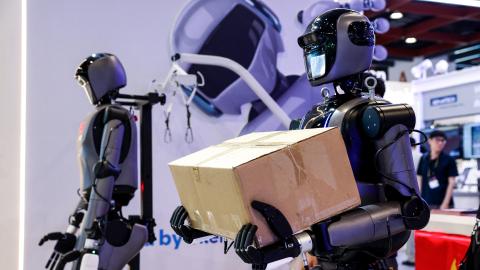
But if consistency is the hobgoblin of little minds, Trump’s is capacious enough to encompass inconsistencies great in range and grand in scale. So against the rare constancy of the Trumpian view of China, he presented a breathtaking contradiction in December 2025. He proclaimed his willingness to allow American chipmaker Nvidia to sell to China its high-end H200 GPU, potentially providing a boost to Beijing’s effort to catch and surpass U.S. companies in pursuit of artificial intelligence.
This accommodation seemed wildly at odds with pretty much everything Trump has done or said about China going back to his pre-presidential years. His announcement produced a broad-based “What the hell?” moment—well, the actual word being used is not “hell”—among all those who have spent a decade getting more and more concerned about China, if not at Trump’s behest than at least in seeming accordance with his sympathies.
Why the apparent reversal? The search for explanations for Trump’s actions often brings trouble down upon the seeker. In many cases, no sooner does a plausible-sounding explanation emerge than events, often generated by Trump himself, overtake and obviate it. Thus, for example, at first blush, overriding the ban on the sale of the H200 was a massive boon to Nvidia, which one might either applaud or abhor in accordance with one’s view of Big Tech in general, Nvidia itself, or the weight of its valuation in one’s 401(k). So perhaps the announced deal was the latest installment of Trump’s deal-making, pro-business streak. But the United States government also stands to benefit fiscally from Trump’s deal, whose terms apparently call for 25 percent of the billions in proceeds from chip sales to flow to the Treasury. The legal basis and policy soundness of the government’s taking a direct cut on the sale of a product seem dubious—in effect, an excise tax beyond the power of the president to impose without congressional authority. But in the Age of Trump, it’s always full speed ahead, since the Republican-controlled Congress provides no blowback and creates no friction.
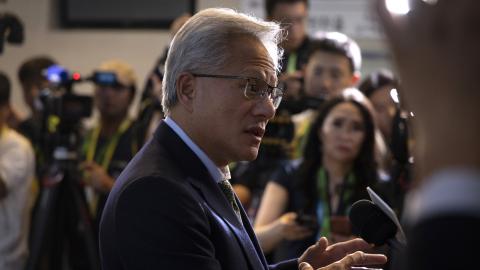
That leaves the courts to act, but if they don’t like it, Nvidia could presumably just make a voluntary contribution to the Treasury anyway according to Trump’s formula. True, that would give the company the discretion to welsh on the deal, but we have also reached the point at which CEOs have good reason to be concerned about incurring the president’s wrath. Certainly, the Nvidia CEO, Jensen Huang, has been heavily courting Trump this year, including at a meeting on December 3, mere days before Trump’s December 8 announcement. So maybe the administration is operating squarely in the tradition of “the chief business of the American people is business,” in the words of Calvin Coolidge. Billionaire CEOs are people, too, including Huang, a man who has contributed hundreds of millions to such public-spirited projects as Trump’s inauguration and Trump’s White House ballroom.
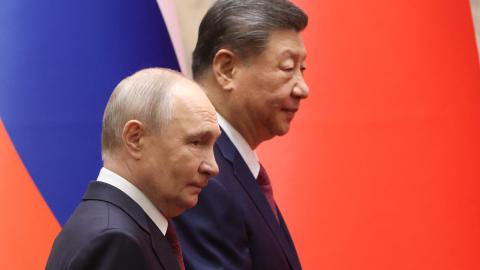
But maybe the Nvidia go-ahead isn’t so much about the company and the Treasury as it is the latest gambit in Trump’s pursuit of a mega-deal on tariffs and other economic matters with Chinese dictator Xi Jinping. The zigs and zags of Trump’s tariff maneuvering are maddeningly difficult for outsiders to follow—as they apparently are even for senior administration officials. While the latter have more access to Trump, they aren’t mind readers, and even if they were, Trump’s mind changes with some frequency for reasons known at most to himself. To Trump stalwarts who thought they knew his mind on China, the Nvidia announcement must have come as an even greater shock than it did to the Trump-curious and neutral Trump-watchers who wish success upon his presidency for the sake of the country. Trump-despisers, for their part, gravitate toward the view that whenever Trump does something of which they disapprove, he reveals his true colors. Here they had the option of classifying the decision as Trump coming under the sway of domestic billionaires kowtowing to him, or as Trump reverting to his supposed affinity for foreign dictators or strongmen. Or both.
To view Trump’s move as a bargaining ploy is to put Trump back into a comprehensible Trumpian context. Selling our biggest adversary our excellent chips doesn’t sound like an element of making America great again, but if the real goal is to butter up Xi for a deal that rectifies all Trump’s trade grievances with China, that sounds more MAGA-compliant.
But maybe that’s not what’s going on either. Maybe—or so emerged another line of interpretation—the Nvidia green light was actually Trump setting a trap for China. Next-generation GPU chips such as Blackwell are already available from Nvidia, and still-more-powerful GPUs like Rubin units are on the runway. So perhaps Trump was opening the way to get China hooked on an obsolescent chip. Widespread Chinese adoption of the H200 might lock in a chip gap with the United States in the lead. Easy access to the H200 would also slow the imperative for Chinese tech companies to develop competitive or possibly superior chip technology. In effect, Trump would be flooding China with American-made goods in the expectation that doing so would undermine China’s indigenous capacity to innovate and manufacture—a karmic high-tech turning of the tables on how China supposedly hollowed out ordinary American manufacturing by flooding the United States with goods produced by cheap Chinese labor.
We live in a golden age of speculative prognostication—not for its accuracy, of course, but for sheer volume and speed. It’s not quite right to say that the posters on X/Twitter foresee every possibility and every conceivable set of consequences flowing from each one. But there’s a lot bouncing around out there. So naturally, the possibility that Trump has set a trap for Xi has generated the second-order argument that Xi is on to him. In the end, the argument goes, China will buy very few H200 chips, precisely in order to avoid stunting the growth of Chinese chip development. Accordingly, the big deal will almost certainly be a bust, both for Nvidia and the Treasury. Or, in the telling of others, China will buy only enough H200s to retro-engineer them to steal the tech, as it has with so many other innovative American products—although it’s rather fanciful to suppose, given the sophistication of Chinese espionage efforts in this area, that export controls have hitherto been successful in preventing China from obtaining sufficient H200s to steal the tech already. But the chip design by itself is not enough. Manufacturing copycats, we are reliably told, is also beyond China’s current capabilities.
Still more esoteric is the rumor making the rounds that a joint effort Google and Meta are about to unveil will undercut Nvidia’s chip dominance with a system that will allow the products of others to easily run on the currently exclusive Nvidia operating system CUDA—which is now the standard for AI development. Though Nvidia is famous for chip-making, a huge component of its market valuation is a product of its software “moat” exclusivity, which will soon end. If true, Trump either knows this or believes it, or he doesn’t. The ensuing possibilities: He’s either supremely well-informed (because billionaires talk to billionaires in the 19th-century manner of the Cabots talking only to the Lodges), or he’s a complete ignoramus. Whichever is true, the China deal is an example of great dealmaking or supreme perfidy, depending on your prior outlook on him.
So to sum up, we don’t know and may never know why Trump made this decision. We don’t know whether it will go through in the end, and if it does, how many Nvidia GPUs will end up in China and with what effect on AI development there. And we don’t know how damaging the implications of such sales will be to U.S. national security. Though many claim otherwise, no one has a Magic 8 Ball. Few have seen the intelligence assessments of the effect of the sale of H200s, and they aren’t talking (and may be wrong). And few of us are privy to the group-chat banter of the Billionaire Boys’ Club, for what that’s worth.
What we do know, with a high degree of confidence, is that if there is indeed a China challenge—and there is—a presidential directive clearing the way to provide Beijing a boost in its effort to outpace us on artificial intelligence is not part of the way to meet it.
The reason that’s true has less to do with the technological ins and outs of the H200 question thanwith questions related to American seriousness of purpose, moral clarity, and resolve on China more broadly. Since the end of the Cold War, the United States has had a relatively easy time presiding over what the Chinese have come to call “hegemonic civilization.” Credit the Chinese Communist Party for recognizing the reality of U.S. power—that’s the “hegemonic” element—as well as its ideational element, the “civilization” that we have used our power to preserve and expand through such means as encouraging indigenous democrats working to liberalize governments of varying degrees of authoritarianism; calling out human rights abuses such as China’s slow-rolling genocide of the Uyghur people; and entering security partnerships or alliances with countries menaced by their neighbors.
We have our values and the power to back them up. China has different values and the power to maintain its grip at home. Increasingly, China seeks to flex and extend its influence abroad, with emphasis at present on intimidation tactics directed against our Asian allies, including military provocations. What, in China’s view, should come after “hegemonic civilization”? At first, a global order in which China is the dominant power in Asia, with U.S. influence there drastically diminished. In the long run, perhaps a return to hegemonic civilization, the problem with which all along may have been that the United States, not China, is hegemon.
That places the desire of the United States to remain on top of the global order on a collision course with Chinese ambition. In many gray-zone areas, that clash is already underway. It’s important to note, for example, that China thinks it has every right to help itself to the fruits of technology developed in the United States and “the West,” broadly construed. That’s because of the supposed illegitimacy of the self-serving global order that “the West” has been imposing on the world since about 1500, and especially during the “Century of Humiliation” from the First Opium War in 1839 through Mao’s revolution in 1949. This outside imposition kept China down, an outrage against a nation with thousands of years of continuous history. China is catching up by all available means and is unlikely to stop at parity.
The George W. Bush administration’s 2005 National Defense Strategy declared that the United States would not allow a “peer competitor” to rise to rival the United States. Some critics called this vow hubristic. Democratic administrations since then have sought to manage the relative decline in American power through adroit navigation of international law and institutions they hoped would buttress a rules-based order with widespread buy-in, including from China. The result wasn’t good. Now we have the Trump 2025 National Security Strategy vowing, like Bush’s, to maintain U.S. military dominance without expiration. It states: “We want to recruit, train, equip, and field the world’s most powerful, lethal, and technologically advanced military to protect our interests, deter wars, and—if necessary—win them quickly and decisively, with the lowest possible casualties to our forces.” That’s fine, but making good on it is not solely an American question. China seems not to accept this American ambition, and Beijing gets a say in whether we achieve it and at what cost.
A third world war, this time primarily between the United States and China, is not inevitable. But protracted conflict with China is indeed inevitable, and managing it requires both strategic clarity and moral clarity. China is not our friend, nor is China going to become our friend, because our ambitions and our values clash. That doesn’t mean we can’t have mutually beneficial trade relations, in the ordinary comparative-advantage sense. We can welcome China’s ideological challenges to the superiority of our system as an opportunity to argue in its favor. We can hold to our view that our “China problem” lies not with the Chinese people but with the Chinese Communist Party. In Trumpian terms, we can acknowledge and welcome the desire in Beijing to make China great again insofar as it can be peacefully reconciled with great-again America. But our relations with China will also have a darker side. To pick a mild example, we need a covert capability to steal China’s technological advances in areas where they surpass us—if we don’t already have one, which would surprise me.
The strategic and moral clarity we need to be effective in maintaining our position as China continues to rise is not just a matter for policymakers and elected officials. It includes the American people as well. Some Trump acolytes have been doing their best to persuade Americans to turn wholly inward—or perhaps more accurately, to persuade American leaders that the people have turned inward. All the talk of “endless wars,” which claims to reflect public opinion, is more an attempt to influence elite opinion against exercising American leadership in the world. It’s having its moment, though Trump himself has had no qualms about bombing Iran, the Houthis, Venezuelan drug-runners, and Islamists in Nigeria—and has enjoyed substantial public support for such actions.
These are not sideshows, but China is the main problem. To navigate it, Trump and his successors will need support in American public opinion. With the proper framing, they will have it. It entails a clear articulation of the value to Americans of the American way of life and the threat the global ambition of the Chinese government poses to it. The proper framing is “what we stand for versus what they stand for.”
Selling advanced American chips to China does not fit with that framing. It’s a rebuke to the proposition that our security interests and China’s are not aligned, a case of business as usual in an area where most Americans can plainly see the potential for peril. Whatever the American ambivalence, or worse, about the coming of AI, it is certain that Americans prefer American dominance in AI over Chinese dominance. The same is true for all other tech areas of consequence. Trump’s H200 decision arises in the context of this competition. It invites the conclusion that this tech competition is no big deal. The next time a proposed tech sale with national security implications arises, it invites the remark, Even Trump thought selling high-end GPUs to China was fine. China will cheerfully exploit this precedent, as will U.S. commercial interests when opportunities arise. Also, the argument that we need to buttress our military capabilities to counter China’s growing power at the same time as we’re selling them chips that can contribute to their growing power doesn’t exactly roll trippingly off the tongue. We’re not necessarily at the Cold War level of worry that “the capitalists will sell us the rope with which to hang them,” in the pithy statement misattributed to Lenin. But we shouldn’t act to compromise the proposition that we ought not sell our adversary the rope with which to hang us.
Late in 2025, I played a war game set from 2028 to 2032 involving an attempt by China to take Taiwan by force. The purpose of the game was not to find out how such a move would turn out, but rather to test the effect of a military capability China is developing that the United States currently has no plans to meet: a conventionally armed (not nuclear-tipped) intercontinental ballistic missile capable of striking anywhere in the United States. But the game was illuminating on the broader question nonetheless.
I played on the China team. This turned out to be a relatively straightforward proposition. China’s objectives, as our team articulated them, were clear. First, obtain Taiwan. Second, do so at the lowest possible cost militarily. Third, reduce U.S. influence in East Asia. The China team understood that achieving the third objective would flow by itself from achieving the first objective. The best path toward achieving the second objective was to do everything possible to avoid provoking the United States into a full-scale war over Taiwan. So no initial Chinese attack on U.S. bases, ships, and military personnel. China’s pretext, in the game, was that Beijing was resolving an internal Chinese dispute over “splittist” tendencies on Taiwan, which Beijing asserts is part of China and the United States, diplomatically, does not dispute.
The China team observed no similar clarity of purpose from the team playing the United States. As the U.S. war-gaming team sent U.S. carriers steaming with uncertain purpose toward the conflict zone, American diplomats busied themselves seeking to reassure U.S. allies of the American commitment to their security. China’s diplomats were busy themselves, reminding U.S. allies that an internal Chinese dispute over Taiwan had nothing to do with them, and that they should stay out—not, by the way, that the United States was actually urging allies to mount a common defense of Taiwan. The U.S. team seemed to think Washington could thwart China’s third goal, reducing American influence in the region, while remaining equivocal about how far the U.S. should or could go to thwart China’s first goal, conquering Taiwan. It’s hard to reassure treaty allies while abandoning a de facto ally under attack. China would not hesitate to draw allies’ attention to this contradiction and the questions it raises about the U.S. commitment to them.
The problem is that “strategic ambiguity”—we might just defend Taiwan, our current declared intent—is a peacetime posture designed to deter. It’s not a policy that directs action if deterrence fails and shooting starts. I think China understands this. In coming years, the most effective deterrent to a Chinese military move may not be the prospect of the U.S. Navy riding the waves to Taiwan’s rescue, its Pacific allies sailing in the wake; it may be a (nonnuclear) Taiwanese capability to inflict harm on China within the power of Taipei to direct.
I would hate to think that the abandonment of the U.S. position in the Pacific, including our allies and our commitment to keep sea lines of communication open, began with Trump’s announcement about H200 sales to China. But such is the possibility that has arisen in his glaring departure from clarity on the China challenge.