

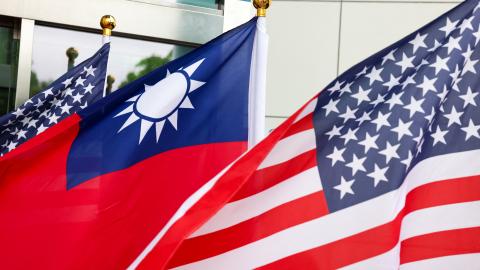
Taiwan's economic ties with the U.S. have never been stronger. Taiwan is now America's fourth-largest trading partner, with bilateral goods and services trade totaling roughly $256 billion.
That represents a remarkable transformation. A generation ago, American companies turned to Taiwan primarily for low-cost manufacturing. Today, Taiwan is an economic and technological powerhouse -- a global leader in semiconductors, artificial intelligence, quantum computing and advanced manufacturing. No one in Tokyo, Brussels, or Washington questions its centrality to the industries that will define the next century.
Taiwan's diplomatic achievements match its economic ones. Facing relentless pressure from Beijing, this resilient democracy has cultivated deep relationships across every Western capital. In Washington, only Israel and the U.K. rival the special ties Taiwan has built with American elected leaders over three decades. That record of diplomatic success is genuinely impressive.
And yet something critical is missing. Despite pledging an additional $250 billion in U.S. investment-spanning semiconductor fabrication plants in Arizona, science parks in Texas, and major commitments in energy and AI, Taiwan is still on the outside looking in. U.S. President Donald Trump has alleged that Taiwan "stole" the American semiconductor chips and has described a $14 billion arms package as a "point of leverage." Taiwan's firms did everything the administration asked and more, yet they still find themselves wondering whether their partners truly have their backs.
The reason is straightforward: Taiwan lacks a powerful business voice in Washington. Unlike Japan, South Korea, Germany or the U.K.—whose major corporations compete aggressively for political influence in the U.S. capital—Taiwan has no equivalent corps of CEOs and executives pressing its case. There is no sustained corporate presence to defend Taiwan's billions in direct investment, to correct false narratives about its role in the global supply chain, or to defend Taiwan's business interests and remind American policymakers that Taiwan's success is inseparable from American competitiveness.
This absence is not accidental. Taiwan's business culture has long rewarded a posture of discretion due to its characteristics of manufacturing: let the customer take the credit, stay out of the limelight, and focus on delivering excellent products. That philosophy helped Taiwan build world-class companies. But in the current political environment—one where no administration in the modern era has been more attentive to what business and finance leaders think—it is a costly liability. By ceding the debate to rivals and adversaries, Taiwan's companies are harming their own shareholders and undermining the democratic order that makes their success possible.
TSMC is the instructive exception. Indispensable to global commerce and central to competitiveness, TSMC CEO C.C. Wei has stood beside Trump to announce a $100 billion U.S. investment— and TSMC is treated accordingly: as a strategic partner, not a trade problem. Yet even TSMC only opened its Washington office in 2020. The lesson is clear: engagement works. The cost of disengagement is to have your interests defined by people you have never met.