












In recent months, the U.S. government has accused China of secretly testing nuclear weapons. The United States and other countries may soon follow suit unless Beijing dispels Washington’s concerns and makes its nuclear program and policies more transparent.
To justify Washington’s assessment, several senior U.S. officials recently released details about a June 22, 2020, incident, when a seismic station in eastern Kazakhstan, operated by the Comprehensive Nuclear-Test-Ban Treaty Organization’s International Monitoring System, detected a pair of small but suspicious seismic events recorded some twelve seconds apart.
The U.S. government determined that neither a natural phenomenon, like an earthquake, nor a benign man-made occurrence, such as a mining-related explosion, caused the incident, which had an approximate magnitude of 2.75. Instead, U.S. analysts assessed that the seismic activity represented a concealed Chinese nuclear weapons experiment, at or near China’s primary testing site at Lop Nur, in which the operators employed “decoupling” (testing in a natural cavern like a salt dome or a manufactured containment vessel) to dampen the seismic signature. The estimated yield was equivalent to an approximately five-ton conventional explosion.
U.S. officials have warned that China is preparing for nuclear tests with yields of one hundred tons or more. The Chinese government has rejected all these U.S. accusations, while international experts identified technical complexities in evaluating the incident. The United States may possess supplementary intelligence regarding covert PRC testing. The additional data might include visual imagery, radionuclide detection, communication intercepts, or human sources embedded within China’s national security community.
Both China and the United States signed the 1996 Comprehensive Test Ban Treaty (CTBT). The accord prohibits all nuclear explosions, whether for military or other purposes, in any environment. The signatories generally consider a prohibited nuclear explosion as a process that generates a self-sustaining, supercritical chain reaction. The treaty’s practical effect would be, if ratified, to extend the limited testing prohibitions contained in current treaties and agreements to encompass the testing of all nuclear explosive devices underground, the last medium not formally prohibited by the existing bans.
The Comprehensive Nuclear-Test-Ban Treaty Organization (CTBTO) in Vienna manages an International Monitoring System (IMS), which comprises a global complex of monitoring stations linked to an International Data Center in Vienna. The treaty also provides for on-site inspections and several consultation, clarification, and confidence-building measures to verify the treaty’s implementation.
The treaty has yet to enter into force as almost a dozen of the 44 “nuclear-capable states” listed in Annex 2, including China and the United States, have not ratified it. However, for several decades, the countries possessing nuclear weapons, except for North Korea, have implemented informal unilateral, but reciprocal, moratoria on weapons testing, relying on the data they collected in earlier tests to validate the properties of their warheads.
Even so, many U.S. analysts have speculated that several factors may incentivize the PRC to resume nuclear testing. Compared with the hundreds of nuclear tests conducted by Washington and Moscow, China conducted fewer than four dozen nuclear weapons explosions from 1964 until the PRC testing moratorium took effect in 1996. China’s scientists and weapons designers might want to verify that their existing weapons still operate as designed decades ago or, conversely, to develop new warheads optimized for battlefield use or for deployment on novel nuclear delivery systems such as nuclear-armed hypersonic gliders or multi-warhead missiles.
Some tests could also make China’s scientific and technical community more confident in the safety of their weapons or improve their ability to maximize the yield of their limited supply of nuclear material. Regarding the latter, greater efficiency would support China’s likely intent to field many more nuclear-armed missiles during the next decade. By some estimates, the PRC arsenal could exceed that of the United States sometime in the 2030s, as the Pentagon keeps a large percentage of the warheads in the active U.S. arsenal on strategic bombers rather than missiles.
The initial U.S. response was to publicize its concerns regarding China by releasing select intelligence data, which also showcased to Beijing and other audiences the U.S. capabilities for detecting other countries’ nuclear activities. U.S. officials have long complained that, “China’s entire nuclear arsenal has no limits, no transparency, no declarations, and no controls.” They have also routinely expressed concern that Russia has conducted covert tests.
The Trump administration is also accelerating the U.S. capacity to conduct nuclear explosive tests. Since the Cold War, the United States has sustained a Stockpile Stewardship Program involving sophisticated supercomputers and “sub-critical” nuclear experiments to ensure the reliability of the U.S. nuclear deterrent. The program employs conventional explosives along with fissile material in ways that do not result in self-sustaining nuclear fission chain reactions.
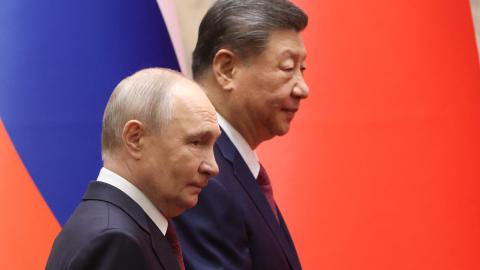
According to media reports, some U.S. officials near the end of Trump’s first term considered conducting a demonstration nuclear test designed less to yield weapons-related technical information than to pressure Beijing and Moscow to constrain their nuclear programs, ideally through a trilateral arms control agreement. Immediately before meeting Xi last October at the APEC in South Korea, Trump directed that the United States would resume nuclear testing “on an equal basis.”
On March 24, Undersecretary of State for Arms Control and International Security Thomas DiNanno told the Senate Foreign Relations Committee that administration officials were still assessing how to execute the President’s order, but confirmed that any testing would be conducted underground rather than in the atmosphere, which the United States ceased doing in 1962, to avoid radioactive fallout. In his view, abstaining while China and Russia covertly test “creates intolerable disadvantage to the United States.”
In principle, China could address U.S. concerns by making its nuclear weapons activities more transparent. For example, the PRC could invite an international inspection team, with U.S. participation, to conduct a comprehensive assessment of what transpired at the location of the seismic events in question, perhaps drawing on the inspection procedures developed by the CTBTO. Under previous administrations, the United States invited various foreign experts to underscore its compliance with international nuclear agreements. The two sides could launch such an initiative when Presidents Trump and Xi meet this May in Beijing. However, the COVID experience, when the PRC authorities severely impeded international access to information regarding the likely origin of the virus in Wuhan, suggests this possibility is remote.
Renewed explosive nuclear weapons testing by China, the United States, and Russia would occur in a transformed strategic environment. During the three decades since the testing moratoria took effect, China’s nuclear arsenal has grown considerably, the strategic arms control process has collapsed, and novel disruptive technologies have emerged. These developments complicate any assessment of the potential consequences of renewed great-power nuclear testing.