

















View full PDF with maps and figures
This is part of a series of briefs on the United States-China technology competition in Southeast Asia and the implications for countries in the region.
The research for this brief was sponsored by Google. For more information about supporters of Hudson, please see pages 73–75 in our 2024 Annual Report, available at https://www.hudson.org/annualreport-2024.
Key Points
- While the United States aims to become the global technological leader in artificial intelligence (AI), China has an industrial and commercial strategy to offer immediate benefits to Southeast Asian partners.
- For developing Southeast Asian countries desperate to secure immediate benefits from the AI revolution, Chinese offerings can be difficult to resist, even if American technology is more advanced. Merely pointing out to them that they risk becoming entrapped in a Chinese AI ecosystem will not be enough.
- The United States should not think about the AI contest in purely—or even primarily—technological terms. It is about presence, relevance, tailored solutions, and building ground-up local partnerships and networks. If the US fails to do better than China in these areas, it will lose the ability to shape the AI norms, standards, and practices in the region.
Introduction
In July 2025, the Trump administration released its AI action plan,[1] which consists of three pillars: accelerating innovation, building AI infrastructure, and leading international AI diplomacy and security. The third pillar includes US leadership in all elements of the AI stack and the broader AI ecosystem.
The plan states that
the United States must also drive adoption of American AI systems, computing hardware, and standards throughout the world. America currently is the global leader on data center construction, computing hardware performance, and models. It is imperative that the United States leverage this advantage into an enduring global alliance, while preventing our adversaries from free-riding on our innovation and investment.[2]
According to the plan, the US will win the AI contest with China largely by developing the best AI technology and applications to attain—and sustain—economic and military advantage.
Clearly, achieving the best AI capabilities is one important element of winning. But as the third pillar recognizes, winning also means having friendly and neutral countries adopt American AI systems. If this does not occur, and other economies become more reliant on the Chinese AI ecosystem, the United States will become more isolated and less relevant in the brave new AI world. Even if the US is dominant in the technological race, it could lose the broader AI strategic and geopolitical contest.
This brief looks at Chinese AI investments and activities in the developing economies of Southeast Asia.[3] It explains Beijing’s plan to surpass Washington in AI partnerships with the region, arguing that while the US has a plan to win the AI technological contest, China has a better-devised plan to win the AI commercial and industrial contest in Southeast Asia’s 10 developing economies. The danger for the US is that the commercial and industrial contest will largely determine whether Washington or Beijing becomes the leading AI power in Southeast Asia.
The Southeast Asian Hedging Mindset
There is a consensus among Southeast Asian nations that the US-China rivalry is the overwhelming dynamic shaping their future environment. There is also a common perception that while middle powers such as Japan, South Korea, India, and Australia could change some of the American and Chinese approaches, they will not be able to significantly alter the trajectory between the two, as a bipolar rivalry plays out on an ostensibly multipolar stage.
Southeast Asian nations therefore grudgingly recognize that the regional order is not only becoming more contested; it is also breaking up into a hybrid and disorganized set of arrangements. In the previous and relatively benign liberal order of the 1990s and early 2000s, underwritten by American hegemony, large and small sovereign states mainly enjoyed equal rights and privileges. In the far more complicated and messy order that is emerging, countries will acquire relatively more or fewer rights and privileges based on their relationships, strategic cunning, and usefulness to the US and/or China.
The larger powers and advanced economies such as Japan, South Korea, and Australia are likely to gain most from closer strategic, economic, and technological alignment with the US. However, most Southeast Asian states believe that hard alignment with either side is too great a risk, as the enduring benefits of such irreversible decisions will likely come with enormous opportunity costs. Underpinning this is the assessment that Southeast Asian nations lack agency to determine the shape of their future environment due to limited size and capabilities. This means that rather than seeking to shape the future regional order or considering which strategic, economic, or institutional principles they prefer, they consider it wise to extract the maximum in rights, privileges, and gains from whatever future is presented to them.
The corollary of this mindset is that the challenge is not necessarily a more assertive, revisionist, and powerful China, but developments that would weaken or eliminate the capacity to make the best of whatever order emerges. Therefore, despite American assumptions, Southeast Asians do not necessarily view China as the region’s predominant threat.
This explains the common complaint that the United States is forcing Southeast Asia to “choose sides.” For these countries, the determination not to make irreversible strategic decisions, as Japan and Australia have done, is driven not just by the terrible risk of choosing the losing side, but also by the fact that choosing sides undermines a country’s ability to maximize its position and prospect of future gain in the emerging hybrid order.
Thus, the question some Americans ask about how Southeast Asian nations hedge and balance against the disruptiveness and assertiveness of China is not necessarily the right one. A more probing question is how Southeast Asian nations hedge and balance against the disruptiveness and assertiveness of China and US demands. Many Southeast Asians believe that just as some elements of Chinese policies and behavior need to be countered and constrained, elements of US behavior and demands should also be rebuffed.
Southeast Asian Hedging and AI
The prevailing Southeast Asian hedging mindset is being applied to technology policies. For example, ASEAN, the Association of Southeast Asian Nations, which has eleven member states, welcomed China’s Global AI Governance Initiative[4] but has also adopted the ASEAN-US Leaders’ Statement on Promoting Safe, Secure, and Trustworthy Artificial Intelligence.[5]
The Chinese initiative advances Beijing’s broader global strategic objectives: It emphasizes state sovereignty as the final arbiter of digital standards and ethics; propounds a “people-centered approach” that calls for “mutual respect, equality, and mutual benefit”; and champions the involvement of the Global South.[6] It is linked to Xi Jinping’s “community for a shared future for mankind,”[7] which advocates for a “new type of international relations”— a transition from the US- or Western-led institutions and norms that evolved after World War II toward Chinese-led institutions and norms that emphasize the uncontested authority and sovereignty of states over individual rights and freedoms. The prioritization of strengthening state authority over individual rights and freedoms is also promoted as a non-Western approach that bolsters Chinese leadership in the developing economies of the Global South,[8] many of which have authoritarian governments sympathetic to Beijing’s political values and are wary of Western democratic ideas. In the cyber and digital contexts, the Chinese advocate an approach contrary to Western notions: While the West believes in the need to balance state regulatory control over AI with the need to protect individual rights and privacy, the Chinese assert the right of states to set and enforce standards that suit their governance arrangements and preferences.[9]
In contrast, the ASEAN-US Leaders’ Statement seeks to strike a balance between unleashing AI’s commercial and technological benefits and “respecting, protecting, and promoting human rights throughout the life cycle of AI systems and protecting individuals from all forms of discrimination, bias, misuse, or other harm from AI systems.”[10] The desire to limit the power of the state in order to protect individual rights and freedoms is common to other Western approaches, including the G7 Leaders’ Statement on AI for Prosperity[11] and Australia’s National AI Plan,[12] although the US AI action plan seems to tolerate more risk to accelerate AI innovation and commercialization, with lighter regulations than other Western approaches.
The ASEAN agreement with two broadly divergent approaches is largely declaratory policy, with few mandatory obligations. ASEAN’s pitch is that by engaging with all AI powers, it becomes less a battleground and more a meeting ground.[13] This in fact demonstrates a strong desire not to commit to one approach at the expense of the other. The question is, for what purpose, other than preserving good diplomatic relations with both Washington and Beijing?
At first glance, the Southeast Asian approach, reflected in documents such as the ASEAN Guide on AI Governance and Ethics,[14] is similar to that of the European Union, with a softer approach to governance—recommended but voluntary frameworks—underpinned by harder mandatory regulations that specify standards and safeguards on issues like personal data and privacy.
Singapore has the most developed AI ecosystem in Southeast Asia, followed by Malaysia and Thailand, while Cambodia, Myanmar, Laos, and Timor-Leste have the least developed. Cambodia, Myanmar, and Laos also lack a national AI strategy, while the other eight ASEAN member states do have formal strategies.[15] These countries, therefore, vary significantly in their approach to AI hedging.[16]
Singapore is far ahead of other ASEAN economies in choosing its role in the future AI landscape. As the region’s most advanced economy and most attractive destination for capital, it has the luxury of choosing its technology partners based on its policy preferences rather than having these imposed from the outside, and it tends to collaborate with the West on AI ventures while minimizing reliance on China. To promote technology diplomacy, Singapore does pursue projects with Chinese entities, but only ones that do not bind its technological future to China’s. For example, Singaporean firm StarHub pursues collaborations with Chinese firms such as Huawei and ZTE in niche or research areas but continues to partner with Western and Japanese firms for key infrastructure or important tech applications.
The countries with weak control over their AI future are also the least attractive places for firms from advanced countries from a commercial perspective. They also lag far behind other Southeast Asian countries in political and economic reform and have less in common with advanced Western and Northeast Asian economies, such as Japan and South Korea. With few options and often with inadequate expertise to formulate and implement effective national and commercial policies, these countries tend to adopt technology infrastructure and solutions, standards, and policies aligned with China.
This means that the main locus of the US-China contest is in countries with moderate control over AI policies and sectors: Thailand, Malaysia, Vietnam, the Philippines, Indonesia, and Brunei. All these countries place high emphasis on the importance of AI in their national economic and social development.
To be sure, these low- to middle-income economies have different strategic cultures and interests. For example, the Philippines and Vietnam view China as a strategic and military threat, and the Philippines is an increasingly important US ally. Both are far more distrustful of reliance on Chinese technology and infrastructure than Thailand, Malaysia, Indonesia, or Brunei.
Even so, all these countries have a sense that they must play AI catchup quickly if they are to remain economically competitive over the next few decades. Singapore is ranked third in the 2024 Global AI Index of 122 indicators;[17] the next Southeast Asian country is Malaysia (39th), followed by Thailand (43rd), Indonesia (49th), and Vietnam (58th). Given the size of the gap between Singapore and the rest of Southeast Asia, the other countries, though wary of overreliance on Chinese technology, must nevertheless strike a balance between security needs and the need to rapidly upgrade AI for maximum economic benefit. These countries, which have adopted hedging strategies to maximize benefits from the great powers, have a strong temptation to seek immediate advantages from external AI technologies. This is especially true of countries not inclined to view China as a perpetual threat. This means that they may make decisions with unintended long-term consequences that bind them in unintended ways.
China’s BRI and Digital Silk Road Strategy
The Belt and Road Initiative (BRI) is China’s most ambitious and comprehensive economic and strategic blueprint since the Deng Xiaoping era began in 1979. It comprises the Silk Road Economic Belt, which goes through the Eurasian continent all the way to Western Europe, and the Maritime Silk Road, which links China with Southeast Asia, Oceania, the Indian Ocean Rim, Africa, and the Mediterranean. The BRI’s authoritative white paper describes its objectives as “promoting policy coordination, connectivity of infrastructure and facilities, unimpeded trade, financial integration and people-to-people bonds.”[18]
In practice, the BRI does not have a formal institutional structure or a set of ironclad guidelines. The Chinese government, a state-owned enterprise, or a state-sanctioned firm, negotiates rules, processes, and terms with the country or individual firm participating in BRI. In the recent past, Beijing has tried to institutionalize aspects of the initiative, for example, by establishing dedicated BRI courts and dispute-settlement entities.[19]
More broadly, the BRI is not based on the rule of law; instead, the rules are the product of negotiation between Chinese authorities and the participating entity. This suits China, since it is always the larger and more dominant party, so that BRI participants generally begin negotiating from a position of weakness or disadvantage. While there are purely economic benefits for China in advancing the BRI—not least providing guaranteed projects and external markets for its large capital-intensive infrastructure and construction firms—there are also overriding strategic benefits to excluding the United States. As Aaron Friedberg has argued, the Chinese Communist Party (CCP) sought to reemerge as the preeminent power in Asia even before Xi. But China’s president has seized on the BRI as a means to create an economic, political, and normative order that not only excludes the United States but also reflects many of the CCP’s authoritarian values and interests.[20]
In short, China aspires to create a Sinocentric zone including Eurasia, East Asia, and Oceania—the core targets of its Global South strategy. The United States will not be prohibited from engaging economically in this region, but will be at an enormous disadvantage. China is seeking to renegotiate its economic relationship with the US and the rest of the world by forcing countries—mainly developing economies—to engage on its terms while reducing reliance on the United States as much as possible.
The BRI has several strategic elements that are the primary framework for China’s engagement with the region.
First, the goal is to make a virtue out of geography, building Sinocentric infrastructure, platforms, and institutions to facilitate trade, investment, and other economic exchanges between China and BRI participants. Consider the six main BRI economic corridors: China–Mongolia–Russia, China–Indochina, China–Pakistan, Bangladesh–China–India–Myanmar, China–Central Asia–West Asia, and the New Eurasian Land Bridge, which stretches from the east coast of China to the Netherlands. The CCP has designed them all so that China is their central hub (see map 1).
The initial goal might have been to create external capital investment opportunities for Chinese firms. However, the greater purpose, on which the CCP has focused since around 2015, is to ensure that all roads, railways, ports, cables, and digital networks begin and end in Chinese provinces and serve China’s interests.
Second, in a vast system dominated by Chinese firms and entities, no other great power can prevent China from negotiating favorable terms with individual countries. The parties will resolve disagreements through political negotiation in which Beijing has the leverage, or through BRI rules and processes that Beijing has drafted.
US firms and the US government, with a greatly reduced commercial presence in East Asia and Eurasia, will have less ability to set or revise commercial and quality standards, which is usually the role of the market’s most powerful stakeholders. (Standards can also mean the “connective tissue” between products, services, and systems[21] and can be simple, like the size of rail gauges, or complex, like guidelines ensuring 5G network interoperability.) Once stakeholders have set commercial, technical, or quality standards, it is usually prohibitively expensive for firms to operate in a different economic ecosystem. When these standards are combined with a Sinocentric infrastructure, BRI economies become captive to China while outsiders can enter only from a much weaker position.
Third, observers should understand the BRI alongside China’s other recent plans, especially the Made in China 2025 (MIC 2025) initiative. MIC 2025 did not arise in a vacuum. In 2006, then–president Hu Jintao issued a 15-year plan to enhance “indigenous innovation” and identified seven strategic industries in which domestic firms needed to excel for China to become an “advanced economy.”[22] MIC 2025 pursued the same central-planning, target-setting approach but was much more ambitious in important ways.
For example, it set targets stating that 40 percent of core components and materials would be domestically produced by 2020 and 70 percent by 2025. It also aimed to control entire manufacturing processes, supply chains, and associated services supporting a dozen sectors. The plan stated explicitly how much control Chinese firms were to exercise over various sectors making core components. In addition, it set out industry- and tech-specific targets and domestic and international market-share quotas for Chinese technology. While Chinese state-owned firms were to take the lead, all private domestic firms were considered potential partners in the initiative and were offered extensive financial, commercial, regulatory, legal, and political state support.
The explicit objective of MIC 2025 was not simply to ensure that China becomes an advanced, competitive economy; it also sought to lay the foundations for control of global supply chains, innovation, and know-how so that Chinese firms would dominate. By late 2018, authorities had issued more than 450 major documents detailing MIC 2025 implementation measures, and the CCP established at least 30 pilot cities for the plan, giving each one specific targets for meeting MIC 2025 objectives. The cities were expected to develop industries related to MIC 2025, with more than 50 sub-industries and 115 industrial sub-fields mentioned in a government plan.[23]
MIC 2025 identified high-value industries that were expected to become increasingly important to national power and wealth, especially AI. The BRI complemented this effort by providing the infrastructure, financing, logistics, and agreements between China and BRI partners to enable them to absorb innovation, expertise, supply chains, and other resources that Chinese firms required to dominate MIC 2025 sectors. The Digital Silk Road, a component of the BRI formally introduced in China’s 13th Five-Year Plan (2016–20), was intended to ensure that Chinese firms dominate MIC 2025 sectors within both China and advanced economies, including the United States, thus encapsulating much of this ambition.[24] The MIC 2025 blueprint is not formally part of the BRI but a complement to the latter.
The purpose of MIC 2025 was to ensure that Chinese firms prevail over US and other international firms and dominate advanced sectors in all global markets—unlike the BRI, which excludes the US. The state employed a variety of methods to prevent US firms from competing effectively in these sectors, providing capital to Chinese firms, imposing market restrictions, building infrastructure, and organizing logistics for Chinese entities. It also protected local innovation and absorbed foreign innovation (through joint-venture agreements, acquisition of foreign firms, and intellectual property theft). This was about renegotiating and reframing economic relationships to allow China to become the dominant party.
Fourth, China is not only creating an exclusive economic region for itself but is also exporting a suite of alternative values. This is most notable in the Digital Silk Road, where Chinese championing of “cyber-sovereignty” represents “the right of individual countries [or, more accurately, regimes] to independently choose their own path of cyber development, model of cyber regulation and Internet public policies.”[25] It was also evident in the export of “Huawei cities,” which seek to offer the regimes in developing countries tools like those Beijing uses to keep Uyghurs under surveillance. The decoupling from the normative standards promoted by the United States and other democracies is very much part of the mindset behind a Sinocentric economic and digital zone.
China’s Southeast Asia AI Strategy
Some criticize the BRI and related elements like the Digital Silk Road as expensive experiments that have left Chinese and foreign banks with enormous debt and a poor return on investment.[26] However, the BRI is primarily a strategic blueprint, not purely economic, and views Southeast Asia as its core geographic priority when it comes to Chinese corporate presence, deepening dependency on China, and setting AI standards.[27]
The data on US and Chinese investment and corporate presence in Southeast Asia does not reveal a clear leader. As Chart 1 shows, in data gathered from 2010–21, the US is well ahead in the number of AI-related investment transactions in the region. However, as Table 4 indicates, Chinese entities have invested more capital than their American counterparts.
While the relative standing of the two countries will change from year to year, the raw number of transactions or dollar investments will not be decisive. More important is how China seeks to win the AI contest in Southeast Asia. Indeed, figures like these can be misleading because China is adopting a different strategy and a different definition of winning, which might well be better suited to Southeast Asia than the US approach.
As argued earlier, the US tends to define strategic success as developing the leading AI capabilities and applications. For American firms, a pathway to increased return on investment and profitability in local and foreign markets is a necessary criterion, and profitability depends heavily on higher-end chips and hyperscale data centers rather than first-to-market embodied AI products and solutions.[28]
These typical commercial items are also important to Chinese firms. However, China places much greater emphasis on expanding market presence, immediate practicality, and making other countries more reliant on its AI offerings.
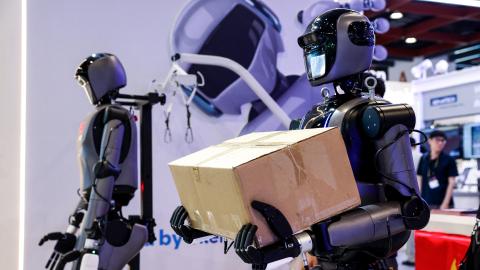
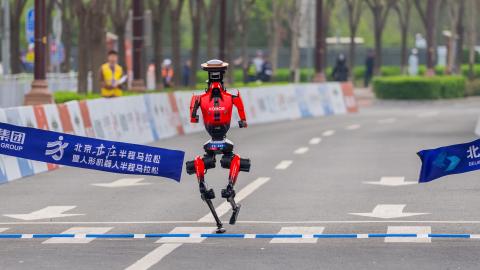
For example, many Chinese firms are not seeking to surpass the United States in computing capabilities; they are, instead, seeking to develop less powerful but cheaper AI infrastructure and applications. Rather than taking the US approach of exercising a high degree of control over technology outflow to maintain a high-end advantage, Chinese firms, with Beijing’s urging and support, are seeking to establish a dominant market presence in developing economies in Southeast Asia. China is therefore more reliant on providing open-source AI that can attract a very large number of users in the region,[29] cheaper and immediately available cloud infrastructure, and immediate access to the entire AI ecosystem, faster than Western competitors.[30] Chinese firms leverage their advantages in cheaper and more available embodied AI with drones, robotics,[31] and automation,[32] offering rapid solutions to upgrade the manufacturing capabilities and productivity of firms in developing economies.
Where US firms offer a superior AI product that is not always immediately available, China offers a “good enough,” cheaper, immediately available option. According to Chinese rhetoric, Beijing is working jointly with countries in the Global South to build their AI capacity, while the US and other advanced economies are looking to entrench their technological advantage and benefit disproportionately from the AI revolution. BRI messaging admits that Beijing is seeking to build a Sinocentric strategic, economic, and technological order,[33] but says that participation ensures benefits for all.
China’s strategic plan for developing economies in Southeast Asia involves the following:
- Offer Chinese entities or entire sectors subsidies, cheap loans, and other state-backed advantages[34] to accelerate AI development.
- Create ever-expanding supply chains and capability within China for the entire AI stack to dominate supply and accelerate domestic innovation.
- Offer partners and customers cheaper, faster access to these technologies to expand market access, entrench presence, and deepen dependency on Chinese firms, even if it harms profitability.
- Design AI applications (such as open-source,[35] free applications built on access to large language models) that increase regional adoption and dependency on Chinese offerings.
- Offer governments capabilities that maximize reliance on, and allegiance to, China, such as AI-enabled surveillance technologies.
A dominant presence will allow China to impose commercial and ethical standards and create institutions relevant to AI. This is a well-trodden and proven game plan that Beijing has used to dominate key sectors and technologies initially developed in advanced economies, such as solar panels and electric vehicles. With this approach, China wins not because it has the better technology or its firms are more profitable; it wins because it has the better strategy and first-to-market advantage that gives it presence and increases dependencies, and therefore leverage.
Tailor-Made for Southeast Asia
Singapore stands apart in Southeast Asia in being able to determine its AI and technological future. Its combination of good governance, sound strategy and policy, quality policymakers, attractive capital market and investment environment, and investor-friendly institutions means it can choose its AI partners carefully.
The other Southeast Asian nations are not as fortunate. All are low- or middle-income countries that see the possibility of missing out on the AI revolution as an existential economic threat. Therefore, they often prioritize cheap, accessible, and immediate in choosing an AI offering over longer-term strategic concerns about being trapped in an AI ecosystem with unpalatable conditions and standards.
Additionally, the poorer the country’s governance and state capacity, the more likely it will be tempted or forced to accept Chinese offerings. Cambodia, Laos, and Myanmar are heavily dependent on China in a broader geopolitical and economic sense due to its authoritarian practices and the poor investment climate in these countries for firms from advanced economies. This is replicated in these nations’ dependency on Chinese technology, especially for security, as with surveillance.
Unlike many Western firms, whose main selling point is that they have the best or superior technology, China offers developing Southeast Asia more tailor-made solutions, which tend to take the following forms.
Security and Surveillance Technologies
Most nations in Southeast Asia have authoritarian institutions or significant authoritarian characteristics. It is unsurprising that Chinese smart city or surveillance systems that integrate AI, big data, and biometric collection enjoy significant demand in the region.
Governments and firms in Myanmar, Cambodia, Brunei, Thailand, Indonesia, and Malaysia have agreements with Chinese firms such as Huawei, Hikvision, Dahua, and ZTE for the supply of AI security and surveillance technology.[36]
A Physical Presence that Entrenches the Chinese AI Ecosystem
Chinese AI-related firms set up regional and subsidiary offices in Southeast Asia, mainly in Singapore, which is used as the hub to target the middle range of countries, like Malaysia, Indonesia, Thailand, Vietnam, and the Philippines.
American companies and those from other advanced economies also tend to use Singapore as their regional hub; the difference is that Chinese firms, with Beijing’s support, take a much more proactive, hands-on approach to building lasting partnerships with local firms.
An instructive example is Alibaba Cloud’s agreement with INDONET, an Indonesian Information and Communications Technology firm, to become “channel partners.” This means that INDONET distributes Alibaba Cloud products to local consumers and integrates Alibaba Cloud products into its own products. This approach helped the two companies expand quickly into AI infrastructure, platform, and application services. It also binds INDONET’s future expansion to Alibaba Cloud.[37]
The broader point is that Chinese entities are partnering with local entities to offer immediate commercial and technological benefits that will evolve along with markets and societies in Southeast Asia. The Chinese approach is designed specifically to build people-to-people networks within industries relevant to AI and not only in pure AI sectors, while deepening dependency on Chinese technology in the future.
Research and Education Partnerships
While most Chinese research and education partnerships are with Singaporean entities, Chinese firms are expanding these partnerships, especially with Malaysia and Indonesia. Examples include the agreement between Chinese firm SenseTime and Malaysian company G3 Global to build a billion-dollar industrial park[38] and the partnership between Huawei and Indonesia’s Bandung Institute of Technology to allow Indonesian students to learn about Huawei technology and take courses related to AI.[39]
This is another illustration of the Chinese approach to tying the AI industrial sectors in Southeast Asia to the Chinese ecosystem. A more recent initiative is the China-ASEAN Countries Artificial Intelligence Application Cooperation Center,[40] which is designed to find ways to strengthen industrial cooperation between China and the ASEAN economies and identify and cultivate AI talent.[41] This includes drawing Southeast Asian economies and talent into contributing to Chinese open-source platforms and to becoming further integrated into the Chinese AI manufacturing system.
Diffusion of Open-Source Models
Many leading Western AI firms, such as OpenAI and Anthropic, maximize profit by offering products based on closed proprietary models that are often driven by cutting-edge technology and tend to offer better data security. This is appealing to customers in advanced economies.
Since China seeks not to win the technology race but to dominate the market, especially in developing countries, leading state-supported firms such as Huawei, Baidu, Tencent, and iFlyTek are investing in more open-source models to integrate the Chinese AI system in regions such as Southeast Asia. These models allow customers to adapt products to local conditions to achieve a quick, cost-effective, and “good enough” solution and reduce the entry barrier for Southeast Asian firms and individuals. The plan is for these companies to control an enormous Chinese-led AI nervous system on which businesses and individuals inside and outside of China are dependent.
Importantly, China promotes its open-model AI as a public good for developing economies. As one observer puts it, “By releasing models, frameworks, and software stacks as open source or ‘open-weight’ (i.e., downloadable trained parameters of AI programs), Chinese companies and research institutions enable thousands of developers, start-ups, universities, and local governments to build on shared foundations.”[42] This gives meat to the bones of Beijing’s pitch that its approach to AI is about mutual benefit and uplifting poorer nations.
Bundling and Offering a Package of Benefits
The Chinese industrial strategy is to bundle user-friendly models and other AI offerings with investment in energy grids, data centers, and training programs located in Southeast Asia.[43] The sales pitch uses an established BRI approach, often including cheap loans and other guaranteed investments backed by the Chinese state (see Table 5).
This approach, of locating key hubs and activity in Southeast Asia and allowing regional partners to participate in upstream and downstream areas of the AI ecosystem, creates an illusion of greater national or sub-regional self-sufficiency and sovereignty. As an example, the government of the Philippines flirted with stricter data localization requirements, which would have deepened reliance on Chinese-built and Chinese-managed data centers located in the country.[44]
For developing economies desperate to secure immediate benefits from the AI revolution, the Chinese offering may be far more attractive and comprehensive than expensive American proprietary systems that are not as well integrated with other necessary elements of the AI stack.
Conclusion
For the ten low- and middle-income countries in Southeast Asia, the common goal is prosperity. In these countries, political elites prioritize economic growth as a way to gain legitimacy and relevance. They fear missing out on the AI revolution and the prosperity it can create, and thus find it hard to resist partnering with Chinese entities promising immediate shared benefits. Merely pointing out to them that they risk becoming entrapped in a Chinese AI ecosystem will not win the day.
The next brief in this series will consider how the United States can better counter Chinese AI offerings to Southeast Asia. The key message is that presence, relevance, tailored solutions, and building ground-up local partnerships and networks will give the US the ability to shape the norms, standards, and practices for AI in the region.
Endnotes
- Winning the Race: America’s AI Action Plan, Executive Office of the President of the United States, July 2025, https://www.whitehouse.gov/wp-content/uploads/2025/07/Americas-AI-Action-Plan.pdf. ↑
- America’s AI Action Plan. ↑
- Singapore is excluded as the only fully industrialized and high-income economy in Southeast Asia. ↑
- The Global AI Governance Initiative was launched in 2023. See https://no.china-embassy.gov.cn/eng/lcbt/lcwj/202401/P020240112008151194499.pdf. ↑
- “ASEAN-US Leaders’ Statement on Promoting Safe, Secure, and Trustworthy Artificial Intelligence,” Association of Southeast Asian Nations, October 11, 2024, https://asean.org/asean-u-s-leaders-statement-on-promoting-safe-secure-and-trustworthy-artificial-intelligence/. ↑
- See Raphael Racicot and Kurtis H. Simpson, “China’s AI Governance Initiative and Its Geopolitical Ambitions,” Centre for International Governance Innovation, July 22, 2025, https://www.cigionline.org/articles/chinas-ai-governance-initiative-and-its-geopolitical-ambitions/. ↑
- See “Holding High the Banner of Building a Community with a Shared Future for Mankind and Striving for Greater Achievements in Major-Country Diplomacy with Chinese Characteristics,” Ministry of Foreign Affairs, People’s Republic of China, January 27, 2025, https://www.fmprc.gov.cn/eng/wjbzhd/202501/t20250127_11546599.html. ↑
- See John Lee, Understanding and Countering China’s Global South Strategy in the Indo-Pacific, Hudson Institute, 2024, https://s3.amazonaws.com/media.hudson.org/Understanding+and+Countering+China%E2%80%99s+Global+South+Strategy+in+the+Indo-Pacific+-+John+Lee.pdf. ↑
- See Racicot and Simpson, “China’s AI Governance Initiative.” ↑
- Article 18 of “ASEAN-US Leaders’ Statement on Promoting Safe, Secure, and Trustworthy Artificial Intelligence.” ↑
- “G7 Leaders’ Statement on AI for Prosperity,” Government of Canada, June 17, 2025, https://g7.canada.ca/assets/ea689367/Attachments/NewItems/pdf/g7-summit-statements/ai-en .pdf. ↑
- “Australia’s National AI Plan,” Australian Government, Department of Industry, Science, and Resources, December 2, 2025, https://www.industry.gov.au/publications/national-ai-plan. ↑
- See “ASEAN’s AI ‘Third Way’ Is a Masterclass in Geopolitical Strategy,” Bennett School of Public Policy, University of Cambridge, July 1, 2025, https://www.bennettinstitute.cam.ac.uk/blog/aseans-geopolitical-strategy/. ↑
- “ASEAN Guide on AI Governance and Ethics,” Association of Southeast Asian Nations, February 2024, https://asean.org/wp-content/uploads/2024/02/ASEAN-Guide-on-AI-Governance-and-Ethics_beautified_201223_v2.pdf. ↑
- See Kristina Fong, “What Is Shaping Artificial Intelligence (AI) Governance Policies in Southeast Asia?,” ISEAS Perspective, February 23, 2026, https://www.iseas.edu.sg/wp-content/uploads/2026/01/ISEAS-Perspective_2026_13.pdf. ↑
- The classification below is borrowed from Xinlei Zhao, “Technological Hedging and Differentiated Responses of Southeast Asian Countries to U.S.-China Technological Competition: A Case Study on Artificial Intelligence (AI),” Pacific Review 38, no. 3 (2025), https://doi.org/10.1080/09512748.2024.2408010. ↑
- “The Global AI Index,” 2024, https://www.tortoisemedia.com/data/global-ai#rankings. ↑
- “Vision for Maritime Cooperation under the Belt and Road Initiative,” State Council Information Office of the People’s Republic of China, June 20, 2017, http://www.china.org.cn/world/2017-06/20/content_41063286.htm. ↑
- Jonathan E. Hillman and Matthew P. Goodman, “China’s ‘Belt and Road’ Court to Challenge Current US-Led Order,” Financial Times, July 25, 2018, https://www.ft.com/content/b64d7f2e-8f4d-11e8-b639-7680cedcc421. ↑
- Aaron Friedberg, “Competing with China,” Survival 60, no. 3 (2018), https://www.tandfonline.com/doi/full/10.1080/00396338.2018.1470755. ↑
- ↑
- “China’s Strategic Emerging Industries: Policy, Implementation, Challenges, and Recommendations,” US-China Business Council, 2013, https://www.uschina.org/sites/default/files/sei-report.pdf. ↑
- Max J. Zenglein and Anna Holzmann, Evolving Made in China 2025: China’s Industrial Policy in the Quest for Global Tech Leadership, MERICS Papers on China No. 8, Mercator Institute for China Studies, July 2019, https://merics.org/sites/default/files/2020-04/MPOC%20Made%20%20in%20China%202025.pdf. ↑
- Robert Greene and Paul Triolo, “Will China Control the Global Internet Via its Digital Silk Road?,” SupChina, republished by Carnegie Endowment for International Peace, May 8, 2020, https://carnegieendowment.org/posts/2020/05/will-china-control-the-global-internet-via-its-digital-silk-road. ↑
- Adam Segal, “When China Rules the Web: Technology in Service of the State,” Foreign Affairs, August 13, 2018, https://www.foreignaffairs.com/articles/china/2018-08-13/when-china-rules-web. ↑
- For example, see Julieta Pelcastre, “Road to Nowhere: China’s Debt Trap and Lies under the BRI,” Dialogo, April 7, 2025, https://dialogo-americas.com/articles/road-to-nowhere-chinas-debt-trap-and-lies-under-the-bri/; Christoph Nedopil, China Belt and Road Initiative (BRI) Investment Report 2023, Griffith Asia Institute, Griffith University and Green Finance and Development Center, FISF Fudan University, February 2024, https://www.griffith.edu.au/__data/assets/pdf_file/0033/1910697/Nedopil-2024-China-Belt-Road-Initiative-Investment-report.pdf; “Debt Distress on China’s BRI: Who Gets Bailed Out and Why?,” SCCEI China Briefs, Stanford Center on China’s Economy and Institutions June, 1, 2025, https://fsi9-prod.s3.us-west-1.amazonaws.com/s3fs-public/2025-05/debt_distress_chinas_bri_6.1.25.pdf. ↑
- See China’s Belt and Road Initiative: A Geopolitical and Geoeconomic Assessment, International Institute for Strategic Studies, November 2022, https://www.iiss.org/globalassets/media-library---content--migration/files/publications/bri-dossier/chinas-belt-and-road-initiative---chapter-one-strategy.pdf. ↑
- See Richard Gray and Michael H. Gary, “Hedged Bets on the U.S.-China AI Race,” Center for Strategic and International Studies, January 20, 2026, https://www.csis.org/blogs/charting-geoeconomics/hedged-bets-us-china-ai-race. ↑
- An example is China’s DeepSeek model, which is cheaper, open-source, and freely available. ↑
- See Mark Kennedy, “America’s AI Strategy: Playing Defense While China Plays to Win,” Wilson Center, January 24, 2025, https://www.wilsoncenter.org/article/americas-ai-strategy-playing-defense-while-china-plays-win. ↑
- See “US Lags China in Factory Robot Deployment by 5 to 1 Ratio,” International Federation of Robotics, press release, September 25, 2025, https://ifr.org/downloads/press_docs/2025-09-25-IFR_press_release_Americas_in_English.pdf. ↑
- See William Hannas et al., “China’s Embodied AI: A Path to AGI,” Center for Security and Emerging Technology, December 2025, https://cset.georgetown.edu/wp-content/uploads/CSET-Chinas-Embodied-AI.pdf; Michael Sobolik, “Embodied AI: How the US Can Beat China to the Next Tech Frontier,” Hudson Institute, July 15, 2025, https://s3.us-east-1.amazonaws.com/media.hudson.org/Embodied+AI+-+How+the+US+Can+Beat+China+to+the+Next+Tech+Frontier+-+Sobolik+(1).pdf. ↑
- See John Lee, Understanding and Countering China’s Approach to Economic Decoupling from the United States, Hudson Institute, August 2022, https://s3.amazonaws.com/media.hudson.org/Understanding+Countering+China’s+Approach+Economic+Decoupling+United+States+-+John+Lee.pdf. ↑
- See Jessica Brandt, “Expert’s Take” video, Council on Foreign Relations, Instagram, March 7, 2026, https://www.instagram.com/reel/DVjCnq8iuZr/; Sebastian Klovig Skelton, “US Artificial Intelligence Developers Accuse Chinese Firms of Stealing Their Data,” Computer Weekly, February 26, 2026, https://www.computerweekly.com/news/366639367/US-artificial-intelligence-developers-accuse-Chinese-firms-of-stealing-their-data. ↑
- Open-source AI exists along a spectrum from fully open to open data to open code to open model. See Noam Unger and Madeleine McLean, “An Open Door: AI Innovation in the Global South amid Geopolitical Competition,” Center for Strategic and International Studies, August 2025, https://csis-website-prod.s3.amazonaws.com/s3fs-public/2025-08/250813_Unger_McLean_Open_Door.pdf?VersionId=gO3r2POQJ.NtkKdU4seLyki6OtNoLxEY. ↑
- See Ngor Luong et al., Chinese AI Investment and Commercial Activity in Southeast Asia; see also Monique Taylor, “AI Surveillance and the Governance Vacuum in the Asia-Pacific,” The Interpreter, Lowy Institute, July 8, 2025, https://www.lowyinstitute.org/the-interpreter/ai-surveillance-governance-vacuum-asia-pacific ↑
- See “Indonet,” Alibaba Cloud website, https://www.alibabacloud.com/en/customers/indonet?_p_lc=1. ↑
- See Justin Lim, “G3 Global Partners Chinese Firms in US$1b AI Park,” Edge Financial Daily, April 11, 2019, https://theedgemalaysia.com/article/g3-global-partners-chinese-firms-us1b-ai-park. ↑
- See Bandung Institute of Technology website, https://stei.itb.ac.id/en/xg-research-center/. ↑
- See State Council, People’s Republic of China, “China-ASEAN AI Application Center Construction Officially Launched,” September 18, 2025, https://english.www.gov.cn/news/202509/18/content_WS68cbee82c6d00fa19f7a28b9.html. ↑
- See Zhang Weilan, “China, ASEAN Countries Eye Closer AI Partnerships to Share Technological Dividends,” Global Times, September 18, 2025, https://www.globaltimes.cn/page/202509/1343908.shtml. ↑
- Jeremy Kahn, “Why China’s AI Models Will Have Greater Global Appeal,” Asia Times, November 25, 2025, https://asiatimes.com/2026/01/why-chinas-ai-models-will-have-greater-global-appeal/. ↑
- Kahn, “Why China’s AI Models Will Have Greater Global Appeal.” ↑
- See John Lee, “The Geopolitics and Risks of Data Localization in Southeast Asia,” Hudson Institute, December 2025, https://s3.us-east-1.amazonaws.com/media.hudson.org/The+Geopolitics+and+Risks+of+Data+Localization+in+Southeast+Asia+-+John+Lee.pdf. ↑