












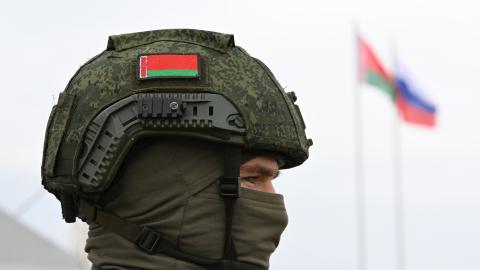
In mid-April, President Volodymyr Zelenskyy warned that Belarus could directly enter the Russia-Ukraine War and cause problems along his country’s northern border. He said that “military activity in Belarus has increased,” and “according to intelligence, the construction of roads toward Ukrainian territory and the development of artillery positions are underway in the Belarusian border areas.” Kyiv believes “Russia may once again attempt to drag Belarus into its war.”[1]
This threat comes at a crucial time for the conflict occurring hundreds of miles away in Donetsk, and Ukraine can hardly afford to divert troops and resources away from that sector of the front.
Although Western policymakers have limited options if Belarus becomes directly involved in the war, they can still take the following steps to help Kyiv:
- Increase intelligence sharing with Ukraine.
- Conduct a large-scale North Atlantic Treaty Organization training exercise in the Baltic region along the border with Belarus to divert Minsk’s attention from Ukraine.
- Quietly consult with the new government in Hungary about the possibility of expanding existing transit routes into Ukraine.
- Work with Romania to plan for a disruption to the traditional Poland–Ukraine supply routes.
In extremis, Western officials should communicate to Minsk that any Belarusian soldiers who enter the war could be legitimate targets for Western forces.
As policymakers focus on the fighting in eastern Ukraine along Donetsk’s fortress belt, they should not ignore what Belarus is doing. Minsk’s entry into the war could be the next big surprise in Russia’s war against Ukraine, and it could carry unforeseen implications for NATO and Europe.
Belarus’s Support for Russia
Belarus has previously made threats to Ukraine since Russia’s full-scale invasion. For example, in 2024 Minsk mobilized one-third of its armed forces near its border with Ukraine to possibly open a new northern front.[2] In response, Ukraine had to focus more on this border.
Whether or not Belarusian troops launch incursions into Ukraine, Minsk is already part of Russia’s war. In fact, Kyiv has demonstrated unbelievable restraint by not striking legitimate military targets inside Belarus, such as in the following cases:
- During the opening weeks of the large-scale invasion in 2022, Russia’s main effort to capture Kyiv and decapitate the Ukrainian government came from Belarus.
- Belarus was the launching pad for the Russian troops who carried out many of the war’s worst atrocities, such as in Bucha and Irpin.[3]
- Belarus has been complicit in the abduction of Ukrainian children during the war.[4]
- Russia used Belarusian territory to launch some of the first Shahed drones to strike Ukrainian targets.[5]
- Belarus served as a staging ground for Russian helicopters, fighter aircraft, and ballistic missiles targeting Ukraine.[6]
- Russian drones and missiles use Belarusian airspace to transit safely and avoid interception before striking targets deep in western Ukraine.[7]
- Russia has taken a lot of equipment from the Belarusian armed forces in recent years to fill gaps after Ukraine destroyed vast amounts of Russian hardware.[8]
Three Scenarios
Belarusian President Alexander Lukashenka is undoubtedly under immense pressure from Moscow to become more involved in the war. But doing so would be deeply unpopular, not only among his opponents but also among many of his supporters, who do not want Belarusian soldiers fighting in Ukraine.[9]
An invasion would be deadly for the Belarusian armed forces. The country’s troops are not combat-tested, and because Russia has taken much of their equipment, they are probably poorly equipped and at a low level of readiness.
But nothing can be ruled out. As seen in recent years with the war in Ukraine, the war in Iran, and geopolitical surprises like the one in Venezuela, the unexpected can occur in conflict. So policymakers should think creatively about possible scenarios in which Belarus might enter the war, such as the three described below.
1. Mobilization. In this scenario, Belarus would either mobilize and prepare for a conflict with Ukraine, or make public statements indicating that it is planning to do so. Both could result in a large number of its forces moving to the border without crossing. While such a move may not precede an incursion, Kyiv would have to take it seriously.
2. An attack on Kyiv. Belarus would have difficulty accomplishing what the Russians failed to do in 2022. But a direct and audacious strike on the capital could rattle Ukrainian morale when war fatigue is already setting in.
Ukrainians have been preparing for this possibility for a few years. When visiting the northern suburbs of Kyiv, the author noticed newly constructed fortifications facing north toward the Belarusian border.[10]
3. A raid into the west. Belarus could conduct a raid deep into western Ukraine while ignoring Kyiv Oblast and targeting the key transportation hubs of Lutsk and Rivne. The raid might even threaten Lviv in the far west near the Polish border, and it could threaten key logistical routes through which crucial Western weapons and munitions arrive.[11] Belarus would not have to occupy Ukrainian territory in this scenario. Instead, it could slice key motorway and rail routes or target key transit junctures and bridges to impact the resupply of Western support. Merely keeping western Ukraine under constant threat and pressure for a long time could disrupt the flow of Western aid.
In all three of these scenarios, Kyiv would have to divert much-needed resources away from the eastern front line.
Recommendations
While the possibility of Belarus invading Ukraine might seem remote, policymakers cannot rule it out. They cannot know what sort of pressure the Kremlin is placing on Lukashenka. And despite recent political overtures from the White House regarding high-level engagement and even the inclusion of Minsk in President Donald Trump’s Board of Peace initiative,[12] engagement with the United States will be secondary for Lukashenka, as his political survival ultimately depends on Moscow.
In case Belarus does get directly involved in Russia’s war against Ukraine, the US and its allies can take the following steps to prepare:
- Increase intelligence sharing with Ukraine. Western nations can share intelligence now on what Belarusian soldiers are doing across the border and on what the Belarusian leadership might intend to do. Continuing to exchange intelligence with Ukraine remains important and should be expanded.
- Conduct a large-scale snap military exercise in Poland, Lithuania, and Latvia along their borders with Belarus. Lukashenka knows he is indebted to Vladimir Putin after Moscow propped him up following Belarus’s fraudulent August 2020 election and the subsequent public unrest.[13] But the Belarusian leader also knows that a war between his country and Ukraine would be disastrous. A large-scale NATO training exercise on Belarus’s border might give him an excuse for why Minsk should stay out of the war and remain focused on homeland defense.
- Communicate to Minsk that its forces operating inside Ukraine will become legitimate targets for US and European forces. After North Korea’s entry, a new belligerent directly joining the conflict should be a red line for Europe, and crossing it should provoke a military response without risking Russian retaliation. A recent precedent shows a country that is not part of the Collective Security Treaty Organization (or CSTO, a Russia-backed security alliance) can attack the troops of a CSTO member outside of that member’s borders without Russia responding with force.[14] During the Second Karabakh War in 2020, Azerbaijan (not a CSTO member) attacked Armenian (a CSTO member) forces. But Russia did not assist its ally because those attacks occurred outside Armenia proper and therefore outside the remit of the CSTO’s security guarantee. There would be no quicker way of ending any Belarusian military adventure than direct NATO involvement against its troops inside Ukraine.
- Consult with the new government in Hungary about expanding transit routes into Ukraine. In recent years, then Prime Minister Viktor Orbán was unwilling to allow NATO or European countries to transport military hardware to Ukraine from Hungarian territory.[15] (Hungary shares an 85-mile-long border with Ukraine.) Now that recent elections have ousted Orbán and his government, NATO military planners should quietly consult with the new government on the possibility of using Hungarian territory to transit goods into Ukraine. This could add much-needed resiliency and redundancy to current supply lines.
- Start working with Romania now to plan for a disruption to the traditional Poland–Ukraine supply routes. After Poland, Romania serves as another crucial corridor for Western goods entering Ukraine. Military planners should already be working with Romanian officials to war-game different scenarios and stress-test infrastructure links to determine possible alternatives if traditional supply routes from Poland into Ukraine were disrupted and resupply had to shift south through Romania. The sooner this is done, the better.
Endnotes
- Volodymyr Zelenskyy (@ZelenskyyUa), “Commander-in-Chief Oleksandr Syrskyi delivered his report. First of all, regarding the front line – I am grateful to all our units that are holding their positions and repelling Russian assaults,” X, April 17, 2026, 12:26 p.m., https://x.com/ZelenskyyUa/status/2045177152379781261. ↑
- “Nearly a Third of Belarus Army Deployed on Ukraine Border, Lukashenko Says,” Reuters, August 18, 2024, https://www.reuters.com/world/europe/belarus-lukashenko-says-nearly-third-army-sent-ukraine-border-belta-reports-2024-08-18/. ↑
- Samya Kullab, “Two Years after the Horrors at Bucha, Some Families Struggle to Come to Terms with Atrocities,” PBS News, April 2, 2024, https://www.pbs.org/newshour/world/2-years-after-the-horrors-at-bucha-some-families-struggle-to-come-to-terms-with-atrocities. ↑
- Amy Mackinnon, “Belarus Is Abducting Ukrainian Children in Plain Sight,” Foreign Policy, August 11, 2023, https://foreignpolicy.com/2023/08/11/belarus-abducting-deporting-ukrainian-children-social-media-networks-kyiv-minsk-camps-russia-war-donbas/. ↑
- Field research by author, November 2022. ↑
- “Images Show New Deployments of Forces, 150 Helicopters in Southern Belarus—Maxar,” Reuters, February 25, 2022, https://www.reuters.com/world/europe/images-show-new-deployments-forces-150-helicopters-southern-belarus-maxar-2022-02-25/. ↑
- Dariia Mykhailenko, “Russia Is Using Belarus and Neighboring Countries to Route Drones into Ukraine,” United24 Media, April 7, 2026, https://united24media.com/latest-news/russia-is-using-belarus-and-neighboring-countries-to-route-drones-into-ukraine-17669. ↑
- Kateryna Hodunova, “Belarus to Transfer Military Equipment to Russia amid Ukraine’s Operation in Kursk Oblast, Media Says,” Kyiv Independent, August 13, 2024, https://kyivindependent.com/belarus-to-transfer-military-equipment-to-russia-amid-ukraines-operation-in-kursk-oblast-media-says/. ↑
- Ryhor Astapenia, Transforming Belarus from a Russian Asset to a Buffer State for European Security: How the West Should Engage with Minsk (Chatham House, January 2026), https://www.chathamhouse.org/sites/default/files/2026-01/2026-01-14-transforming-belarus-russian-asset-buffer-state-european-security-astapenia.pdf. ↑
- Field research by author, March 2024. ↑
- Rob Mudge, “How Are the West’s Weapons Getting to Ukraine?” DW, March 1, 2022, https://www.dw.com/en/western-arms-supplies-for-ukraine-how-are-they-getting-there/a-60959864. ↑
- Aleksandar Brezar, “Belarus Joins Trump’s ‘Board of Peace,’ Raising Eyebrows over Lukashenka’s Role,” Euronews, January 28, 2026, https://www.euronews.com/2026/01/28/belarus-joins-trumps-board-of-peace-raising-eyebrows-over-lukashenkas-role. ↑
- Andrei Makhovsky and Polina Devitt, “Battling Protests, Lukashenko Says Putin Agreed to Help Security of Belarus,” Reuters, August 15, 2020, https://www.reuters.com/article/us-belarus-election/battling-protests-lukashenko-says-putin-agreed-to-help-security-of-belarus-idUSKCN25B0E0/. ↑
- Arshaluys Barseghyan, “Outrage in Armenia over Putin’s Controversial Statement on CSTO,” OC Media, November 29, 2024, https://oc-media.org/outrage-in-armenia-over-putins-controversial-statement-on-csto/. ↑
- Alice Tidey and Sándor Zsíros, “Hungary Is Blocking Release of €500 Million in EU Military Aid to Ukraine,” Euronews, January 20, 2023, https://www.euronews.com/my-europe/2023/01/20/hungary-blocking-release-of-500-million-in-eu-military-aid-to-ukraine. ↑